
Publisher claims Japan's first AI video magazine at 1,760 yen
Asuka Publishing's AI Douga Saizensen carries 12 interviews and copyright guidance from a lawyer whose firm the publisher says sits on the justice ministry's AI legislation committee.
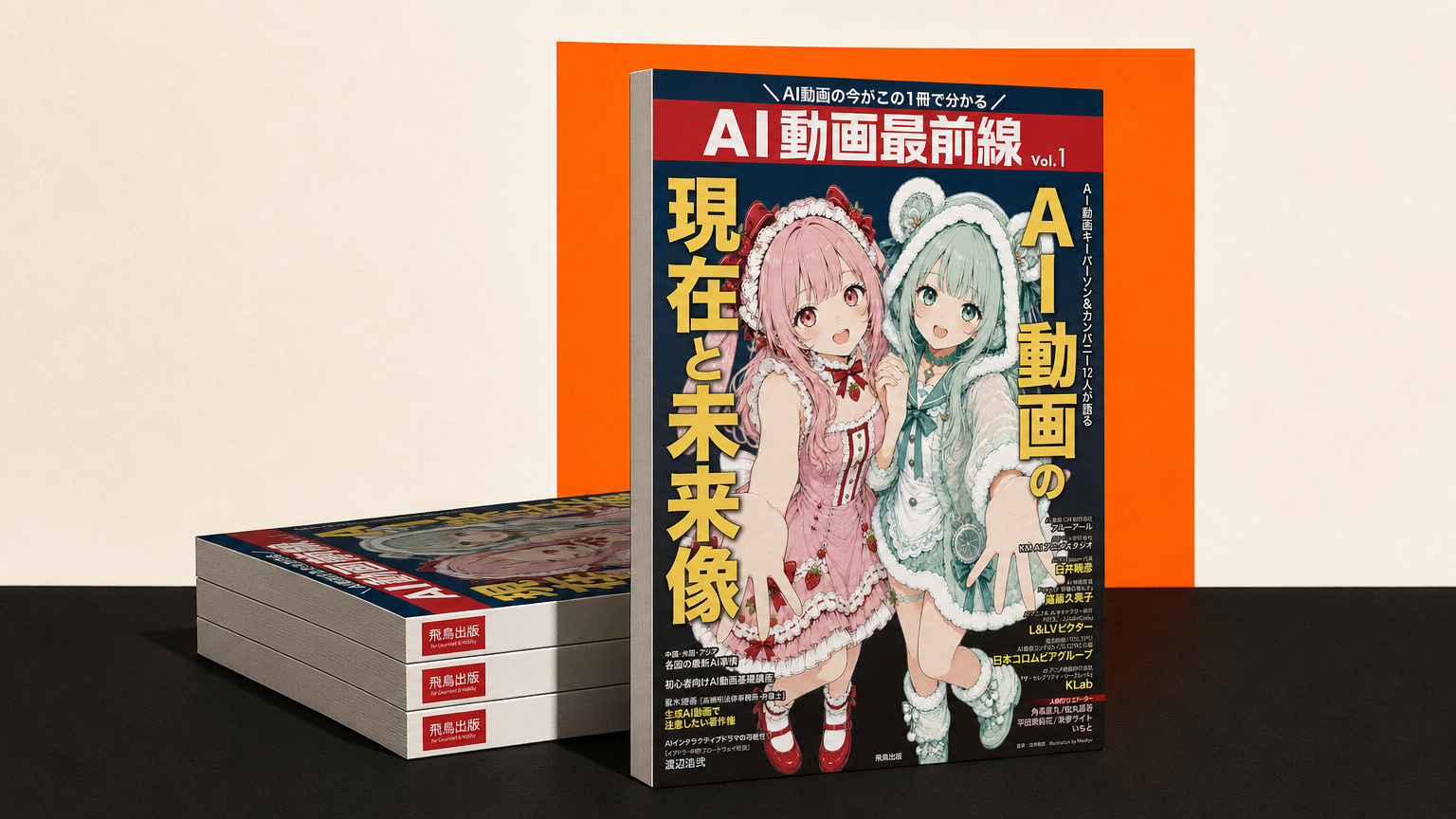
Key takeaways
- Asuka Publishing put AI Douga Saizensen, a 96-page A4 magazine, on Japanese bookstore shelves on October 6, 2026, priced at 1,760 yen with tax.
- The issue carries 12 exclusive interviews, including the director Kumiko Endo, the AI anime studio KLab, the Nippon Columbia Group's COLOTEK contest, and the creators Raimu Light and Matsumaru Suigo, under the supervision of AICU Japan's Akihiko Shirai.
- Copyright guidance fills a chapter from page 86, written by the lawyer Kengo Yabuki of Takagi-cho Law Office, which the publisher says takes part in the justice ministry's committee on AI-related legislation.
- Asuka Publishing calls AI Douga Saizensen Japan's first magazine for AI video creators, a claim it bases on its own September 1, 2026 search of the National Diet Library catalogue and the e-hon book database.
- Asuka Publishing says it will grow the title into a regular periodical rather than a single special issue.
Asuka Publishing released AI Douga Saizensen, a 96-page magazine it calls Japan's first aimed at AI video creators, in bookstores nationwide on October 6, priced at 1,760 yen with tax. The A4 title, subtitled AI Video Now and in the Future, is Vol.1, and the publisher says it intends to grow it into a regular periodical rather than a one-off special issue.
The launch was announced by the publisher on September 7 and confirmed by the magazine's own site, which lists the issue as on sale. Asuka Publishing, based in Shinjuku, Tokyo and headed by Fumio Kurokawa, also publishes TateDora Saizensen, a magazine about short-form vertical drama. The new issue is supervised by Akihiko Shirai, an engineering PhD who runs the AI video community AICU Japan, and its cover carries "Minty Berry," a character by the creator Mankyu that won an AICU Japan contest in June.
What is in the first issue
The spine of the issue is a run of 12 exclusive interviews that the table of contents lists from page 4 to page 54, with the key people and companies in AI video. They include the film director Kumiko Endo, whose feature Matilda: The Devil's Gene is billed as an AI film; the studio KLab, which has announced an AI anime film, The Celebrity Secret; the Nippon Columbia Group, which runs the COLOTEK contest with a 10 million yen prize pool; and the entertainment company L&LV Victor. Five creators appear: Raimu Light, Matsumaru Suigo, Hirata Marika, Kakuni Seimaru and Imoto.
The later sections turn practical. One chapter walks through the basics, from text-to-video and image-to-video to reference-to-video, a prompt section built around GPT Image2 and Seedance, and running ComfyUI or MiniMax H3 on a local PC. A guide to companies and popular services, plus a glossary, closes the reference material at page 84.
Copyright gets its own chapter, from page 86, written by the lawyer Kengo Yabuki of Takagi-cho Law Office. The publisher says the firm takes part in the justice ministry's committee on AI-related legislation, and the chapter covers the copyright questions the magazine says to watch in generative AI video.
Why a print magazine, and for whom
Asuka Publishing calls AI Douga Saizensen Japan's first magazine for AI video creators, a claim it bases on its own research: a September 1, 2026 search of the National Diet Library catalogue and the e-hon book database that the publisher says turned up no matching title. BRANC, an industry outlet, reported that method along with the launch details, and Anime! Anime! also covered the launch.
The publisher frames print as a deliberate choice. It positions the title as a historical record for a moment when AI video is becoming ordinary, and says it will build it into a periodical. The magazine sits inside a small, active scene: AICU Japan, which supervised it, runs creator contests, and the launch was marked with a free online seminar on October 2 featuring Shirai and Kurokawa.
Early readers do not all see a beginner's guide. The single customer review on Amazon Japan, dated October 5 and rated three out of five, says the opening two-thirds is interviews and the closing third is a service guide and glossary, with no technical articles, and concludes that it is not really a beginner's guide to AI video. That is one buyer's account, not a verdict.
What this changes for someone who makes AI video
If you work in Japanese-language AI video, there is now a physical reference that did not exist a month ago: a named list of the creators and companies the domestic scene treats as central, a plain-language route into the tools, and a lawyer's account of where the copyright lines sit. The interviews are the part worth the 1,760 yen. The tool and model lists date fastest, and the "first" claim belongs to the publisher, not to an independent registry. For creators outside Japan, the issue is a rare look at how one national scene is organising itself around AI video, with television and commercial work moving in alongside the hobbyists.
The magazine is on sale now in Japan, in bookstores and through online retailers, and Asuka Publishing has not dated a second volume.
Sources
- prtimes.jp - Asuka Publishing's own launch release: title, date, price, format and the interview list
- aidouga.site - the magazine's official site, run by the publisher: on-sale status, contents and news log
- hanmoto.com - Japanese publisher-data registry entry: ISBN 978-4-7801-0099-0, A4, 96 pages, full table of contents
- branc.jp - BRANC's independent write-up, carrying the publisher's method for the "first" claim
- news.infoseek.co.jp - Anime! Anime!'s coverage of the launch
- amazon.co.jp - retailer listing (ISBN, page count) and the first buyer review
- aicu.ai - AICU's own award record: Mankyu's "Minty Berry" took the grand prize at the June 2026 Kawaii! AI Character Audition and illustrated the magazine's cover