
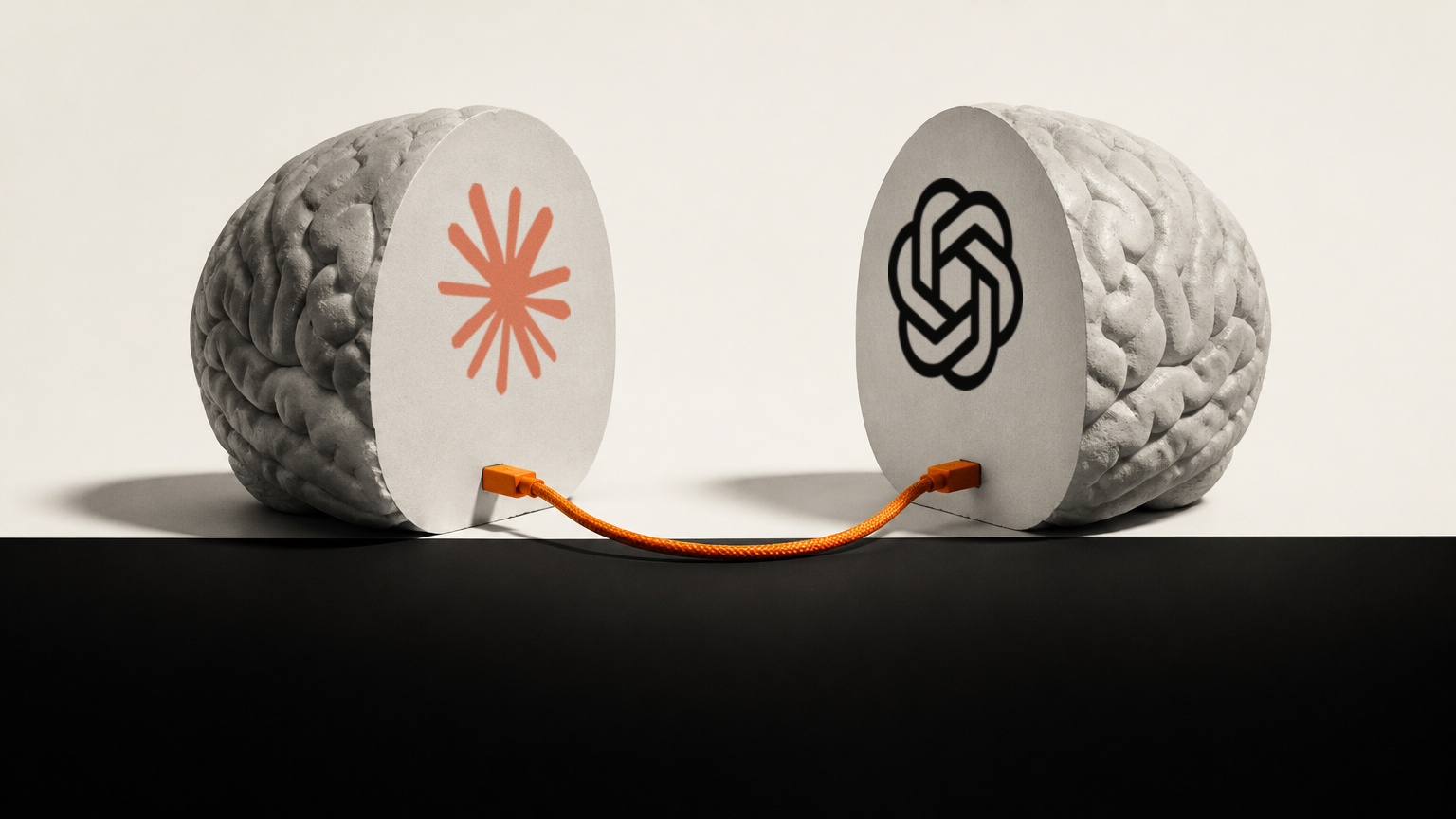
Claude Fable 5.1 is the left brain, GPT-6 Astra the right
Neither model can make a single frame of video. The benchmarks that pull them apart measure language and spatial sense, which is where the old split-brain research drew its line too.
Key takeaways
- Anthropic's and OpenAI's own documentation list text as the only output of Claude Fable 5.1 and GPT-6 Astra. Neither generates images or video; both reach generators through tools such as MCP servers.
- Claude Fable 5.1 leads Artificial Analysis's Coding Agent Index (70 to 67, per DataCamp) and Arena's agent leaderboard; GPT-6 Astra leads the spatial tests in OpenAI's table, including BenchCAD (95.9% to 84.3%) and ScreenSpot-Pro (92.7%, against 87.3% for the earlier Fable 5).
- A 2013 University of Utah study of 1,011 brains found no left-brained or right-brained people, but did find that "language tends to be on the left, attention more on the right," which is the split these two models show.
- MCP, which Anthropic introduced in November 2024 and donated to the Linux Foundation's Agentic AI Foundation in December 2025, now connects both models to fal, Higgsfield, Runway, ComfyUI, Blender and DaVinci Resolve.
Two of the most capable language models on sale this month end their spec sheets the same way. Anthropic's page for Claude Fable 5.1 lists its input and output as "text and images → text". OpenAI's model page for GPT-6 Astra lists text and images in, text out. The two models most often credited this fall with AI video cannot, on their makers' own paper, produce a single frame of it.
That line is the whole argument, so here is the verdict before the proof. Fable 5.1 is the better left hemisphere and Astra the better right. The metaphor holds exactly as far as the neuroscience does. The split is not between code and art, and it is not between the logical machine and the creative one. It is between language and space: between the model that finishes the sequence and the model that sees where things sit. Anyone building a video pipeline this autumn should hire both and pay close attention to the wire that runs between them.
Two spec sheets, one missing output
Take the makers at their word first, because their words are more revealing than their charts. Anthropic released Fable 5.1 on September 1 and describes it as built "for demanding reasoning and long-horizon agentic work". Its release notes put the claim in plain procedural terms: "Agentic coding over long sessions, including multi-file features, large refactors and migrations, debugging, and code review across sessions that run for hours." The customer quotes Anthropic chose tell the same story. Shopify says the model is "more comfortable with long, unattended work". Canva praises the writing.
OpenAI launched GPT-6 Astra two days later and calls it "state of the art for computer use, browsing, software engineering, cybersecurity, science, and professional work". Nowhere in that list is video, image or design. The creative claims come from the partners. Higgsfield's announcement of its MCP server on Astra divides the labour in one sentence: the model handles "coding, logic, reasoning, and multi-step orchestration", and Higgsfield makes the pictures. fal says it more bluntly: "GPT-6 Astra handles direction, planning, code, and review, while we handle every stage that requires a model to run."
So the popular picture, in which one model writes code and the other makes video, gets the second half wrong. Astra makes a video the way Fable 5.1 does: it decides, then calls something else to render. Whether the output is pretty is not the question worth answering. The question is which model makes better decisions about what goes where, and which makes better decisions about what comes next.
The case that they are the same brain
The strongest objection to the whole metaphor is the numbers, and it deserves its full weight. On Artificial Analysis's head-to-head, read on September 27, the two models score 53 each on its Intelligence Index, and both list at $10 per million input tokens and $50 per million output. The two companies' own tables disagree about who wins coding, and each company's table favours its own model. In the figures OpenAI published, Astra edges Fable 5.1 on Terminal-Bench 4.0, 57.7% to 55.8%. Anthropic's table leaves Astra out and compares Fable 5.1 with OpenAI's previous model instead. DataCamp's reviewer drew the fair conclusion: Astra "leads on the coding benchmarks OpenAI chose to publish, but the margins are thin and the independent index disagrees."
And Anthropic has not left the creative side empty. In April it announced Claude for Creative Work, with connectors to Adobe, Ableton, Blender, Resolume and Autodesk Fusion, and a line that reads almost like a disclaimer: "Claude can't replace taste or imagination, but it can open up new ways of working." Higgsfield's MCP server has given Claude more than 30 video and image models since May. By that account these are two general-purpose engines with the same prices, the same context windows and the same plugs.
That case is right about the averages. It is wrong about where the averages hide the difference.
Where they split
Look past the composite scores to the tests that measure one kind of skill at a time, and the pattern is consistent. Fable 5.1 wins where the work is a long sequence of language that has to end in something that runs. It leads Artificial Analysis's Coding Agent Index, 70 to 67, and it sits first on Arena's agent leaderboard, ahead of Anthropic's own Opus 5.5, with Astra third. On GDPval-AA, a measure of professional knowledge work, Artificial Analysis has it at 1,735 against Astra's 1,542.
Astra wins where the work is about position. In OpenAI's table it leads BenchCAD, a computer-aided design test, 95.9% to 84.3%, and ScreenSpot-Pro, which asks a model to find the right element on a screen, 92.7% against the 87.3% OpenAI records for the earlier Fable 5, run without its safeguards. Hierarchy's Tenzin Langdun gave both models the same job: turn a floor-plan PDF into a furnished house in Blender, then export it as a walkable scene in Unreal Engine 5. The review, published September 8, says of Astra: "Astra is the best model I have ever used in Blender and 3D." Fable 5.1 worked through a Blender MCP server, where it "builds scenes, looks at the viewport and corrects its own mistakes", and once "made a style decision I had not asked for". The same review gives Fable 5.1 the other half of the ledger in four words: it "gets things finished."
That is the whole difference in one test. The better eye for the room belonged to one model; the surer hand on the job belonged to the other. A furnished house needs both, and so does a cut.
What the split-brain research actually found
The left-brain, right-brain language comes from real science that was then oversold. Roger Sperry shared the 1981 Nobel Prize in Physiology or Medicine "for his discoveries concerning the functional specialization of the cerebral hemispheres", from patients whose hemispheres had been surgically separated. The self-help industry turned his findings into personality types: the analytical left-brainer, the creative right-brainer.
In 2013 a University of Utah team tested that idea directly. Jared Nielsen, Jeff Anderson and colleagues analysed resting-state scans of 1,011 people between the ages of 7 and 29 across 7,266 brain regions. Their data were "not consistent with a whole-brain phenotype of greater 'left-brained' or greater 'right-brained' network strength across individuals." Nobody in the sample was one or the other. Anderson's summary kept the part of the old idea that survives: "Language tends to be on the left, attention more on the right."
The psychiatrist Iain McGilchrist built a book on that surviving part. The Master and His Emissary, published by Yale in 2009, argues that the hemispheres do not divide tasks so much as ways of attending, and its publisher describes them as "two whole, coherent, but incompatible ways of experiencing the world". The core distinction still fits these two models: one attends to sequence and the other to space.
That is the useful version of the metaphor, and the only honest one. Fable 5.1 is not the logical model and Astra is not the creative one. Fable 5.1 attends to order: what happens next, what breaks if it doesn't, when a thing is done. Astra attends to arrangement: where the camera is, what fits in the room, which element on the screen is the button.
The wire in the middle
A divided brain works because of what joins it. In the machine version of 2026, the join is the Model Context Protocol. Anthropic introduced MCP on November 25, 2024 as a standard way to connect AI assistants to other systems. On December 9, 2025 it handed the protocol to the Agentic AI Foundation under the Linux Foundation, which Anthropic co-founded with Block and OpenAI. At the time the protocol counted more than 97 million monthly SDK downloads and 10,000 active servers.
This year the creative tools arrived on it. fal, Higgsfield, Runway and Replicate all run MCP servers in front of their generators. Comfy Org's Comfy MCP went into public beta in June. Blender's own lab publishes one. DaVinci Resolve 21.1 Studio added a native MCP server in September, and Blackmagic names Claude and Codex as clients. Both models can reach every one of these tools. What differs is what each notices once it gets there.
The limits are real too, and the most careful account of them came from an editor. Implicator ran Claude Code through five tasks in Resolve and concluded that timestamped transcripts make automated cuts reviewable, but "seams, silence markers, crops and performance choices still need an editor."
What a film looks like to each half
A finished film is two documents at once, and the page for our own film UNC makes the point better than a benchmark can. Its YouTube page is a left-hemisphere object: a 44-minute running time cut into nine timecoded chapters, a credit block and a list of hashtags, one of which is #HiggsField. The film behind that page is a sun-soaked thriller set, its description says, over Los Angeles and the waters of Catalina Island. That is the other document, the one made of where the plane sits in the frame and where the sea sits behind it. No chapter list ever made that decision.
A pipeline built this autumn should route work the same way. Give the sequence to the model that finishes things: the script, the shot list as data, the edit decision list, the Resolve automation, the render queue, the code that ties it together. Give the geometry to the model that sees space: the Blender previs, the blocking, the layout of a frame before a generator is asked to fill it, the check that the room fits.
A practice for the two-model studio
The discipline the tools do not sell is routing, and it can be made concrete this week.
Split the brief before you prompt. Write down which parts of the job are order and which are arrangement. Script, timing and code go to one side. Camera, layout and 3D go to the other.
Connect both models to the same MCP servers. fal, Higgsfield, ComfyUI, Blender, Resolve. Then the difference in results is the model's, not the plumbing's.
Run one head-to-head a week on your own material. Take one real shot from your current project, give it to both, and keep the result that fits the room. Benchmarks are the makers' choice of test. Your footage is yours.
Keep the cut for yourself. Seams, silences, crops and performances were an editor's job before either model shipped, and an independent test says they still are.
Finish something. Two hemispheres that never ship are an expensive conversation.
Both spec sheets still end on the same word, and that word is still text. Neither half makes the picture. The picture gets made in the join, and by the person holding both ends of the wire.
Route the sequence to Claude Fable 5.1 and the space to GPT-6 Astra, connect both to the same MCP servers, and keep the final cut.
Disclosure: this essay was drafted with Claude Fable 5.1, one of the two models it judges. Every figure above links to its source.
Sources
- platform.claude.com - Anthropic, Fable 5.1 model page: released September 1, 2026; text and images in, text out
- platform.claude.com - Anthropic, what's new in Fable 5.1
- anthropic.com - Anthropic's Fable 5.1 announcement, benchmark table and customer quotes
- developers.openai.com - OpenAI, GPT-6 Astra model page
- deploymentsafety.openai.com - OpenAI, GPT-6 Astra system card, September 3, 2026
- community.openai.com - OpenAI's launch post, September 3, 2026
- datacamp.com - DataCamp comparison citing OpenAI's benchmark table, September 5, 2026
- artificialanalysis.ai - Artificial Analysis head-to-head, read September 27, 2026
- arena.ai - Arena agent leaderboard
- hierarchy.ch - Hierarchy's hands-on Blender test, September 8, 2026
- fal.ai - fal on dividing work with GPT-6 Astra, September 16, 2026
- higgsfield.ai - Higgsfield MCP on GPT-6 Astra, September 7, 2026
- higgsfield.ai - Higgsfield MCP for Claude, May 8, 2026
- anthropic.com - Anthropic, Claude for Creative Work, April 28, 2026
- anthropic.com - Anthropic introduces MCP, November 25, 2024
- blog.modelcontextprotocol.io - MCP joins the Agentic AI Foundation, December 9, 2025
- ymcinema.com - DaVinci Resolve 21.1's MCP server, September 17, 2026
- implicator.ai - Implicator on Claude Code in DaVinci Resolve, August 19, 2026
- docs.comfy.org - Comfy MCP documentation
- blender.org - Blender Lab's MCP server
- pmc.ncbi.nlm.nih.gov - Nielsen et al., PLOS ONE, August 14, 2013
- healthcare.utah.edu - University of Utah release, August 14, 2013
- nobelprize.org - The 1981 Nobel Prize in Physiology or Medicine
- yalebooks.yale.edu - Iain McGilchrist, The Master and His Emissary, Yale University Press
- youtube.com - UNC, a Slop TV film, on YouTube