
Claude proved the Riemann hypothesis, an Anthropic mathematician says — and the checks are running
Levent Alpöge published a Lean proof of the 167-year-old problem on 20 November, with no human-readable paper and 175,187 files. MIT's independent kernels accept it. A human, Alessandro Masullo, published a rival proof the same day. Here is what has actually been verified, and what the room is saying.
Key takeaways
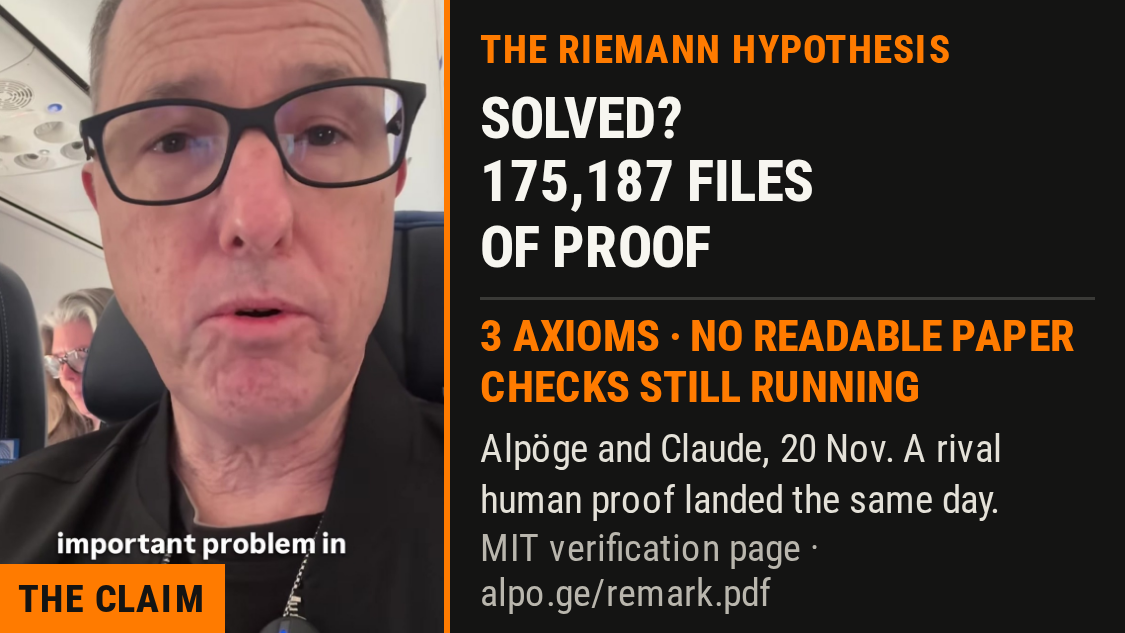
- Levent Alpöge, a mathematician employed by Anthropic, published a note on 20 November 2026 claiming a proof of the Riemann hypothesis, and of the generalized Riemann hypothesis, found working with Claude.
- Only Lean code was released — 175,187 modules, about 17.4 million lines, with no human-readable paper. Andrew Sutherland at MIT reports it compiles with zero errors and depends only on Lean's three standard axioms.
- Independent kernels nanoda and con-leche accept the full export, and con-leche's comparison mode matched all five headline theorems against a Mathlib-only challenge; a full comparator run and the paranoid kernel replay were still running when MIT last updated.
- Alessandro Masullo, a human mathematician, has a rival proposed proof of GRH, posted by Stanford's Ravi Vakil the same day, examined for months by Brian Conrad and containing no AI work.
- Mathematicians note that the practical consequences for number theory were already largely delivered in October, when AI work moved the bound on the zeros of the zeta function to 3/8 of the distance to the critical line.
There is a genre of message that arrives in a group chat and makes everyone put down their coffee, and on Friday it arrived on Instagram: "It's hard to put into words the news that dropped today in AI, that Claude has apparently solved the Riemann hypothesis." The reel goes on to say that mathematicians thought this could never be solved by an AI, that Scientific American had posted about it, and that it is "cataclysmic for the world of mathematics". Sixty-two seconds, one person talking to a camera, and the largest claim in the field in 167 years.
The claim is real, the caveats are real, and the two are tangled together in a way that is going to define the next year of this argument. So let us take them in order.
What was actually published
Levent Alpöge, a mathematician employed by Anthropic, published a four-page note on 20 November. The key sentences are his own:
I believe I have, working with Claude, discovered a proof of the Riemann Hypothesis. In fact, the method easily extends much further, resolving the so-called Generalized Riemann Hypothesis, and I expect, with more time, the Extended Riemann Hypothesis too. Claude and I have also formalized the arguments without assumptions.
He describes the collaboration in terms that no press release would dare. He guided the approach — combining two ideas from a toy setting, one of them "already new and shocking" — and then: "Claude far outpaced me near the finish line. No, Claude flew, and danced, and sparkled near that finish line." He singles out one line of the argument, a chain of theta lifts whose suggested length was the square root of X, as the kind of thing that "will suffice to make fellow mathematicians fall out of their chairs".
Then the part that matters more than any of the poetry. There is no human-readable paper. The argument, in his words, "is incredibly long at the moment", and what he released is the formalization: a fourteen-part archive of Lean source, about 17.4 million lines across 175,187 modules, which if rendered for a human would run past a quarter of a million pages. For scale, that is roughly ten times the size of Mathlib, the formal library the entire field shares.

Source: https://www.instagram.com/reel/Df-UGPXycgo/.
What has been checked, and by whom
This is where the story becomes legible, because the verification is public and it is itemized.
Andrew Sutherland at MIT ran the archive, with Claude Code doing the mechanical work, and published a table of results. All 175,187 modules compile under Lean v4.33.1 and Mathlib v4.33.1, zero errors. The five headline theorems depend only on the three standard axioms — propext, Classical.choice, Quot.sound — and no axioms are declared outside Lean's core. The Mathlib files are byte-for-byte identical to the official cache. leanchecker replayed every module: 175,187 of 175,187, zero rejections. nanoda, an independently written Rust kernel, accepts the full export; con-leche, another independent checker, accepted 1,468,418 declarations and, in its comparison mode, matched all five theorems against a Mathlib-only challenge file. lean4lean passed every compiled module, five of them only after its default step limit was raised.
Two things had not finished when that page was last updated: the lake comparator end-to-end run and the paranoid-kernel replay. Sutherland's own summary of where this leaves the question is the sentence to remember:
The Lean proof has been compiled and independently rechecked by the Lean kernel with only the three standard axioms. Honestly the chance that anything is fishy here is approximately zero.
The caveats are equally specific, and mathematicians have been careful about them. Kevin Buzzard of Imperial College London framed the first question any Lean release raises: "what is the statement of the theorem in the Lean code, and does this correspond to the actual theorem statement." Elliot Glazer answered it: the formalized statement in the release is the generalized Riemann hypothesis, which is what Alpöge claimed — and he put the chance the result rests on a bug in Lean itself at under 1%, on the grounds that frontier models "virtually never do that on accident".
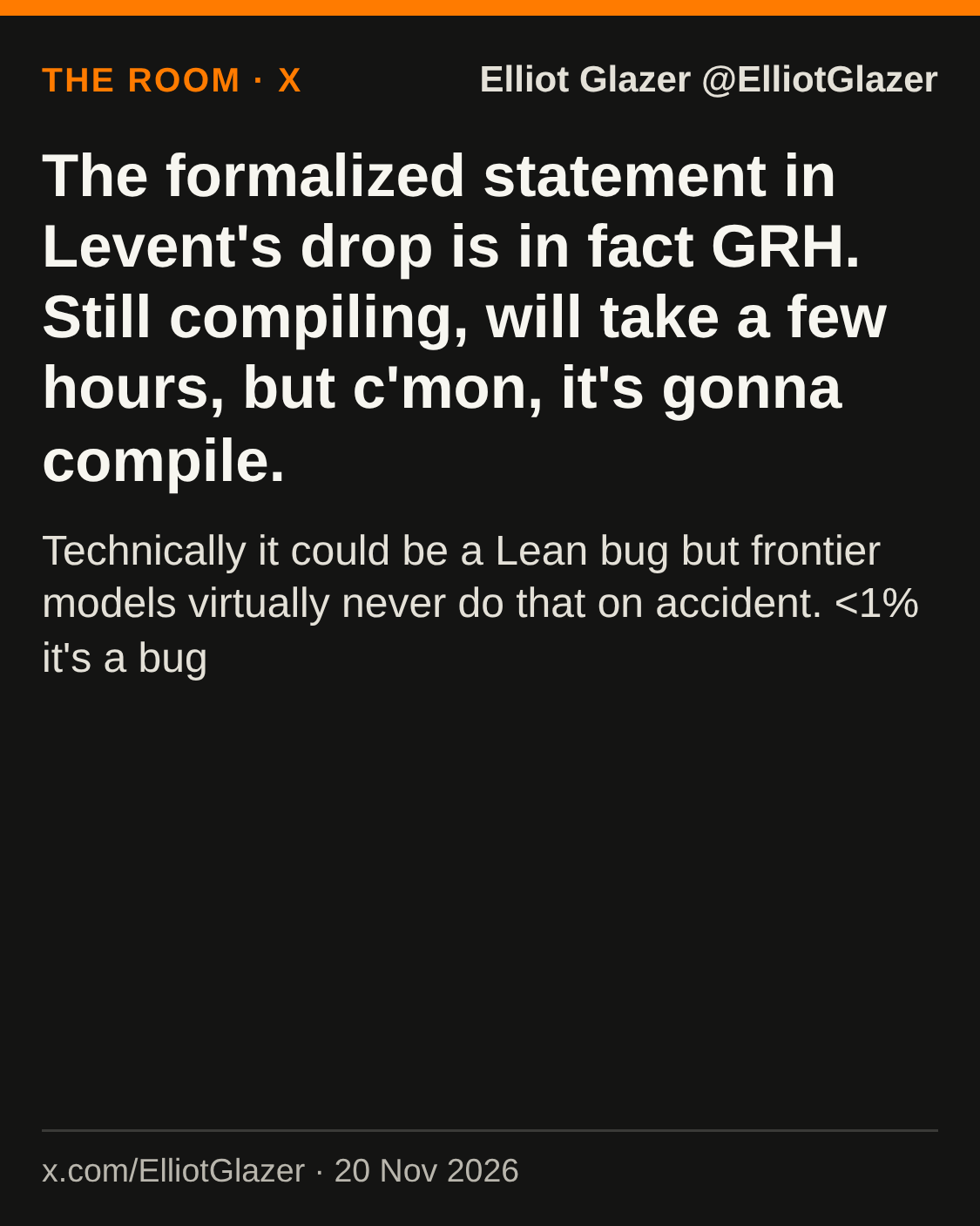
@ElliotGlazer, 20 Nov 2026. Source: https://x.com/ElliotGlazer/status/2123792743503933774. 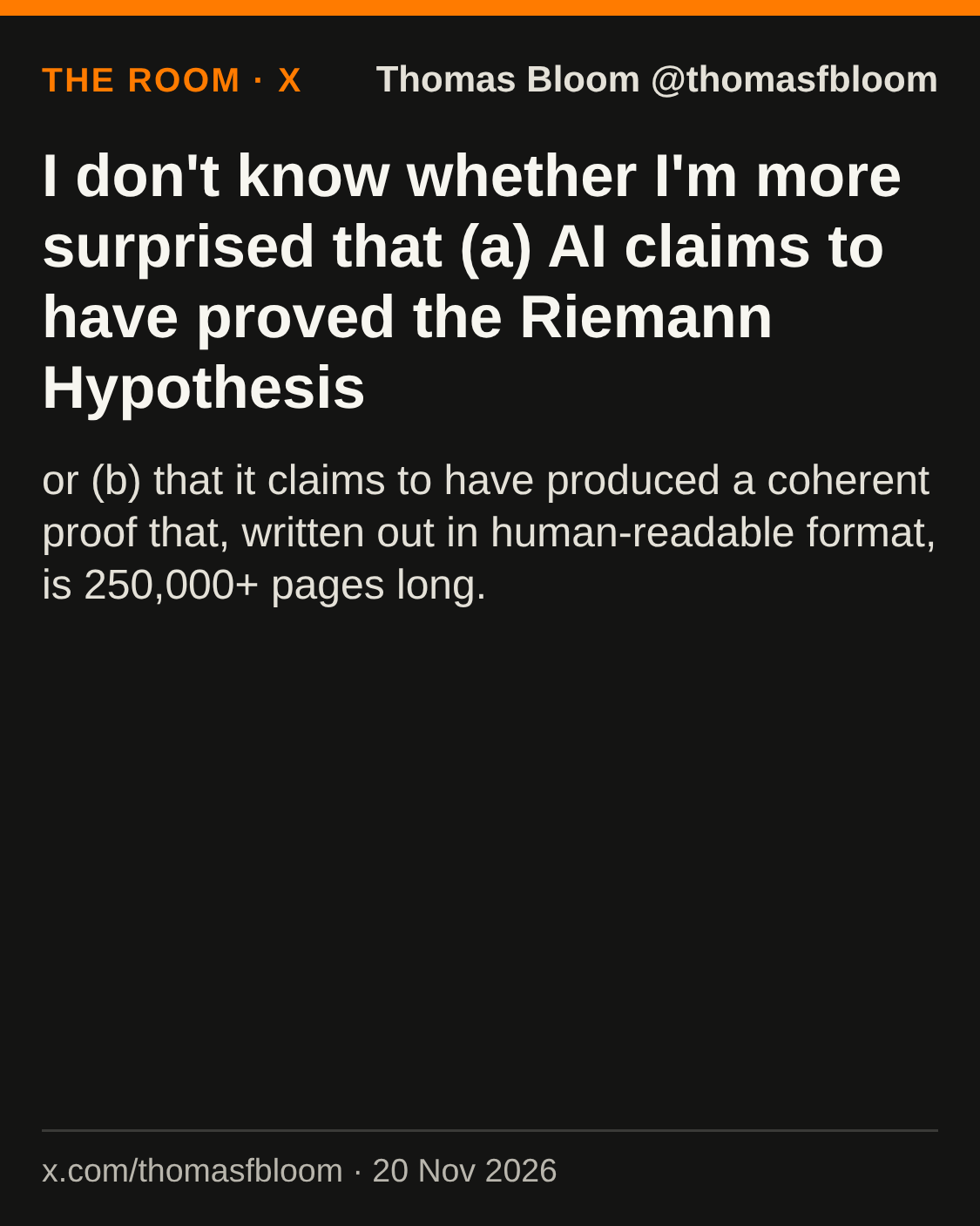
@thomasfbloom, 20 Nov 2026. Source: https://x.com/thomasfbloom/status/2123796489197514945.
Thomas Bloom of Manchester, following the Lean community's Zulip channel, was struck by the scale rather than the claim:
I don't know whether I'm more surprised that (a) AI claims to have proved the Riemann Hypothesis or (b) that it claims to have produced a coherent proof that, written out in human-readable format, is 250,000+ pages long.
A public verification log tracks each step, and as of 21 November its status line reads: claimed proof, independent build passed, review ongoing.
The human who published the same day
The most surprising thing about Friday is that the AI claim was not the only one on the table.
At 18:18 UTC, Stanford's Ravi Vakil posted a hurried announcement on his course blog: Alessandro Masullo has a proposed proof of the generalized Riemann hypothesis, titled The Music Of The Primes, which Brian Conrad has been examining closely for months and giving extensive feedback on. Vakil's emphasis is that it is all human, no AI, and he asks people to check and formalize it. It is a distinct claim, unverified in the same way, and it changes nothing about the machine's archive — except that the machine no longer has the field to itself.
What it actually means, which is not the same as what it feels like
A proof of the Riemann hypothesis would settle how prime numbers distribute, and it would do so in a way the field has assumed for 167 years without being able to show. But the honest answer to "what does it mean" is narrower than the reaction, and one person who said so first is Scott Aaronson, whose blog post on Friday was titled, provocatively, "The stochastic parrots have apparently proved the Riemann Hypothesis". His point, made before the verification finished: AI had already shown in October that the nontrivial zeros of the zeta function are at most 3/8 of the way from the critical line, a result that "already carries most of the implications for number theory that a full proof of RH would have". The remaining distance is enormous and the practical payoff of closing it is, for now, philosophical.
What is new is not the arithmetic. It is the size. A proof no human will read, checked by machines, with machine-checkers themselves independently written and audited, is a different kind of mathematical object than anything the field has handled — and it raises the question of who is qualified to say that it is true. The Lean kernel, as the skeptics keep pointing out, was written by humans. The people answering that question are the ones who spent Friday compiling it on their own laptops.
The room, channel by channel
X. Glazer on the statement and the bug risk; Bloom on the 250,000 pages and the Zulip channel where Lean experts are working; Kevin Weil among those amplifying the claim. Google's chief executive posted about it too, which the r/singularity thread noted within hours.
Hacker News. The submission "Levent Alpöge claims proof of the Generalized Riemann Hypothesis" reached 2,352 points and 1,588 comments; Aaronson's post ran separately at 213 points and 176 comments. The best of it is not the cheering. One commenter walked the actual dependencies, calling it "a heroic-looking ascent, likely not feasible through human-effort alone" and dating the steps. Another explained what Lean's axioms actually buy you. A third connected it to the Navier-Stokes result Alpöge had a hand in, which is why one of Friday's other threads was titled "Unforced Navier-Stokes Singularity and the Generalized Riemann Hypothesis". And a fourth was the argument that will be had for a decade: "There's a reason Paul Graham wrote Hackers and Painters and not Hackers and Assembly Line Workers."
Source: https://www.reddit.com/r/singularity/comments/1y1ibpk/.
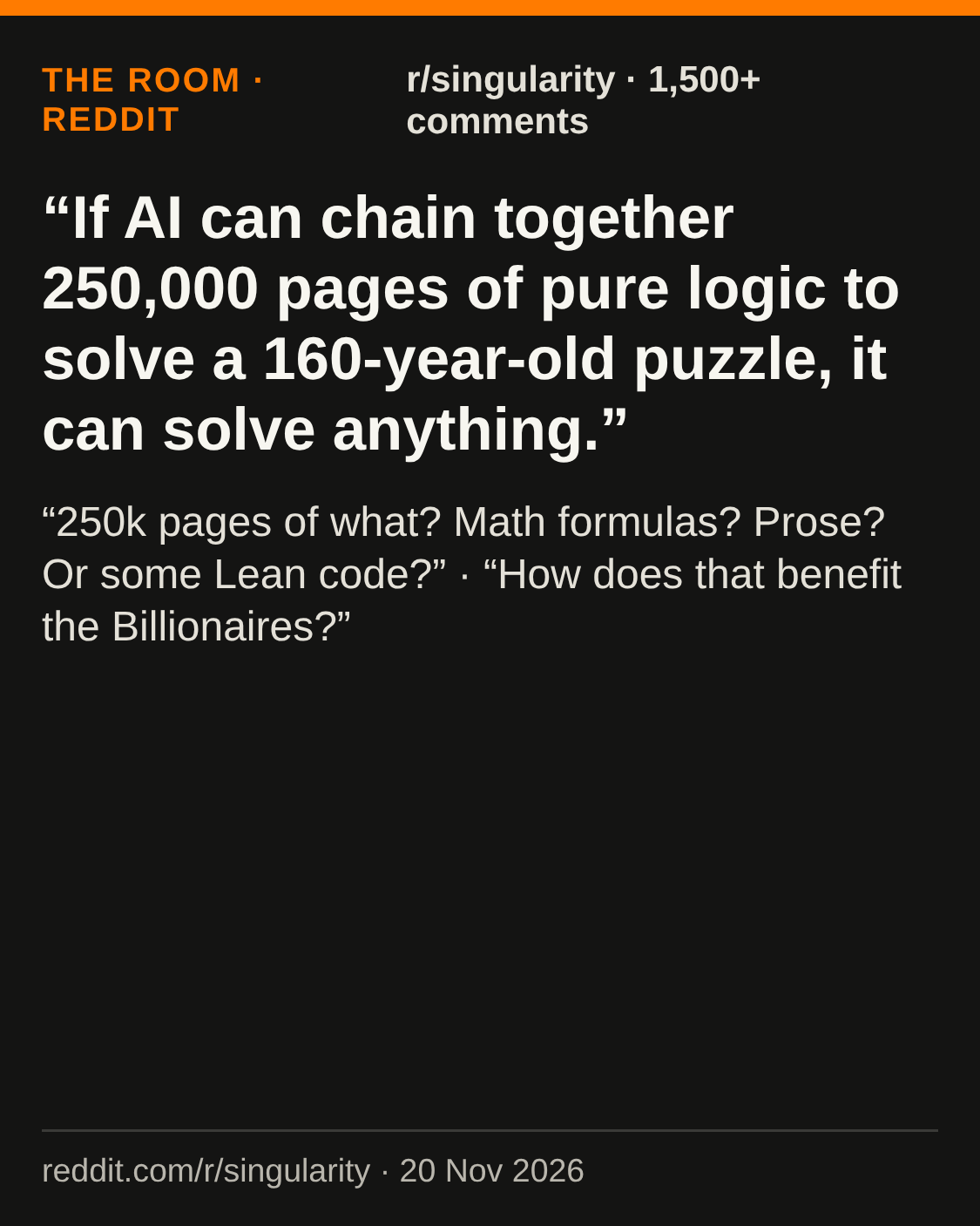
Reddit. The r/singularity thread is the most-read summary in circulation and reads like a news wire edited by a fan: "It's holding up!", "Alpöge used an internal frontier model", and a section headed the Mathpocalypse Drama, in which a human mathematician "rushed out an unfinished 'all-human' draft hours later to compete, but it's human-readable and experts are already finding errors in it" — a claim about Masullo's draft that no one has substantiated in public, and which the thread states flatly. The comments underneath are the honest register of what people actually want to know: "Can we just get to the Universal high income part so I can quit my job to play GTA6, guitar, and travel the world?" · "How does that benefit the Billionaires?" · "Interesting from a math perspective but what does it mean for us people that are not giant math nerds?" · "If AI can chain together 250,000 pages of pure logic to solve a 160-year-old puzzle, it can solve anything." · and one that gets to the awkward heart of it: "250k pages of what? Math formulas? Prose? Or some Lean code?"
r/antiai. A working mathematician wrote the best skeptic's primer anywhere on the internet: what Lean is, why a machine-verified proof is not an AI-verified proof ("I would not trust a purely AI-verified proof at all"), and the three ways a Lean proof can still be wrong — the statement not matching the claim, the proof not compiling, and the proof having found a bug in the Lean kernel itself. On the first, they looked: "The statement of GRH is just a few lines of Lean code... I've looked through it and it checks out."

Source: https://www.instagram.com/reel/Df-UGPXycgo/.
Instagram. Which is where this started: the reel that opened this article, sixty-two seconds of someone working through the same news, saying "we've got to keep watching this because it's really hard to wrap my head around what just happened."
Where this stands
As of 21 November: a Lean archive that compiles, checked by independent kernels, with two verification steps still running; no human-readable paper; a rival human proof in circulation and unverified; and an employer that, in the same week, became a publicly traded company. The Millennium Prize that comes with a proof of the Riemann hypothesis is one million dollars, and it is not going to be paid on the strength of a compile log — the rules require publication in a refereed journal and general acceptance, and there is at present nothing for a referee to read.
Which leaves the field exactly where the machine left it: with a proof that appears to be true, that no one can read, and a verification process that is itself being run by the tools that produced it — while thousands of mathematicians, on their own laptops, check the arithmetic by hand.
Corrections or additions: the sources for every claim above are linked, and the ones that are still unverified are described as unverified.
Sources
- alpo.ge - Alpöge's own note, opened and quoted
- math.mit.edu - Sutherland's verification table, opened; every check listed above is from it
- scientificamerican.com - Buzzard's and Sutherland's assessments, quoted
- scottaaronson.blog - Aaronson's post, including the 3/8 result and its consequences
- math216.wordpress.com - Vakil's announcement of the rival human proof
- riemannhypothesisclaude.org - the public verification log, cited as such
- news.ycombinator.com - the 2,352-point thread the comments are quoted from
- x.com - the statement assessment, quoted
- x.com - the 250,000-page line, quoted
- reddit.com - the thread, with the comments quoted and the unverified Masullo claim flagged
- reddit.com - the mathematician's sceptic's primer on Lean
- quantamagazine.org - the October result Aaronson refers to
- techcrunch.com - the dueling claims