
Invoker-Render 1.0 renders a graybox camera move into video
Ant Group's inclusionAI published the weights for the 33.12B-parameter renderer under a non-commercial license, and the default profile needs eight Nvidia GPUs on one node.
Key takeaways
- inclusionAI, Ant Group's research lab, published Invoker-Render 1.0's weights on Hugging Face under Apache 2.0 and CC BY-NC 4.0, which bars commercial use.
- The checkpoint holds 33.12B parameters in FP32 across 29 safetensors shards, about 132.5 GB, and the default production profile runs on eight Nvidia GPUs on one node.
- Invoker-Render takes a 24 FPS structural proxy video, one 1344 by 768 reference frame and a text prompt, and inclusionAI reports a chunk every 930 ms on eight GPUs.
- inclusionAI reported a stable 30-minute racing rollout, but the CodeWorldModel repository says that demo used a reference-guided quality policy the default service does not enable.
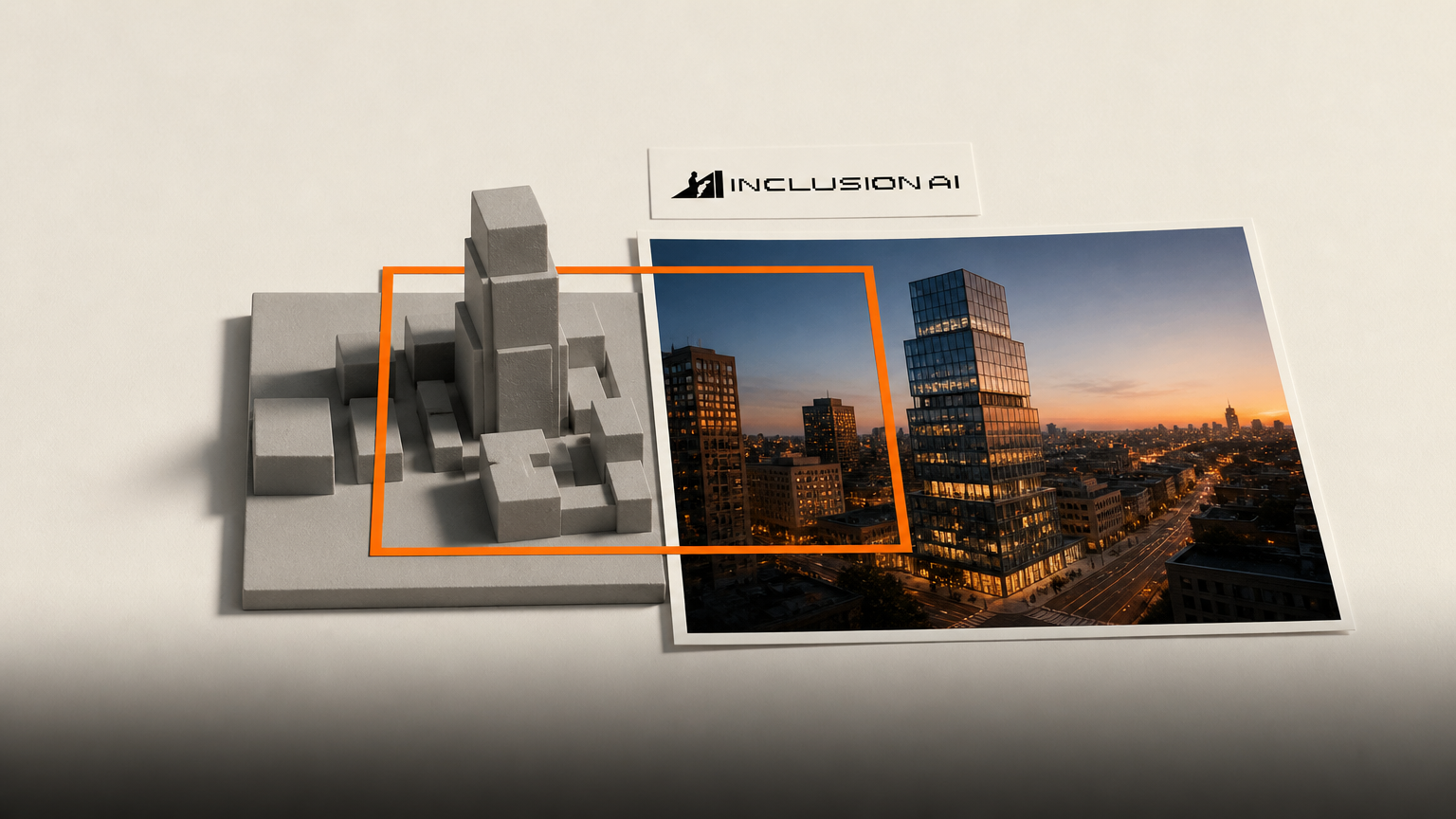
inclusionAI, Ant Group's research lab, released Invoker-Render 1.0, an open-weight video renderer that turns a blocked graybox camera move into finished footage instead of guessing the scene from text.
The weights are on Hugging Face, the inference code is on GitHub, and the method is in the technical report Code World Model 2.0: Towards Infinite Controllable Video Generation, posted to arXiv on November 17. AI FILMS Studio published a breakdown on November 23, and VP Land covered the release on November 25.
Invoker-Render is the renderer half of Code World Model 2.0. An upstream 3D engine keeps the world state and owns the camera path, the scene layout and the object motion. The model paints appearance only, so a director can re-block a shot in the engine without the lighting and textures drifting between takes.
It takes a 24 FPS structural proxy in one of five forms: semantic maps, sparse 3D boxes, subject masks, shaded geometry, or boxes paired with skeletons. One 1344 by 768 reference frame sets the look, and a text prompt adds surface detail. inclusionAI says the same model handles coarse blocking and fine geometry, chosen at run time.
The streaming model is built on MiniMax-H3 with SGLang and SGLang-Omni. It runs causal four-step inference, trained with a staged method the paper calls Progressive Forcing on an aligned corpus of about 200 hours of video and proxy pairs.
The published checkpoint holds 33.12B parameters in FP32 across 29 safetensors shards, about 132.5 GB, and is not quantized. The default production profile runs on eight Nvidia GPUs on one node. The project page reports a chunk every 930 ms, which inclusionAI puts at 1.82 times its 1,770 ms baseline, or 18 frames per second.
On 140 held-out rollouts, inclusionAI reports an overall Elo of 1343.2, ahead of SolarRenderer (Causal) at 1245.3, StreamRender-H3 at 1051.9 and Streaming CWM at 359.6. Those are the maker's own numbers, from its own evaluation.
Two terms shape who can use it. The weights carry Apache 2.0 and CC BY-NC 4.0, which bars commercial use, and the hardware is a multi-GPU node rather than one card. The 30-minute racing rollout the team showcased used a reference-guided quality policy that the default service does not enable, according to the CodeWorldModel repository. To see the output before provisioning a server, VP Land and the AI FILMS Studio breakdown both point to a free Hugging Face Space that takes a proxy video and one reference image in a browser.
Try a proxy clip and a reference frame in the browser demo, then pull the weights onto a node when the look holds.
Sources
- huggingface.co - parameter count, shard count, precision, license, inputs
- github.com - production profile, eight GPUs, streaming evaluation, 30-minute demo caveat
- arxiv.org - method, submission date, Progressive Forcing, 200-hour corpus
- inclusion-ai.org - reported 930 ms chunk, 18.0 fps, baseline, proxy types
- vp-land.com - release coverage, license terms, Elo figures, browser Space
- studio.aifilms.ai - architecture breakdown, license matrix, eight-GPU requirement