
McGill researchers tie 3,201 deepfake videos to 293 accounts
The videos keep a real creator's head, eyes and hair and redraw only the mouth, and TikTok's AI label caught about 4% of those built on real footage.
Key takeaways
- A report published November 12 by McGill University's Centre for Media, Technology and Democracy ties at least 293 TikTok and Instagram accounts to 3,201 videos that drew 22.1 million plays between August 7 and November 4, 2026.
- The accounts take real creators' footage and use AI to redraw the lips and replace the voice, so the person appears to say words they never spoke; almost every account is built on a single real person's footage.
- TikTok's AI label appeared on only 26 of 709 network videos built on real people's footage, about 4%, while it labeled 22 of 24 videos from accounts using fully AI-generated avatars.
- The network's most-played story, a fabricated Trump 48-hour ultimatum answered by Carney canceling $8 billion in U.S. defense contracts, never happened but ran in 161 videos across 129 accounts for 5.1 million plays.
Researchers at McGill University have tied 3,201 AI-altered videos to a network of 293 TikTok and Instagram accounts that drew 22.1 million plays.
The accounts take a few seconds of a real creator's own footage, keep the head, hair and eyes, then use AI to redraw the mouth and replace the voice so the person appears to say words they never spoke. The findings come from Stolen Faces, an incident report published on November 12 by McGill University's Centre for Media, Technology and Democracy.
The videos ran from August 7 to November 4, 2026: 36 Instagram accounts and 257 TikTok accounts, with 82% of the plays on TikTok. The network grew from three accounts posting two videos a day to 157 accounts posting 108 a day, and it was still posting about 100 videos a day when the researchers stopped collecting on November 4.
How one face carries six scripts
Almost every account, 283 of 293, is built on footage of a single real person. The researchers counted 226 distinct people and identified 104 of them. American creator Ashley Hetherington posted a four-minute TikTok about dating on June 17. On October 25, a near identical video appeared from an Instagram account that had taken the first 21 seconds of it and changed her lips to match a new voiceover about Canada's job losses, U.S. tariffs and Alberta's referendum. Her head, hair and hands move exactly as in the original; the mouth and the voice do not.
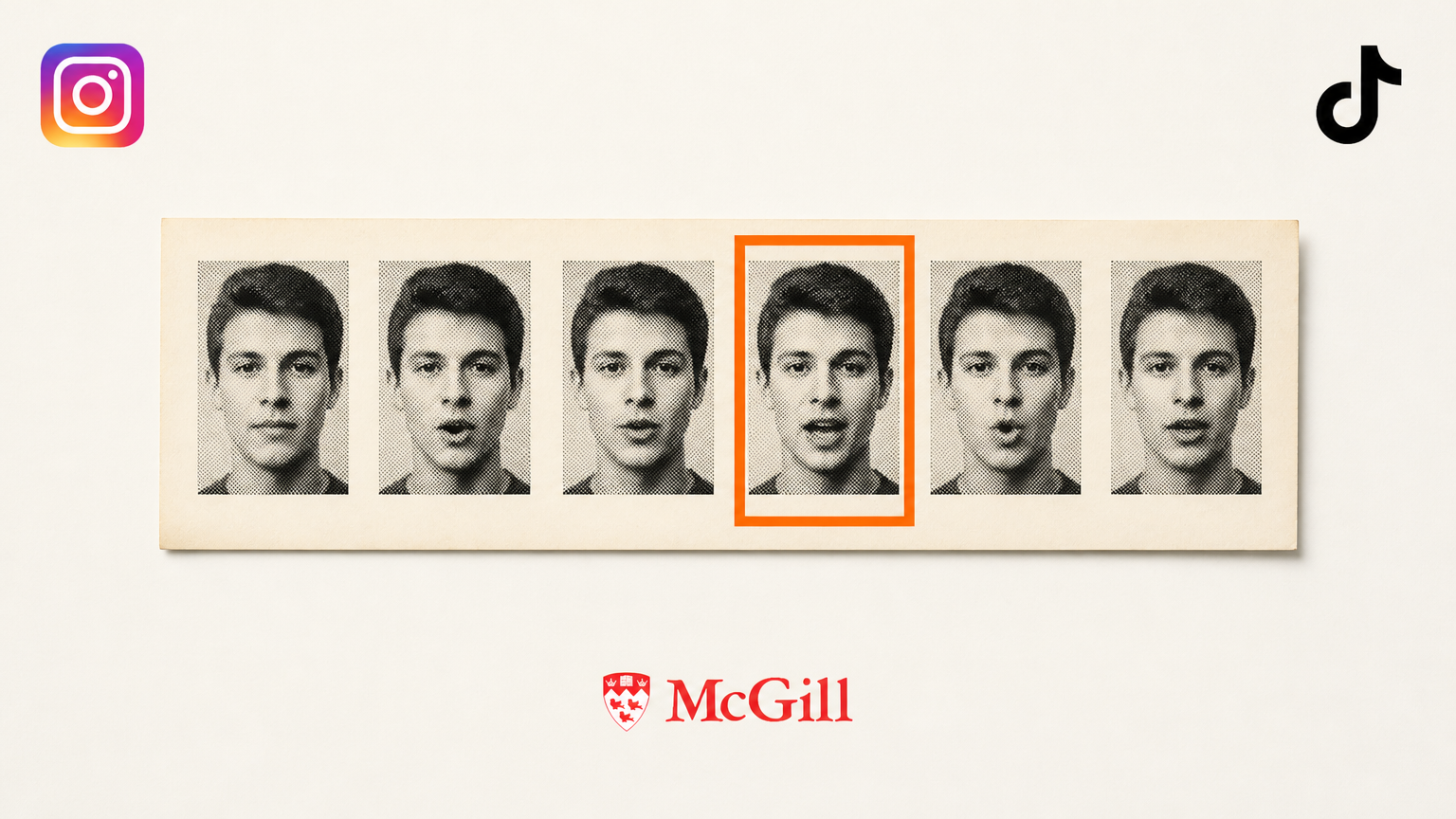
One clip can carry several scripts. Between October 23 and 30, an Instagram account posted six reels built from the same clip of one creator, the head moving identically across all six while the mouth followed a different script each time.
Many of the most-watched videos are fabricated. The network's most-played story claimed that President Donald Trump issued a 48-hour ultimatum for Canada to drop its retaliatory tariffs and that Prime Minister Mark Carney answered by canceling $8 billion in U.S. defense contracts. Neither happened, but the script ran in 161 videos across 129 accounts for 5.1 million plays.
Platform labels missed nearly all of it. TikTok's AI label sat on 22 of 24 videos from accounts using fully AI-generated avatars, but on only 26 of 709 videos built on real people's footage, about 4%. A speech detector rated the narration as AI-generated in 94% of the videos, and an AI-text detector rated about 46% of the scripts as entirely machine-written. None of the network's videos disclosed AI use, and only 6.3% of comments suggested a video was fake, copied or propaganda.
The report could not name who runs the network. Posting and registration times point to East or Southeast Asia, most likely the UTC+8 or UTC+7 zone, and 12 of the 184 accounts the researchers could check carry a Chinese-language setting or a China registration, the report's only country-specific lead. The accounts show no sign of making money.
TikTok said on November 13 that it had permanently banned the accounts named in the report, The Canadian Press reports. Meta declined to comment on the report, the same account says.
For creators, the lesson is that the platform's own label is not a reliable tell. Building the fakes on top of real footage is what lets them pass, because detection software reads the source video as real. Aengus Bridgman, the centre's associate director of research, told The Globe and Mail that the network "has found a loophole." If a face you recognize posts a political breaking-news clip, checking that person's own verified account is the faster test, The Circuit notes.
The full report, Stolen Faces, is free to read at the Centre for Media, Technology and Democracy.
Report card
- Report: Stolen Faces: An Inauthentic TikTok and Instagram Network Inflaming the U.S.-Canada Trade War
- Publisher: Centre for Media, Technology and Democracy, McGill University
- Published: November 12, 2026
- Sample window: August 7 to November 4, 2026
- Accounts: 293 (257 TikTok, 36 Instagram)
- Videos and plays: 3,201 videos, 22.1 million plays
- TikTok AI label rate: 26 of 709 videos built on real people's footage
- Read it: https://mediatechdemocracy.com/en/publications/stolen-faces_2026/
Sources
- mediatechdemocracy.com - the report itself: 293 accounts, 3,201 videos, 22.1M plays, label counts, the Hetherington example, origins
- theglobeandmail.com - Bridgman interview quote, the technique, named Canadian creators, TikTok statement
- nationalobserver.com - TikTok ban of the named accounts, Meta decline, Canadian Press report
- bnnbloomberg.ca - Canadian Press report quoting the report
- montreal.citynews.ca - CityNews copy of the Canadian Press report
- techtimes.co.uk - the 26-of-709 label count, TikTok ban
- thecircuit.ca - summary and the "check their own verified account" advice