
SolarRenderer turns game-engine block-outs into video in 4 steps
The team froze a 33B MiniMax-H3 video model, added two small LoRAs, and cut sampling from 50 steps to four, with a streaming variant at 768p.
Key takeaways
- SolarRenderer, a paper posted to arXiv on October 20, 2026, renders finished video from coarse scene structure in four denoising steps, 12.3 times faster than 50-step sampling, the authors report.
- The method adapts a frozen MiniMax-H3 33B video model with two lightweight LoRAs and trains on a frame-aligned corpus of 136,000 clips drawn from game engines, simulators and YouTube videos.
- A block-causal variant streams 768p video in real time, producing a 17-frame chunk every 0.70 seconds at 24 fps and running about 1.1 seconds behind its input, according to the authors.
- The team reports state-of-the-art results on a benchmark of 16 structural representations and generalization to 11 it never trained on, including pose skeletons, drawings and point clouds; no per-representation accuracy breakdown is published.
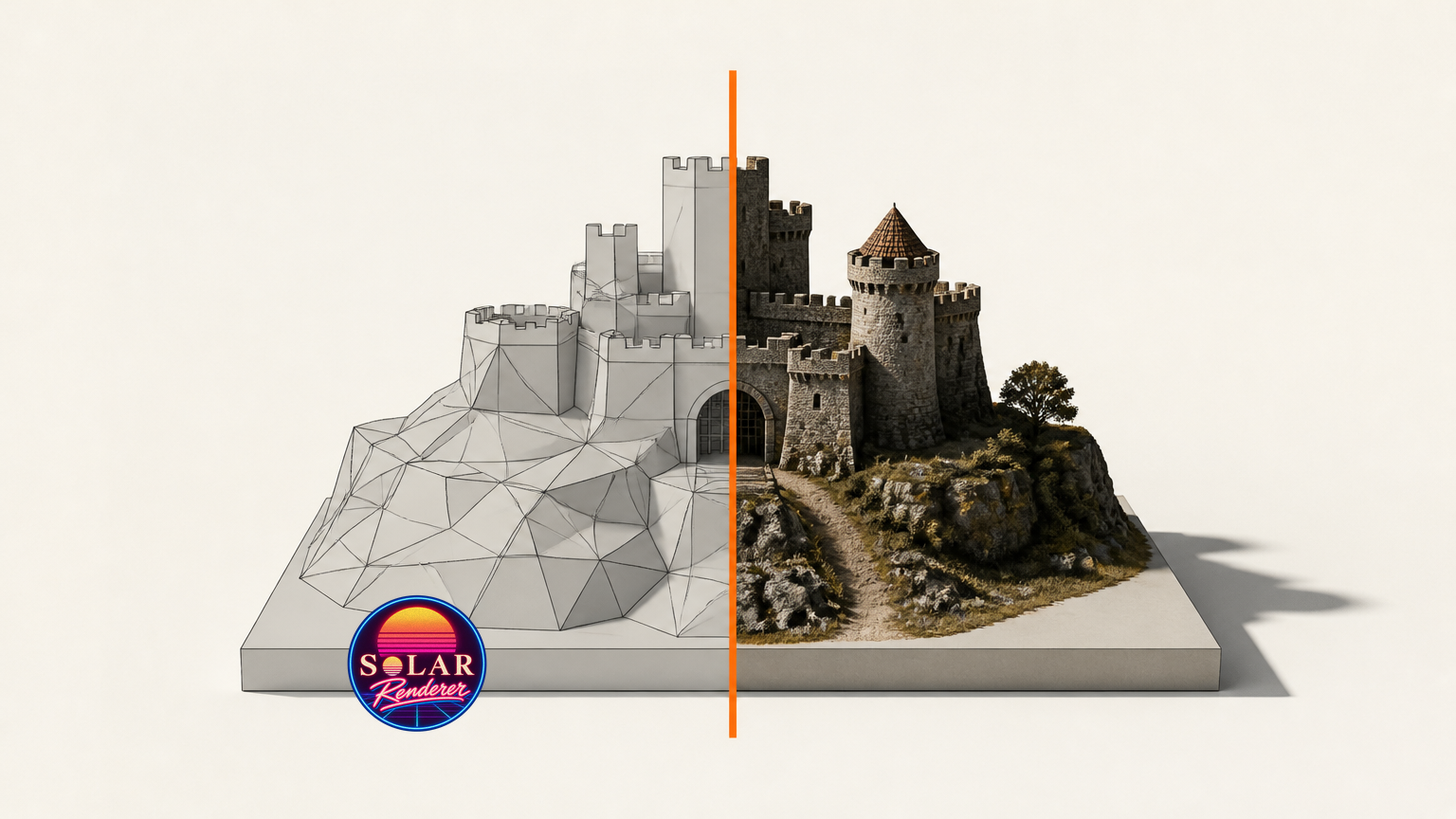
A research team has published a way to turn the rough, untextured geometry a game engine draws into finished, realistic video in four denoising steps, which it says is 12.3 times faster than sampling the same model at 50 steps.
The method, called SolarRenderer, is described in a paper posted to arXiv on October 20, 2026 by Guian Fang, Shengju Qian, Dongyue Lu, Junchao Huang, Lutao Jiang, Xin Wang, Yiren Song, Li Jiang and Mike Zheng Shou, whose Show Lab at the National University of Singapore is credited on the paper's Hugging Face page. Code and weights are on GitHub and a set of live demos is on the project page.
The problem the paper attacks is narrow and practical. Coding agents and game engines can already specify where objects are, how they move and where the camera points, but that structure is not a picture. Existing renderers that turn structure into video are tied to one engine's format, need tens of denoising steps, or have to be distilled separately.
SolarRenderer keeps a frozen MiniMax-H3 33B video model and trains two small LoRAs on top of it. Structural videos, meaning block-outs, depth maps, pose skeletons, drawings or point clouds, enter the backbone's native reference pathway at the positions of the frames they describe. There is no type identifier and the structure is described only in plain text, which the authors say is why a single control LoRA can follow formats it was never trained on.
Sampling starts from a pretrained four-step LoRA. Structure-guided distribution matching then renders in four steps while preserving the learned control, the paper states. Training used a frame-aligned corpus of 136,000 clips from game engines, simulators and YouTube videos.
The paper reports state-of-the-art results on an in-distribution test set and on a generalization benchmark covering 16 structural representations, and says the model transfers to 11 representations it never saw in training, including pose skeletons, drawings and point clouds. A separate block-causal variant extends the design to streaming and renders 768p video in real time.
The submitting author's comment on the paper's Hugging Face page puts numbers on the streaming claim: four steps per chunk, a 17-frame chunk every 0.70 seconds at 24 fps, about 1.1 seconds behind the input, continuing as long as the input does with a KV cache. On the held-out structure benchmark the author reports the model ranks first on structure with an Elo of 1313 against nine other methods.
Two caveats sit alongside the claims. The abstract publishes no per-representation accuracy breakdown, so the 11-unseen-representations figure is a count of what generalized rather than a per-format score. And the four-step figure is measured against the same model at 50 steps, not against another team's renderer, so it describes the method's own speedup rather than a head-to-head win.
The weights, training data and benchmark are released in the Enderfga Hugging Face collection linked from the project page.
Sources
- arxiv.org - the paper: four-step render, 12.3x, the 136K-clip corpus, the 16-representation benchmark, the 11 unseen representations
- huggingface.co - paper page; the submitting author's comment with the 17-frame chunk, 0.70 s, 1.1 s lag and the Elo 1313 structure ranking
- github.com - released code and weights for the model
- enderfga.cn - project page and live demos
- aiweekly.co - independent summary; author affiliations and the note that no per-representation accuracy breakdown is published