
ACTx486 puts new words in Elon Musk's mouth, and labels them
Karina Nguyen and Jakub Zegzulka's research demo puts new words in Elon Musk's mouth over real podcast footage, and labels every generated second.
Key takeaways
- Karina Nguyen posted ACTx486 on September 23, 2026, a research demo that makes an existing podcast interactive, built on a real Joe Rogan episode with Elon Musk; the post drew 809,023 views in a day.
- The project states on its own site that in the generated segments the faces, voices and words are synthetic and that nothing said there was said by the people depicted.
- The on-screen disclosure works as claimed: sampled at twelve points, the label reads REAL at 3, 62 and 95 seconds and ARTIFICIAL at the other nine.
- The authors state that the demos were generated in advance rather than in real time, that a full interaction still takes minutes, and that their target of under six seconds is not yet met.
Karina Nguyen posted ACTx486 on September 23 and called it "a research demo of a new interactive medium". The pitch is a question: what if you could talk to any video and ask anything? Within a day the post had 809,023 views and 1,255 bookmarks.
The demonstration is built on a real episode of The Joe Rogan Experience featuring Elon Musk. In the clips, a viewer asks questions and the hosts answer, in their own faces and voices, about things they never said. The project's own site is blunt about it: "In the generated segments, their faces, voices and words are synthetic. Nothing they say there was said by them, and nothing in these clips is a statement by either of them."
That sentence is the story, and it is the first thing worth checking. What follows is what the demo claims, what holds up from outside it, and what does not.
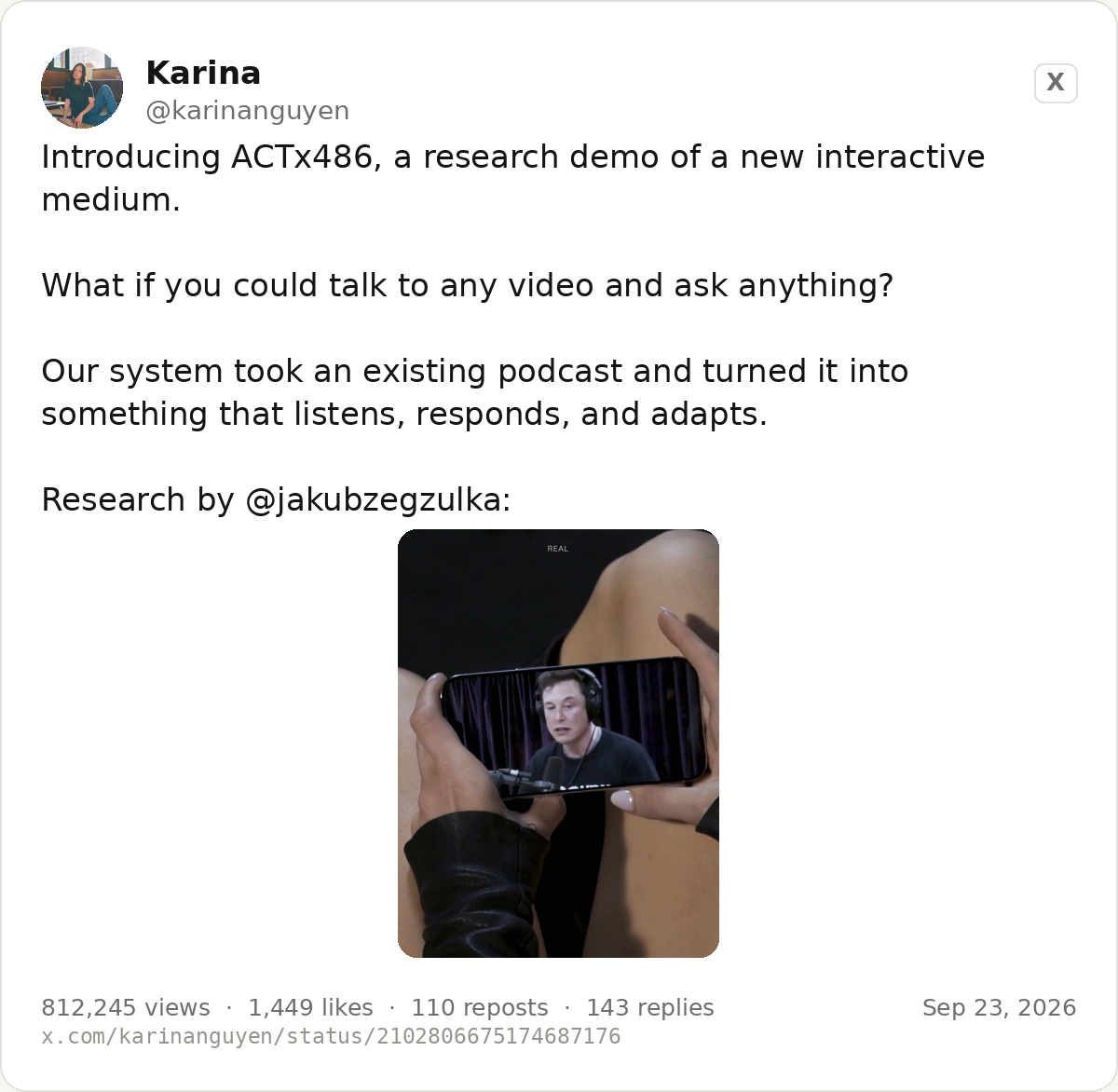
@karinanguyen, September 23, 2026. Card rendered from the post; read it on X at https://x.com/karinanguyen/status/2102806675174687176.
What the Demo Claims
The demo's clips walk through them. The system knows who you are, so when a viewer says she is heading to Los Angeles, the host answers with recommendations sent to her phone. Each host can speak your language, so she asks in Italian and gets an answer in Italian, in the host's voice. You can direct a single action, and the demo's example is a request that the host stop smoking. You can ask to see Mars, and the studio scene becomes a Martian one. The project's site carries a note under the post stating plainly that the demos combine real footage with generated segments, that the statements in those segments were not made by the people depicted, and that the project is unaffiliated with the show.
The project's site lists more: diagrams generated in real time and timed to the host's speech; a host who asks what you meant when a question is unclear; answers personalised from a stored viewer profile; anything worth keeping sent to your phone as a card; new worlds that keep the original dialogue "untouched and in sync"; independent language switching; 3D objects placed in a scene that survive every follow-up question; and a mode that puts the viewer into the scene using their own camera. Twelve clips accompany it.
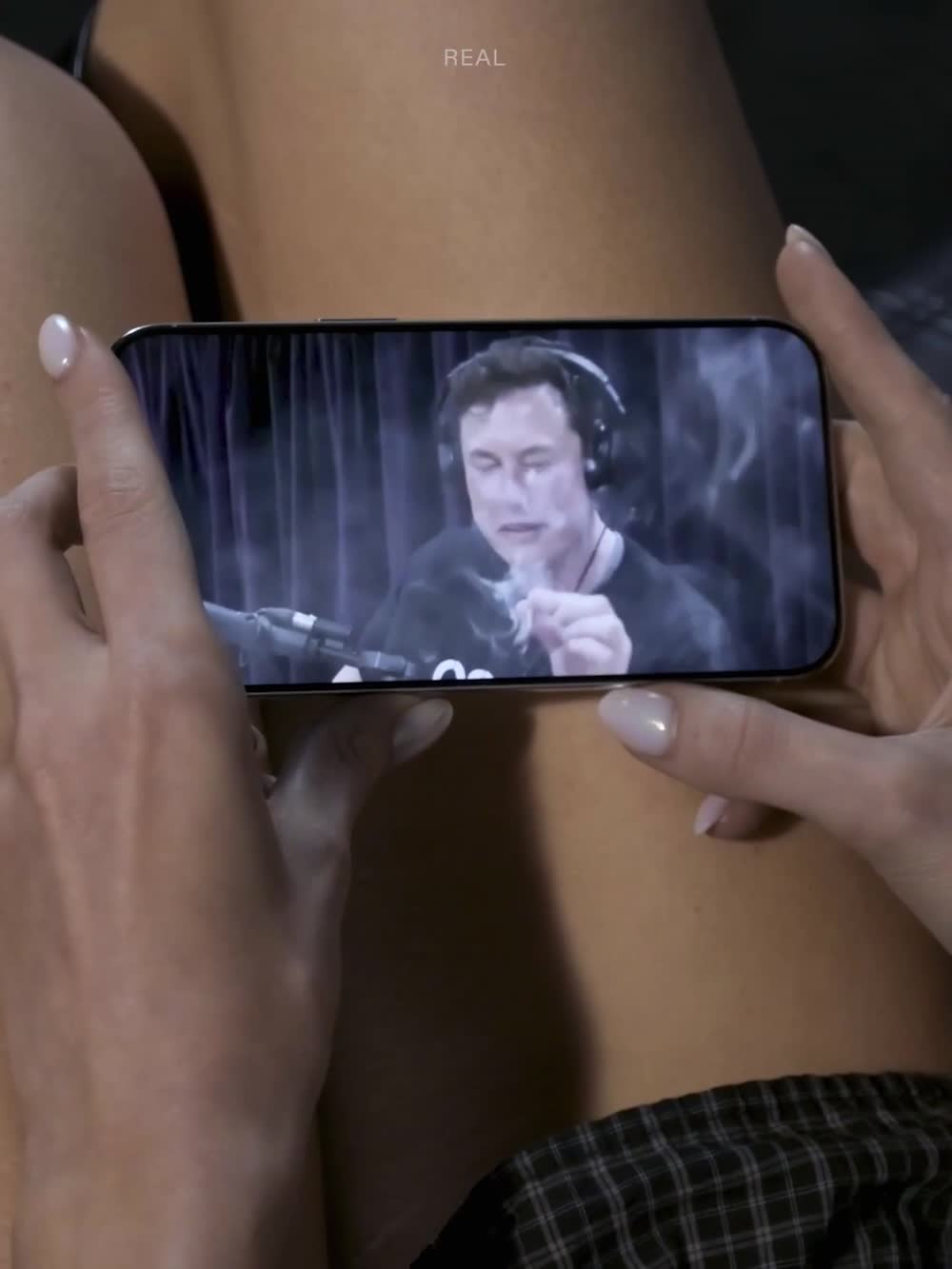
The demo is presented as a phone in someone's hands, with the label REAL at the top of the frame where the original episode is running. Still: ACTx486.
What Checks Out
The authors are who they say they are. Nguyen's own site says she is "currently building Thoughtful" and describes her prior work at OpenAI on Canvas, Tasks and the o-series; an AI Engineer speaker page separately confirms her OpenAI affiliation. Jakub Zegzulka's X profile lists previous work at Apple, Meta and OpenAI. This is a demo from people with the background to build it.
The disclosure works exactly as claimed. The site says the on-screen label "switches exactly where real footage stops and resumes". Extracting the label band from the top of the demo at twelve points confirms it: the label reads REAL at 3, 62 and 95 seconds, and ARTIFICIAL at the other nine. Of everything in this project, the labelling is the part that behaves precisely as advertised.
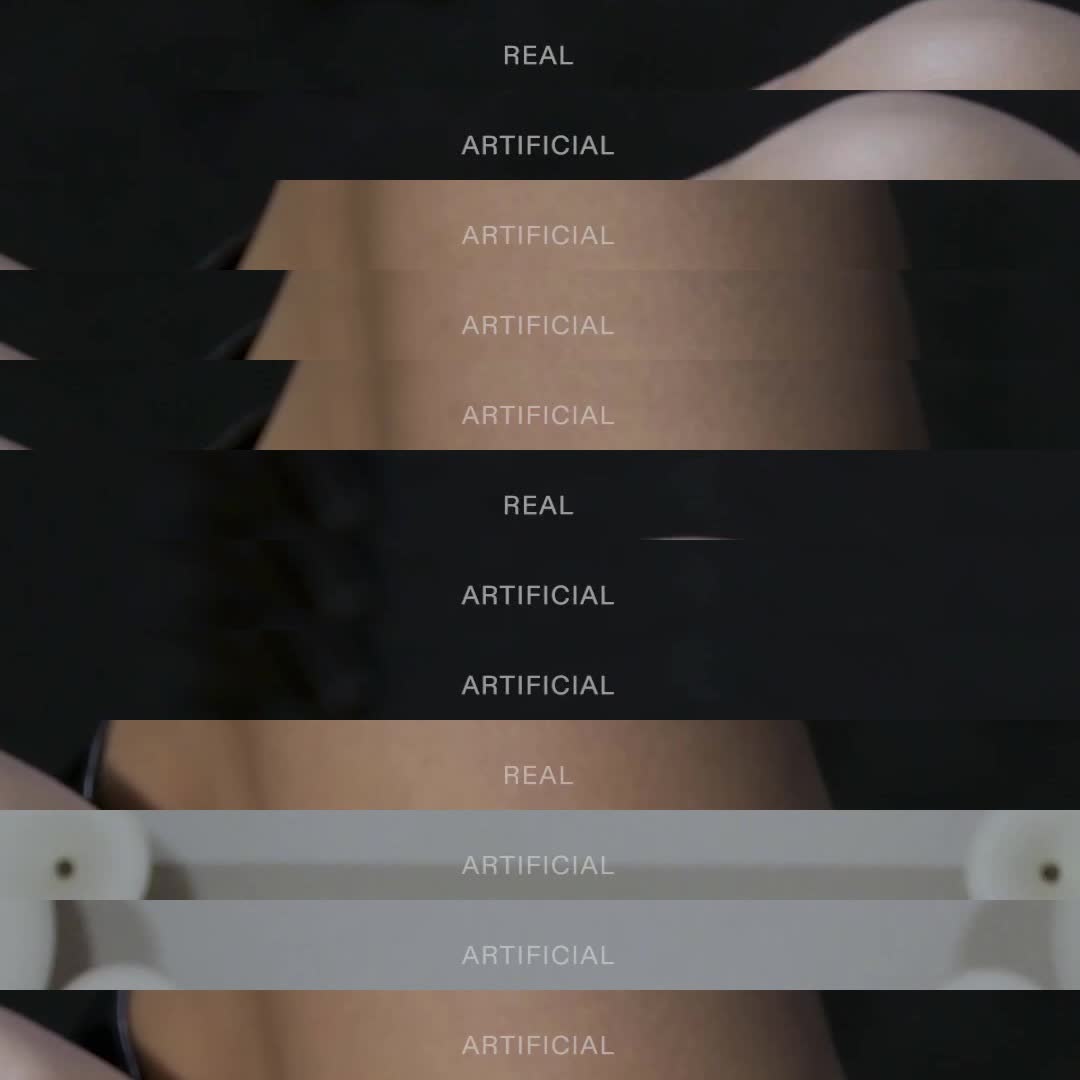
The label at twelve sampled points, top to bottom: 3s, 15s, 28s, 40s, 52s, 62s, 74s, 86s, 95s, 108s, 120s, 133s. It switches between REAL and ARTIFICIAL as the demo moves between the episode and generated segments. Still: ACTx486.
And the limits are published by the authors rather than extracted by critics. The most important line on the site is not a capability. "Real generation, not real time," it reads. "The system routed, researched, wrote answers and generated every scene. A full interaction still takes minutes, so the demos were generated in advance. We think the ideal response time is under six seconds. We're not there yet."
What Cannot Be Corroborated
The interactivity. A video is a recording, and nothing in it can show that the system answers in the moment. By the authors' own account it does not: the clips were generated in advance, and a full interaction takes minutes.
Neither is there anyone outside the project who has tested it. Searches for independent coverage turn up the project's own material, the podcast hosting the source episode, and one outsider write-up, a RuntimeWire account that restates the project's claims, plus reaction posts on X and Reddit: no hands-on report, no third-party verification, no paper, no benchmark, no access.
Nor is there comment from Musk, Rogan, Spotify or the show. The site says the episode was used "without asking them", and gives its reason: they are two of the most recognisable people alive, and the question the project raises is clearer for it.
Why This One Lands Differently
X's own synthetic media policy, quoted in a 2024 Public Citizen letter to Musk, reads: "You may not share synthetic, manipulated, or out-of-context media that may deceive or confuse people and lead to harm." It carves out satire "provided these do not cause significant confusion about the authenticity of the media". Labelling every generated segment on screen and leading with the disclaimer is what that carve-out asks for, and it is more than most projects manage.
The history is not abstract. In 2023 an AI-generated Joe Rogan episode featuring Sam Altman circulated, labelled as not the actual words of either man, and Rogan's own response was "This is going to get very slippery, kids." In 2024 Musk shared a deepfake of Kamala Harris and called it parody, and Public Citizen asked X to remove it under the same policy.
The authors name the risk themselves. Under a heading of Dual use, the site says the capabilities that make interactive media compelling "can make information far more useful and falsehoods far more believable. The same capabilities also enable deepfakes." Their stated reason for choosing this episode is the question they want asked, and it is a better one than the demo's own pitch: "What happens when a system can put new words in the mouth of someone you already trust?"
That question is the finding, and it arrives with a working answer attached. The software exists, the labelling is honest, and it is not yet real time, which is what stands between this and something far harder to argue with.
ACTx486 is at https://actx486.com. The launch post is at https://x.com/karinanguyen/status/2102806675174687176.
Sources
- x.com - the launch post, its claims and its engagement counts
- actx486.com - the project's own site: credits, the synthetic-content disclaimer, the capability list and the real-generation-not-real-time admission
- karinanguyen.com - Nguyen's own site listing her OpenAI work
- ai.engineer - speaker page confirming her OpenAI conference affiliation (does not itself name Thoughtful)
- citizen.org - quotes X's synthetic media policy and its satire carve-out
- foxnews.com - the 2023 AI-generated Rogan episode, its labelling and Rogan's response
- x.com - Zegzulka's own X bio, confirming previous work at Apple, Meta and OpenAI
- runtimewire.com - outside coverage of the launch (Sep 23, 2026); it restates the project's claims and does not test the demo