
Australian creators launch copyright campaign against AI firms
The Australian Society of Authors and a coalition spanning music, publishing, screen and news want AI companies to seek permission before training on their work.
Key takeaways
- The Australian Society of Authors said on November 16, 2026 that it joined Australian creative and media organizations to launch Not AI's to Take, a national campaign asking the government to keep existing copyright protections.
- The campaign says AI companies should not train on Australian creative work without permission first and agreed payment, and offers a petition, a letter-to-your-MP tool and a campaign toolkit.
- The ASA attributes the campaign's figures of $70.3 billion in economic contribution and almost 600,000 workers; both trace to the Bureau of Communications, Arts and Regional Research.
- The Attorney-General's Department has since presented rights-holder groups with two opt-out models for AI training, and the Joint Select Committee on Artificial Intelligence reports by November 30, 2026.
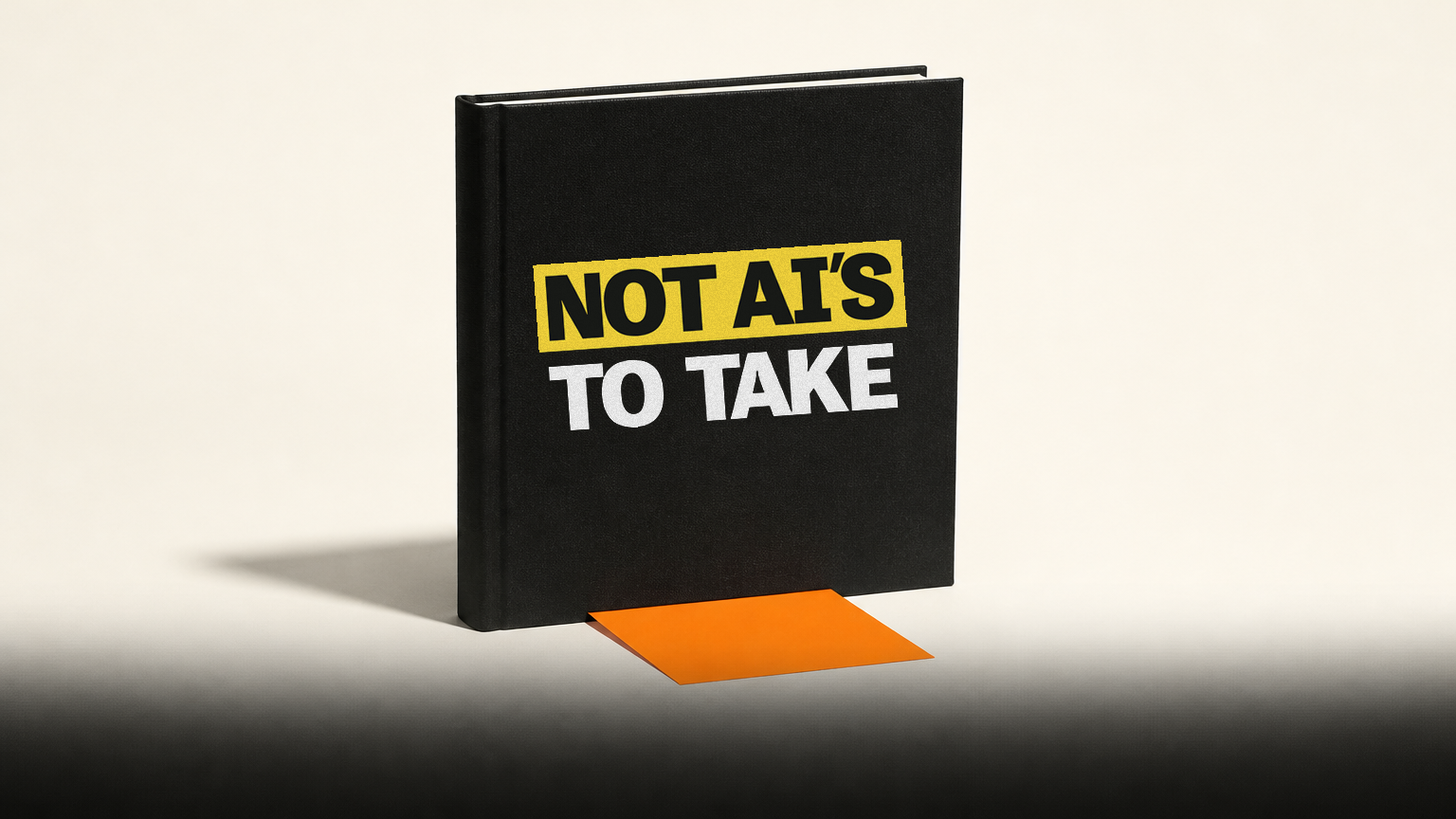
The Australian Society of Authors said on November 16 that it has joined Australian creative and media organizations to launch Not AI's to Take, a national campaign against proposals that would let AI companies train on Australian work without permission.
The authors' body announced the campaign in a post on its own site and sent readers to nottheirstotake.com.au, where the coalition is running a petition, a letter-to-your-MP tool and a downloadable campaign toolkit. The demand on the campaign's front page is that "AI companies should not be able to use Australian creative work without permission and agreed payment." The campaign asks the government to keep existing copyright protections in place.
The ASA's post puts the Australian creative and media sector at $70.3 billion in economic contribution and almost 600,000 workers. Those are the campaign's figures, and they trace to the Bureau of Communications, Arts and Regional Research. BCARR reported cultural and creative activity at $70.3 billion in 2024-25, about 2.5% of the economy, and estimated 591,302 people employed in a cultural or creative industry or occupation as their main job in 2023-24.
The campaign's supporters page lists organizations across music, publishing, screen and news. They include the Australian Society of Authors, APRA AMCOS, the Australian Publishers Association, the Copyright Agency, Free TV Australia, Screen Producers Australia, the National Association for the Visual Arts, the Australian Recording Industry Association, the Australian Independent Record Labels Association, Mushroom Music, Guardian Australia, Nine, Seven and News Corp Australia.
A coalition letter published by the News/Media Alliance and dated October 19 warns Prime Minister Anthony Albanese against three ideas it says are circulating: a statutory licensing pool, deals with a set number of rights holders and extended collective licensing. Its signatories include the News/Media Alliance, the Recording Industry Association of America, the International Federation of the Phonographic Industry, The Authors Guild, the Association of American Publishers, Australia's AIR and Country Press Australia. The letter says the proposals would "turn the principles of copyright law upside down" and amount to "a broad TDM exception in all but name."
Attorney-General Michelle Rowland's department ruled out a free text and data mining exception in October 2025. In September 2026 the ABC reported that the department had instead shown rights-holder groups two options under the heading "AI on Australian Terms," both of which make inclusion in AI training opt-out by default. One would let AI companies train on "unprotected" material after paying a central body that distributes the money to registered owners; the other would require deals with a minimum number of rights holders and a minimum period. The department has told a parliamentary committee that it developed the statutory data training authorization model itself and that an opt-out would require legislation.
AI companies want the legal uncertainty resolved. OpenAI's vice president of global policy, Ann O'Leary, said the company would not be able to build a training center in Australia while the copyright law stands, in remarks to The Australian that the ABC reported. An OpenAI spokesperson told the ABC the company was taking part in the consultation and wanted an approach that is "practical, sustainable and right for Australia." Anthropic has told the government its investment was contingent on clarity on copyright law, according to a Treasury FOI document the ABC cited.
The Productivity Commission recommended in its final report, dated December 10, 2025, that the government make no changes to copyright law for three years, and monitor licensing markets for open web material, the effect of AI on creative incomes and how overseas courts draw the limits of copyright exceptions.
Other governments face the same question. The UK dropped its preferred opt-out model in March 2026 after its consultation was rejected by the creative sector, and now says it has no preferred option. The EU keeps a text and data mining exception that rightsholders can opt out of, and is consulting on which machine-readable protocols count as a valid opt-out.
For creators who make video, images or text with these models, the Australian outcome could set how far permission is required before their work enters a training set. A licensing pool or an opt-out default would shift the burden onto the creator to register or block use; the campaign and the coalition letter both argue that is unworkable for individual artists.
The Joint Select Committee on Artificial Intelligence, appointed on August 20, 2026 and given copyright in its terms of reference, reports by November 30, 2026; any change to the law would still need legislation.
Sources
- nottheirstotake.com.au - campaign site: demand, figures attribution, toolkit, supporters
- asauthors.org.au - ASA announcement, November 16, 2026
- newsmediaalliance.org - coalition letter to the Prime Minister, October 19, 2026
- abc.net.au - Attorney-General's Department's two opt-out options; OpenAI and Anthropic positions
- aph.gov.au - committee terms of reference and November 30, 2026 reporting date
- aph.gov.au - Attorney-General's Department answers: model origin, legislation needed for opt-out
- assets.pc.gov.au - Productivity Commission final report no. 111, Recommendation 2.1
- infrastructure.gov.au - BCARR $70.3 billion, 2024-25
- arts.gov.au - BCARR 591,302 cultural and creative jobs, 2023-24
- afr.com - AFR report on the campaign's plan (paywalled; opening paragraph only)
- bbc.co.uk - UK drops its preferred opt-out model, March 18, 2026
- digital-strategy.ec.europa.eu - EU TDM exception and opt-out protocol consultation