
Meta and Oxford's AVM generates camera angles never filmed
The research model walks a virtual camera through a scene from photos or video, reports 70.67 on WorldScore's camera score, and ships no code or weights.
Key takeaways
- AVM generates short clips along a requested camera path from images or video, without building a 3D model of the scene.
- On WorldScore's static camera score AVM reports 70.67, against 68.94 for SEVA and 3.91 for the best world model tested.
- Removing AVM's retrieval of earlier views drops revisit fidelity from 28.04 to 11.13 PSNR in the paper's own ablation.
- No code, weights, demo or API has been released; the paper and a trailer are all that exist.
A model from Meta and the University of Oxford moves a camera through a room it has only seen in photographs, and generates the view from angles no camera occupied. It is called AVM, for Autoregressive View Model, and the technical report went up on arXiv on November 17.
The claim is narrower than the one traveling around feeds, where Tellers asked on November 21 whether AVM can change the camera angle of an existing video. AVM does not edit a finished shot. It generates new short clips along a camera path you specify, using your images or video as the evidence of what the scene contains. It never builds a 3D model along the way.
AVM is research, not a product. There is no code repository, no model weights, no demo and no waitlist. What exists is the paper, a project page and a 115-second trailer. VideoTech Wire drew the same line in its November 19 summary, describing the work as generation rather than a production pipeline.
What AVM actually does
AVM treats a scene as a stream of views rather than a volume. Each view carries a camera pose and a timestamp, so the model can be asked for a view at a position and a moment. Inputs go into a pool the authors call prefill. Clips the model has already generated go into the same pool as history, which is what lets a camera leave a room and come back to it.
Every new clip is conditioned on a fixed number of context slots rather than on everything the model has ever seen. It fills those slots by retrieving views from the pool: nearby camera poses supply spatial context, matching timestamps supply the scene's motion. A local window of recent frames handles continuity. The result is a context that stays bounded whether you started with one photo or a dense set of them.
The model itself is a fine-tuned video diffusion transformer. The paper cites Wan2.1-I2V-14B, a 14-billion-parameter image-to-video model, as the starting point, and trains on roughly 8 million scenes and video clips assembled from real captures, game renderings, multi-camera video and synthetic environments. Clips are five seconds during training.
A second stage converts the model into an autoregressive one that generates chunk after chunk, tuned on its own output so errors do not compound. That stage also cuts the sampling cost: the base model needs 50 Euler steps per clip, the tuned causal model needs four.
What the demos show
The trailer is the only moving evidence released. It opens on a snowy bicycle and an arcade cabinet, then settles into a pattern: a scene, a small corner card showing camera frustums and a dotted orange path, and the generated move.
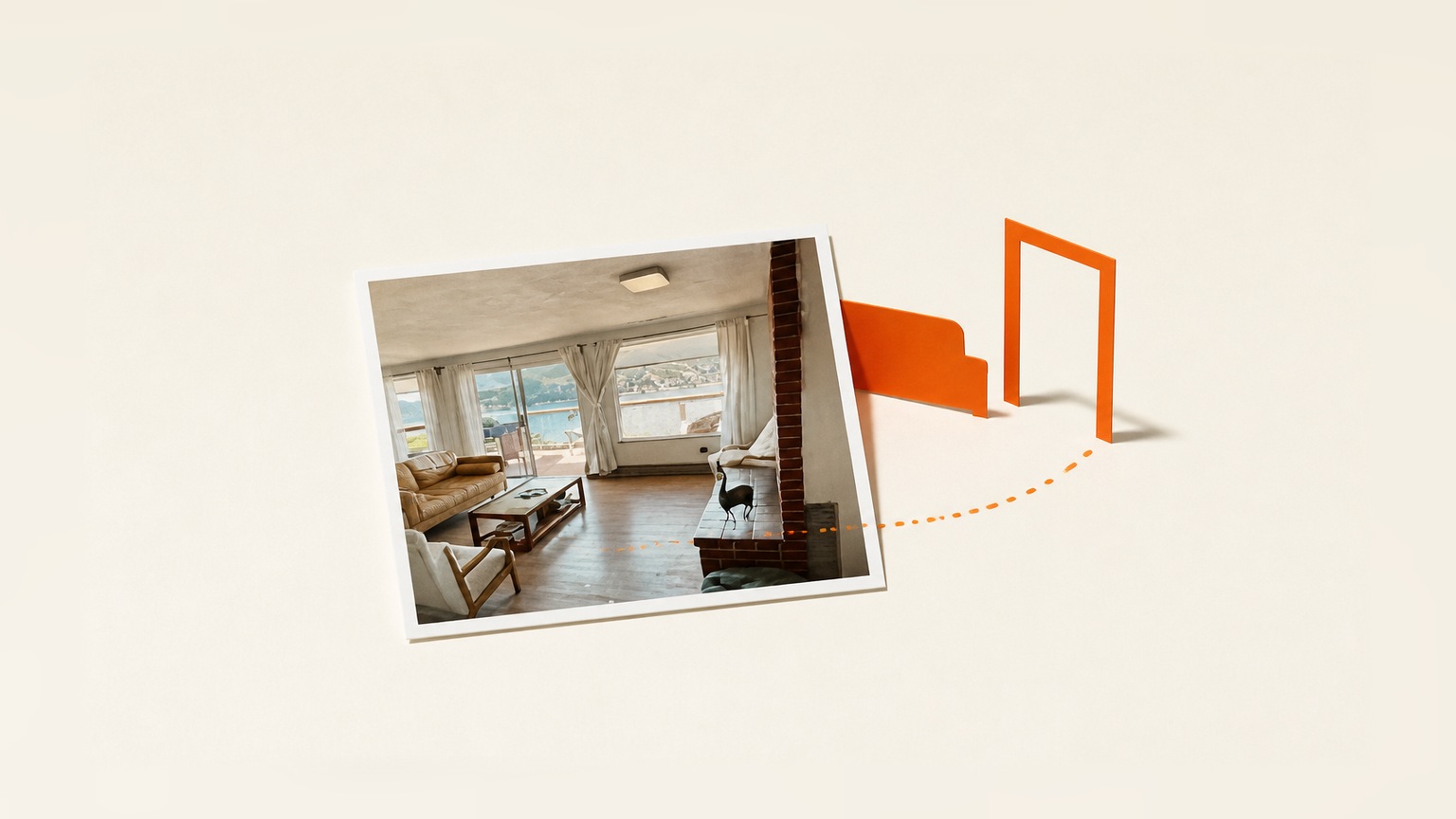
The captures vary as much as the paper claims. One segment lays four photographs of a living room on a dark background under the label "Image context", then generates a walk through the same room. Another flies down a museum corridor past visitors. A third walks through a seaside apartment, past a wooden door, into a room with a sofa and a coffee table. Outdoors, two cameras on tripods stand on artificial grass beside two men, labeled "Streaming", and the generated camera moves between the physical positions. The trailer ends on a grid of roughly thirty scenes stamped with the AVM wordmark.
The generated frames are not all clean. In the apartment walk the walls and door frames carry smeared, liquid texture where flat painted surfaces should be. The project page concedes that visual artifacts remain even in its dense-capture examples, and the reel is a highlight cut rather than a survey.
The numbers, and what they measure
The headline figure is camera control. On the static split of WorldScore, AVM scores 70.67 on the camera metric against 68.94 for SEVA, a view-synthesis model, and 3.91 for the best world model the authors tested.
On the same kind of test its FID on DL3DV is 18.69 against 25.04 for the next-best model, where lower is closer to the reference distribution.
Where AVM separates from world models is the revisit. After a long loop, generated views that return to an earlier position score 28.04 PSNR against 12.29 for the best baseline, DreamX-World. The ablation matters: switch off retrieval of older views and the same score falls to 11.13. Shrinking the recent window from 21 latent frames to 15 barely moves it, to 28.00. Specific earlier views carry the consistency; a larger buffer does not.
Reconstruction numbers land in the same range. From seven posed images AVM reports 24.14 PSNR against 23.91 for SEVA, a small margin. From one synchronized video it reports 21.16 against 13.53 for ReCamMaster.
None of these numbers says the unseen parts are right. PSNR compares generated pixels to held-out real frames on benchmark scenes, and a model can score well on layout and still invent a doorway.
Four limits to know before you plan a shoot
Content the model never saw is invented. The paper's own description is that visual context grounds reconstruction and interpolation while a learned prior handles extrapolation into unseen regions. Extrapolation means those pixels come from the model's training, not from your footage. A venue tour that gains a door nobody built is a legal problem, not a nice camera move.
Text control is weak. AVM trails every world-model baseline on text alignment, 39.65 against 54.07. The paper's example is blunt: asked for a garden party, the model produces an indoor room while keeping the input layout. The model follows a camera path far more reliably than it follows a prompt.
Motion is timid. Its dynamic degree is the lowest measured, 24.88 against 35.55. Its cow example keeps appearance across frames and barely changes pose. AVM moves cameras well and moves subjects conservatively, which is the opposite of what an action shot needs.
Timestamps align, they do not edit. Timestamps exist so synchronized clips and generated views line up in scene time. The paper makes no claim of frame-accurate control, and there is no mechanism described for hitting a specific frame of a performance. Treat any "change the angle of this shot" reading as unsupported.
One practical gate sits under all four: AVM conditions on metric-scale camera poses. Your photographs have to arrive posed, and the paper does not describe estimating those poses from a casual phone capture.
How it compares with what you can use today
The nearest thing most creators already have is start and end frame control in an image-to-video model. You supply two stills, the model fills the motion between them, and you get one move with a fixed beginning and end. The Kling guide to the feature, published in November 2025, notes that the content of the two frames should be as similar as possible, because significant differences may cause what it calls a lens switch.
That is a two-point constraint. AVM is a path constraint, and the path can continue: generate a clip, keep it as history, generate the next one from a new pose, and come back later to a view it already made. Start and end frames cannot revisit anything.
The 3D route solves the same problem from the other side. Neural radiance fields and Gaussian splatting fit a representation to the input views and render it, which is faithful where the captures are dense and fails where they are not. AVM skips the fit entirely, which is why it can start from a single image, and why it has to invent more.
Against world models, the comparison is the revisit table. LingBot-World, HY-WorldPlay 1.5 and DreamX-World all lose the scene on a long loop, with revisit PSNR between 10.70 and 12.29. They generate forward; they do not remember where they have been.
What to do with it today
Nothing, beyond watching the trailer. There is no endpoint to call and no weights to run, and the paper does not say when that changes. Anyone selling you an AVM workflow this week is selling you something else.
If you need a camera move now, the honest options are unchanged: pin two frames in an image-to-video model, or reconstruct the set and render it. Both cost you either control or capture time, and neither remembers a room for you.
Whether the approach ships anywhere at all matters more than Meta's roadmap, which has not been published. The paper's first author, Jensen Zhou, lists a stealth startup on world models and in-context video models for creative media, VFX and robotics on his personal site, announced in the same month the paper appeared.
The trailer and the full paper are on the AVM project page. There is no sign-up, no waitlist and no download.
Sources
- arxiv.org - paper, authors, submission date, all benchmark figures and stated limitations
- autoregressive-view-model.github.io - project page, capability examples, no code or weights links, clip metadata
- tellers.ai - the framing this piece responds to; no figures used from it
- videotechwire.com - independent summary of scope; corroborates that the described capability is generation, not a production pipeline
- moguravr.com - independent Japanese-language report; corroborates the 70.67 and 21.16 figures and the remaining artifacts
- kling.ai - maker documentation for start and end frame control, used for the comparison
- jensenzhou.com - lead author's personal site; PhD status and the stealth startup note