
The 8 cheapest AI video APIs, ranked by price per second
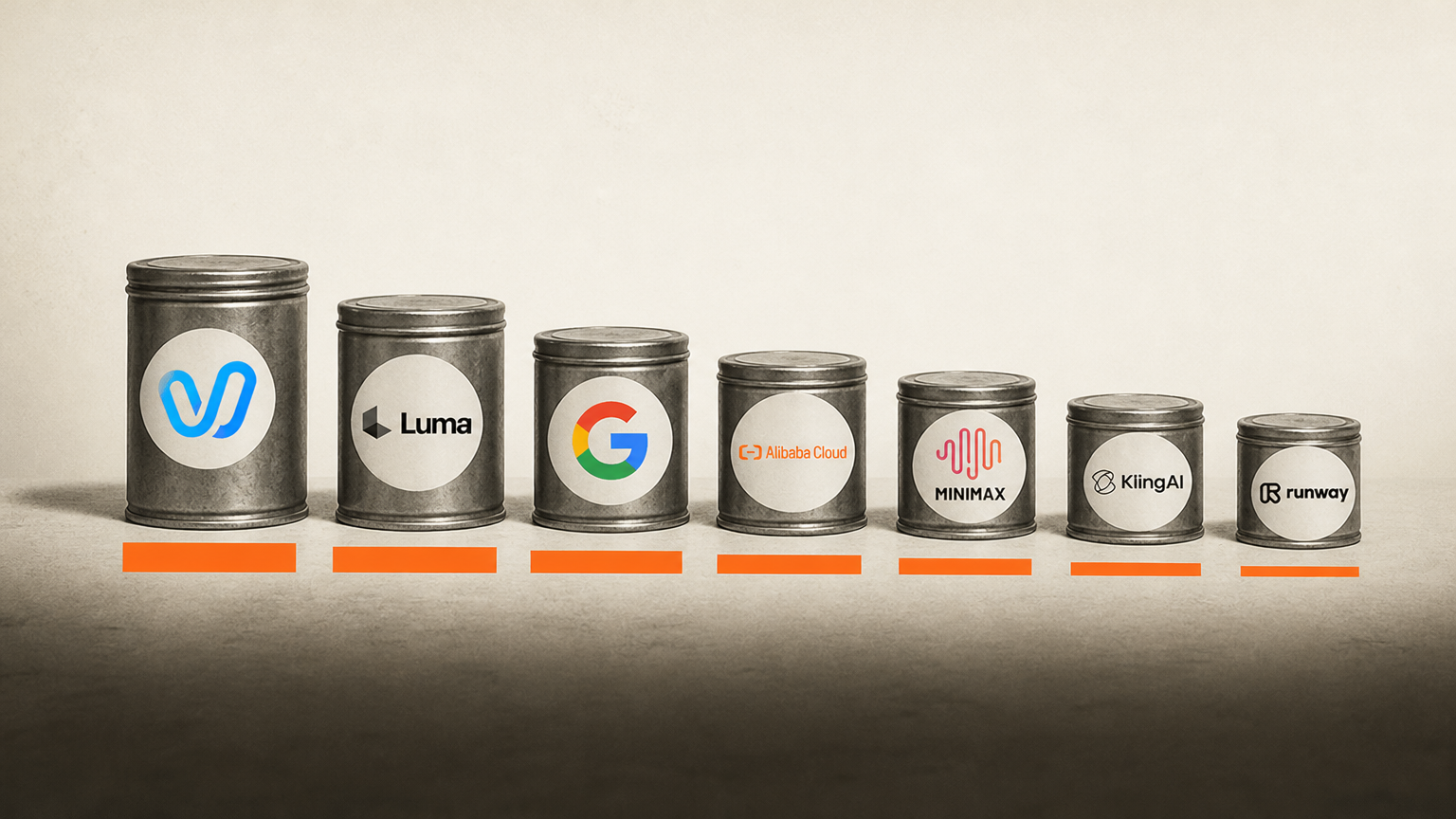
Vidu Q4 Preview leads at $0.014 a second on launch pricing, while Google's Veo 3.1 Lite, Alibaba's Wan 3.0 and MiniMax's H3-Max tie at five cents.
Key takeaways
- Shengshu Technology's Vidu Q4 Preview carries launch pricing from $0.014 a second, the lowest per-second rate among the eight video APIs priced here as of October 8, 2026.
- xAI's Grok Imagine video 1.5 Lite generates text-to-video at $0.02 a second in 480p, the cheapest rate with a plain dollar-per-second price on the maker's own page.
- Three models tie at five cents a second: Google's Veo 3.1 Lite at 720p with audio, and Alibaba's Wan 3.0 and MiniMax's H3-Max at 480P.
- Every vendor prices by resolution tier, so a per-second rate compares only within a named tier; Kling 3.0 runs $0.084 a second at 720p without native audio.
Vidu Q4 Preview arrived on October 7 with the lowest per-second price any flagship-tier video model has yet carried. Shengshu Technology's launch release puts Q4 Preview at pricing from $0.014 a second of generated video, with native audio, clips up to 16 seconds, and output from 540p through 4K. The release says the model is available now through Vidu's web product and API.
That figure tops this list, and it also warns you about the list. Every one of the eight APIs below prices by resolution tier, and no vendor sells a single flat rate. Vidu's own public API pricing page still shows Q3 rates, and a second Shengshu release from the same day, distributed through GlobeNewswire, quotes $0.045 a second at 540P against the $0.014 headline. Both are the company's own words, so the ranking uses the launch-promotional figure the company led with and treats the higher one as the realistic ceiling.
The criteria, stated plainly. The unit here is US dollars per second of generated video, text-to-video, with audio counted on where a maker charges separately for it. Each entry is priced at a named resolution tier, and a 480P rate is not the same product as a 720P one, so the list names the tier rather than pretending the cents are equal. Prices are as of October 8, 2026, read from each maker's own pricing or API page. Where a price ties, the entry that buys the higher resolution or the included audio ranks higher. No hands-on tests were run for this list; it weighs documented per-second price and the tier that price buys.
Eight models made the cut. ByteDance's Seedance 2.5 does not, because ByteDance bills it per million video tokens on Volcengine Ark and BytePlus ModelArk and publishes no per-second rate of its own, so there is no vendor number to rank. OpenAI's Sora 2 is absent too: a migration guide from the hosting platform WaveSpeedAI says OpenAI has removed the Sora 2 API from its platform. WaveSpeedAI's own per-second table is a useful lead, and each rate below traces to the maker's own page.
8. Gen-4.5 (Runway)
Runway's flagship text-to-video model sits at the top of this list on price because Runway publishes one rate rather than a matrix. Gen-4.5 costs 12 credits a second and Runway's developer API sells credits at a flat $0.01 each, so every generated second runs $0.12. That covers 720p output at 24 or 25fps and clips from 2 to 10 seconds.
No native audio is produced, so a soundtrack is a separate cost, and professional formats add more: a ProRes or PNG-sequence export costs five extra credits a second, and 10-bit or HDR profiles add 20 credits a second, rising to 40 above roughly 4K. That makes Gen-4.5 the priciest way to buy a silent 720p second here, and also the easiest to forecast. It suits a shop that wants one predictable rate and grades its own sound.
7. Kling 3.0 (Kuaishou)
Kling sells in units, and the company's own developer pricing page states the unit price, which is what lets Kling rank here at all. One unit is $0.14 at list, and Kling 3.0 without native audio bills 0.6 units a second at 720P, or $0.084. The 1080P rate is $0.112 a second, and 4K is $0.42.
The cheaper tier drops the thing Kling is known for. The same model with native audio and no voice control costs $0.126 a second at 720P, and the flagship Kling 3.0 Turbo with audio runs $0.112 at 720P and $0.14 at 1080P. Kling suits a creator who wants a Chinese-lab model with strong motion and will pick the audio setting to hold the bill down.
6. MiniMax H3-Max (MiniMax)
MiniMax splits its H3 line, and the cheaper half is H3-Max. MiniMax's pay-as-you-go page lists H3-Max at $0.05 a second at 480P and $0.08 at 768P, billed per second of output. The full H3 model costs more at the top, at $0.08 a second for 768P and $0.13 for 2K.
Audio is free on the H3 line, and the first two reference images are included before a per-image charge starts. H3-Max is the family's fastest tier, built for text-to-video and image-to-video with first- or last-frame control. It suits a high-volume shop that renders previews at 480P and only pays the 2K rate for a keeper.
5. Wan 3.0 (Alibaba)
Alibaba's Wan 3.0 is the cheapest route to a full 30-second generation in a single pass. Alibaba Cloud lists it at $0.05 a second at 480P, $0.10 at 720P and $0.20 at 1080P, billed per second of output, in the company's own release post.
At those rates a 30-second 1080P clip costs $6.00 and a 30-second 480P draft costs $1.50. Wan 3.0 reads text, images, audio, video, and, new in this version, documents such as PDF and PowerPoint. Alibaba's own notes flag audio texture and on-screen text as still improving. It suits a team that wants long drafts cheap and finishes at 1080P.
4. Veo 3.1 Lite (Google)
At five cents a second Veo 3.1 Lite buys the most of any entry at that price: 720p output with audio included. Google's Gemini API pricing page lists Lite at $0.05 a second at 720p and $0.08 at 1080p, with no 4K tier, and audio sits inside the price rather than on a switch. Google lists no free tier for any Veo 3.1 variant.
Lite generates 4-, 6- or 8-second clips at 24fps from text or a first-frame image. The tiers above it cost far more for their quality: Veo 3.1 Fast is $0.10 a second at 720p, and standard Veo 3.1 is $0.40. At the same five cents as Wan 3.0 and MiniMax H3-Max, Veo 3.1 Lite returns a higher tier, which is why it leads the tie.
3. Ray 3.2 (Luma AI)
Luma prices per clip rather than per second, and the arithmetic lands at three cents in the lowest tier. Luma's own API page lists a 5-second 540p text-to-video clip at $0.15, which is $0.03 a second. A 720p clip is $0.30 for five seconds, or $0.06 a second, and 1080p is $1.20, or $0.24 a second. A 10-second 540p clip costs $0.45, lifting the per-second rate to $0.045 on longer takes.
Ray 3.2 generates no audio, so budget a separate sound pass. It is the model here to reach for when camera motion has to obey the prompt: Multi-Keyframe takes up to 16 keyframes in one clip, and video-to-video runs to 20 seconds. It suits a product or spatial shot that has to hit an exact camera move.
2. Grok Imagine video 1.5 Lite (xAI)
xAI publishes plain dollar-per-second rates, and its lite video model is the cheapest of them. The xAI developer pricing page lists grok-imagine-video-1.5-lite at $0.02 a second at 480p, $0.03 at 720p and $0.14 at 1080p, for text-to-video and image-to-video.
The step up in the same family is cheap too. The full grok-imagine-video-1.5 is $0.08 a second at 480p, $0.14 at 720p and $0.25 at 1080p, and the older grok-imagine-video is $0.05 at 480p and $0.07 at 720p. The lite tier suits a creator pushing volume at low resolution, with a clear path up the same price list when a shot has to hold.
1. Vidu Q4 Preview (Shengshu Technology)
Vidu Q4 Preview takes first place on the launch price Shengshu put on its own release: from $0.014 a second, for a model with native audio, clips up to 16 seconds, and output from 540p to 4K. The preview is live now through Vidu's web product and API, the company says. It takes up to 15 reference images to hold a character, wardrobe and set, and up to three audio references to keep a voice consistent across shots.
That headline rate is promotional. The same release says final pricing and supported resolutions vary by plan and region, and a second Shengshu release from October 7 quotes $0.045 a second at 540P, rising to $0.39 at 4K. Vidu's public API page still shows Q3 rates, with credits priced at $0.005 each. At $0.014, and from a company that shipped a preview ahead of a full Q4 model, Q4 Preview is the cheapest documented flagship-tier second on the market today. It suits a creator who wants to block a scene at 540p and finish it at 4K without changing tools.
Sources
- prnewswire.com - Shengshu's launch release, Vidu Q4 Preview pricing from $0.014/sec
- finance.yahoo.com - the same day's Shengshu release giving $0.045/sec at 540P
- platform.vidu.com - Vidu API credit price, $0.005 per credit
- docs.x.ai - xAI Grok Imagine video per-second rates
- lumalabs.ai - Luma Ray 3.2 per-clip pricing
- ai.google.dev - Google Veo 3.1 per-second rates
- alibabacloud.com - Alibaba's Wan 3.0 per-second pricing
- platform.minimax.io - MiniMax H3 and H3-Max rates
- kling.ai - Kling 3.0 unit rates, 1 unit = $0.14
- docs.dev.runwayml.com - Runway API credits and the Gen-4.5 rate
- wavespeed.ai - third-party per-second table used as a lead