
FlashVSR+ runs untiled 4K video upscaling on one RTX 4090
The open-source model from Shanghai AI Lab skips the spatial tiling that leaves seams in 4K clips, reporting up to 2x DiT speedup and 45% lower peak memory.
Key takeaways
- FlashVSR+ enables spatially untiled 4K video super-resolution on a single 24GB RTX 4090, according to its GitHub repo and arXiv paper.
- Its Hybrid Attention design reports up to 2x faster DiT inference and 45% lower peak memory than dense attention, per the makers.
- Turbo, Base and V1 presets run through the same CLI and Python API, and the code, weights and training dataset ship under the Apache License 2.0.
- FlashVSR+, from Shanghai AI Lab and MMLAB CUHK, was posted to GitHub on October 14, 2026 and to arXiv on October 13, 2026.
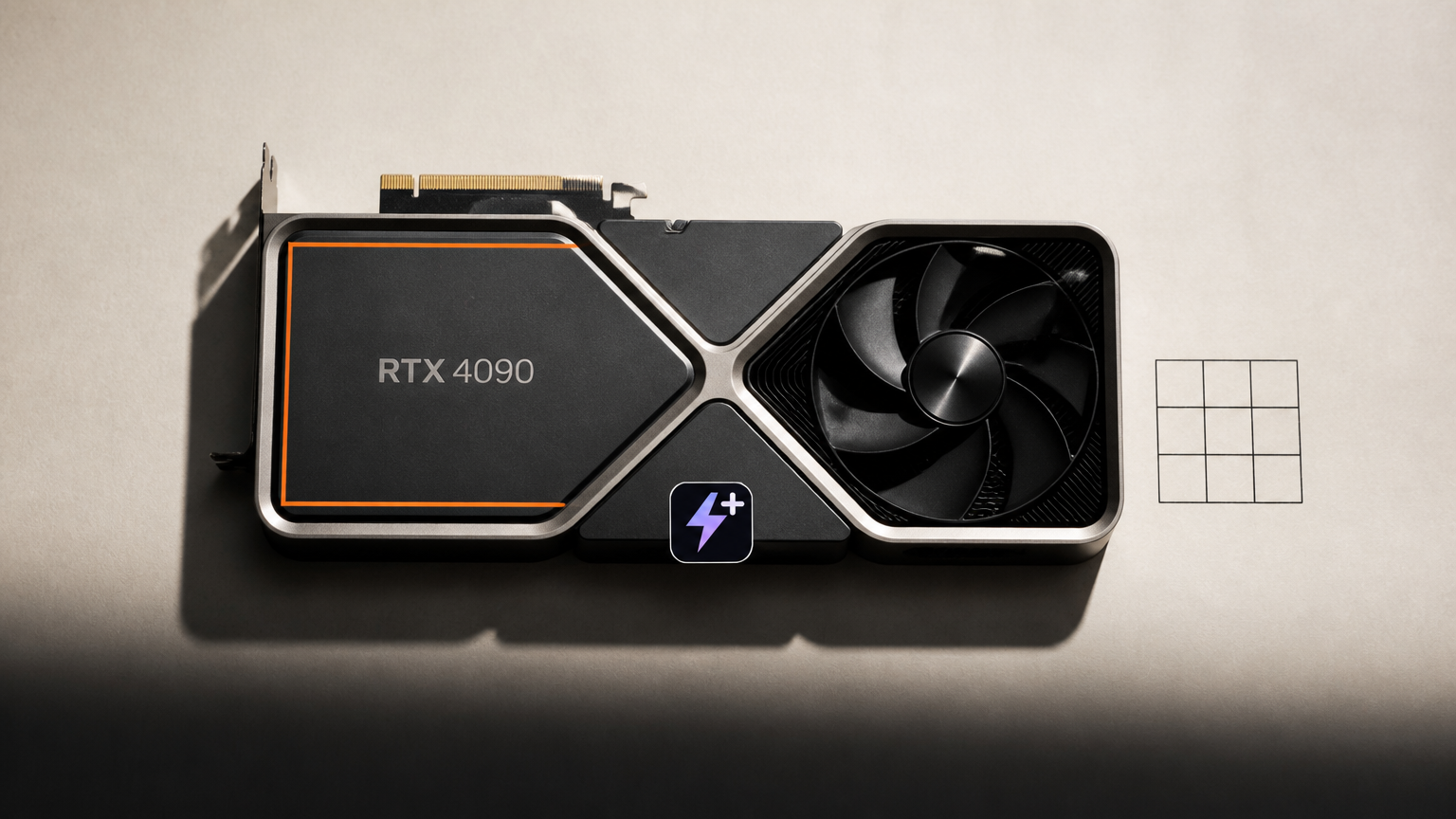
FlashVSR+ upscales video to 4K without chopping the frame into tiles, and its authors say the job fits on a single 24GB RTX 4090.
The model is an open-source video super-resolution framework from Shanghai AI Lab and MMLAB CUHK, posted to GitHub on October 14, 2026 and to arXiv the day before. For a creator taking an AI-generated 720p clip up to 4K, the part that matters is what FlashVSR+ skips: the spatial tiling most diffusion upscalers need on consumer cards, and the seams that tiling can leave behind.
What FlashVSR+ does
Video super-resolution rebuilds a high-resolution clip from a low-resolution one. A plain upscaler stretches pixels. A diffusion VSR model predicts the fine detail that was never captured, which is the difference between a soft 720p render and a 4K frame where hair, skin texture and small text hold up.
Creators hit this whenever a generator tops out below the deliverable. The FlashVSR+ paper states the tradeoff plainly: inference on consumer-grade GPUs (e.g., RTX 4090) often requires spatial tiling, which limits global context and may introduce boundary artifacts. Tiling cuts each frame into patches and upscales them separately. It fits the memory budget, and it means a face on the left of the frame gets rebuilt without any knowledge of what is on the right.
How Hybrid Attention makes untiled 4K possible
FlashVSR+ replaces most dense attention with local spatiotemporal attention and keeps a few periodic global blocks for long-range consistency. The design comes from what the authors found inside pretrained VSR models. The project page reports that about 1% of valid key blocks sit in the local neighborhood, and that those blocks take more than 20 times their proportional share of attention mass. Attention is local in practice, so computing it globally spends memory for little return.
The reported payoff is up to 2x faster DiT inference and 45% lower peak memory. The pipeline runs as a three-stage distillation: a 14B full-attention teacher, a 1.3B hybrid-attention student, then a one-step model.
What Ry-DMD adds
Reward-Yield Distribution Matching Distillation is the training-side change. It samples several teacher continuations from a noisy student state, scores them, and tilts the training target toward the higher-scoring samples. The reward model only has to return a number, so nothing is backpropagated through it.
The team tested the idea past video. On four-step SD3.5-M image generation, the project page reports OCR accuracy rising from 0.501 to 0.824 at the same sampling budget.
What you need to run FlashVSR+
Linux, an NVIDIA GPU with CUDA, and either Conda or a Python 3.10 virtual environment. The repo states the released inference pipeline is CUDA-only and does not support CPU inference, and that input height and width must both be divisible by 128.
Three presets run through the same CLI and Python API: Turbo, Base and V1. V1 uses the same inference configuration as Base with its own checkpoints. Attention runs on one of three backends. Block Sparse Attention from MIT HAN Lab is the repo's recommendation for A100, H100 and H200 cards. A bundled Triton operator is the one it recommends for the RTX 4090 and other consumer GPUs, and PyTorch SDPA is the fallback when neither is installed.
Two flags matter for real footage. Lowering --temporal-compression from the default 4 to 2 or 1 preserves motion detail in clips with large motion, at the cost of inference time. A numeric --decode-every reads and writes video in segments for long clips; the default auto mode loads the full input first.
What it costs
The code, the pretrained weights and the training dataset are free, under the Apache License 2.0, with weights on Hugging Face. The cost is the card. The untiled 4K claim assumes 24GB of VRAM, which is an RTX 4090 or better.
Where the numbers come from
The 2x and 45% figures appear in both the abstract and the repo README, which makes them the makers' own measurements rather than independent ones. The efficiency table on the project page reports 4K peak memory on what it calls an NVIDIA H200 equivalent GPU, not on a 4090: 26.33 GB for the Turbo preset, against 51.76 GB for SeedVR2, which the table notes falls back to tiled inference at 2K and 4K because full-frame inference runs out of memory. The RTX 4090 chart reports end-to-end wall-clock time instead, so the 24GB figure rests on the team's own testing.
This is also very new code. The repo was created on October 14, 2026 and lists no releases or tags. AI Weekly's alert on the release notes that the abstract publishes no PSNR or LPIPS figures against prior VSR baselines.
The ComfyUI question
If you would rather not touch a CLI, the wrappers that exist today run the earlier model. ComfyUI-FlashVSR_Ultra_Fast, by lihaoyun6, is a one-node upscaler for FlashVSR v1.1, and its listing carries the caveats that come with it: faces can lose detail or come out wrong at default settings, people with 16GB cards report out-of-memory errors in full mode at 4x scale, and the model is the wrong pick for a genuinely low-resolution source, where the listing says SeedVR2 has the edge. No ComfyUI node for FlashVSR+ has been announced.
How it compares
SeedVR2 is the closest name in the community's video-upscaler conversation, and it sits in the paper's own table. At 4K on the H200 equivalent GPU, the project page lists Turbo at 30.59 seconds and Base at 46.34 seconds, against 410.5 seconds for SeedVR2 and 374.7 seconds for DOVE. That is roughly 13 times faster than SeedVR2's tiled 4K pass, on the makers' numbers. SeedVR2 carries more parameters, 3.0B against FlashVSR+'s 1.3B, and the table flags it as tiled at the top resolutions.
What comes next
FlashVSR+ follows the group's earlier FlashVSR, a one-step streaming framework that runs at about 17 FPS for 768x1408 video on a single A100 and reports up to 12x speedup over prior one-step diffusion VSR models. That model's repo is tagged CVPR 2026, and it already has community ComfyUI wrappers and a hosted playground that advertises upscaling a low-resolution or blurry video up to 4K.
Whether FlashVSR+ inherits that ecosystem is the thing to watch. The repo ships the training dataset next to the weights, which is what lets other teams fine-tune the model rather than only run it.
FlashVSR+ is on GitHub under Apache 2.0, with weights on Hugging Face and a project page at flashvsr.tech; the CLI needs a CUDA GPU, Python 3.10, and inputs sized in multiples of 128.
Sources
- github.com - official repo: untiled 4K on a 24GB RTX 4090, Hybrid Attention and Ry-DMD claims, presets, requirements, Apache 2.0, creation date
- arxiv.org - paper abstract: 2x DiT speedup, 45% lower peak memory, submission date, affiliations
- flashvsr.tech - project page: efficiency table, attention locality figures, three-stage pipeline, Ry-DMD OCR result
- zhuang2002.github.io - earlier FlashVSR project page: 17 FPS on an A100, 12x speedup, VSR-120K dataset
- github.com - earlier FlashVSR repo: CVPR 2026 tag, arXiv 2510.12747, v1.1 weights
- comfy.icu - community ComfyUI node for FlashVSR v1.1 and its caveats
- aiweekly.co - third-party write-up on the release