
What Made on YouTube 2026 changes for AI video creators
From video A/B tests to swappable sponsor segments, YouTube is absorbing the production pipeline, and the creators it rewards are the ones who can generate and test variants.
Key takeaways
- YouTube will let creators test up to three cuts of the same video, feeding each to small audience segments and judging them on watch time; the creator can make the winner permanent, or YouTube does it automatically after seven days, per The Verge.
- Creators have run more than 40 million title and thumbnail A/B tests since 2024, and dynamic thumbnails will show different images to different segments of the audience.
- Shorts series bring seasons and episodes to the format after microdramas passed 6.5 billion views in the first half of 2026, with watch time up more than 50 percent year over year.
- YouTube Shopping tags drive more than twice the clicks of description links, and the affiliate program expands to 35 countries by the end of the year with Amazon in the mix.
YouTube used its Made on YouTube event on September 23 to announce a set of tools that mostly do the jobs creators were doing by hand: writing the hook, cutting the edit, testing the packaging and pitching the sponsor. For anyone making AI video, this is the main story: the platform is moving into the part of the workflow where AI video creators currently have their only real advantage, and it changes what is worth spending your time on.
The platform says more than 20 million videos are uploaded to it every day, and its own framing of the event is that its job is to stay a step ahead of how the world creates, discovers and connects. Read the announcements together and the pattern is clear: YouTube wants to own the loop from idea to payout, and it is happy to use AI to do it.
The headline change: your hook becomes a test variable
The biggest announcement is video A/B testing. YouTube has allowed title and thumbnail tests for years, and it says creators have run more than 40 million of those experiments since 2024. The new feature extends the same logic to the video itself: upload up to three cuts and let the system work out which one holds attention.
The mechanics, as reported rather than as announced: The Verge writes that the versions are fed to small audience segments to see which produces the highest watch time, and that a creator can promote the winner to become the permanent video, or YouTube will do it automatically after seven days. TechCrunch reports the feature starts in 2027 and covers three different cuts for Shorts. YouTube's own post is vaguer, saying only that creators will soon be able to test up to three video cuts to see which hook performs best. The gap between the blog and the reporting is worth noticing, because it is the difference between a small experiment and a permanent fork in how a video is published.
For an AI video creator this is the single most useful announcement of the day, and also the most demanding. Generating three versions of a hook is cheap when the hook is a generation rather than a shoot day. That is a real advantage over a traditional production, which has to pay for a second shoot to test a second opening. It also means the platform is now grading a skill that used to be invisible: whether you can write a first fifteen seconds worth testing.
The skepticism deserves stating plainly. Marques Brownlee posted on X on September 23 that "the more I think about it... the less I like it," and listed practical questions: do viewers know they are watching a test, how do you know which version a commenter watched, and do timestamps in a comment break for someone seeing the other version. Those are fair. The replies you get will describe a cut that may not exist a week later, and any chapter markers, pinned comment or sponsor read that references a timestamp is only correct for the version that wins.
Dynamic thumbnails end the single cover image
The second change is thumbnails, which stop being one picture. With dynamic thumbnails, a creator uploads up to three options and YouTube shows the one most likely to work for that particular viewer segment, rather than declaring a single global winner. Studio will also generate channel-matched thumbnails from the video itself, and Ask Studio can run in the background reviewing older videos to suggest and test refreshed thumbnails.
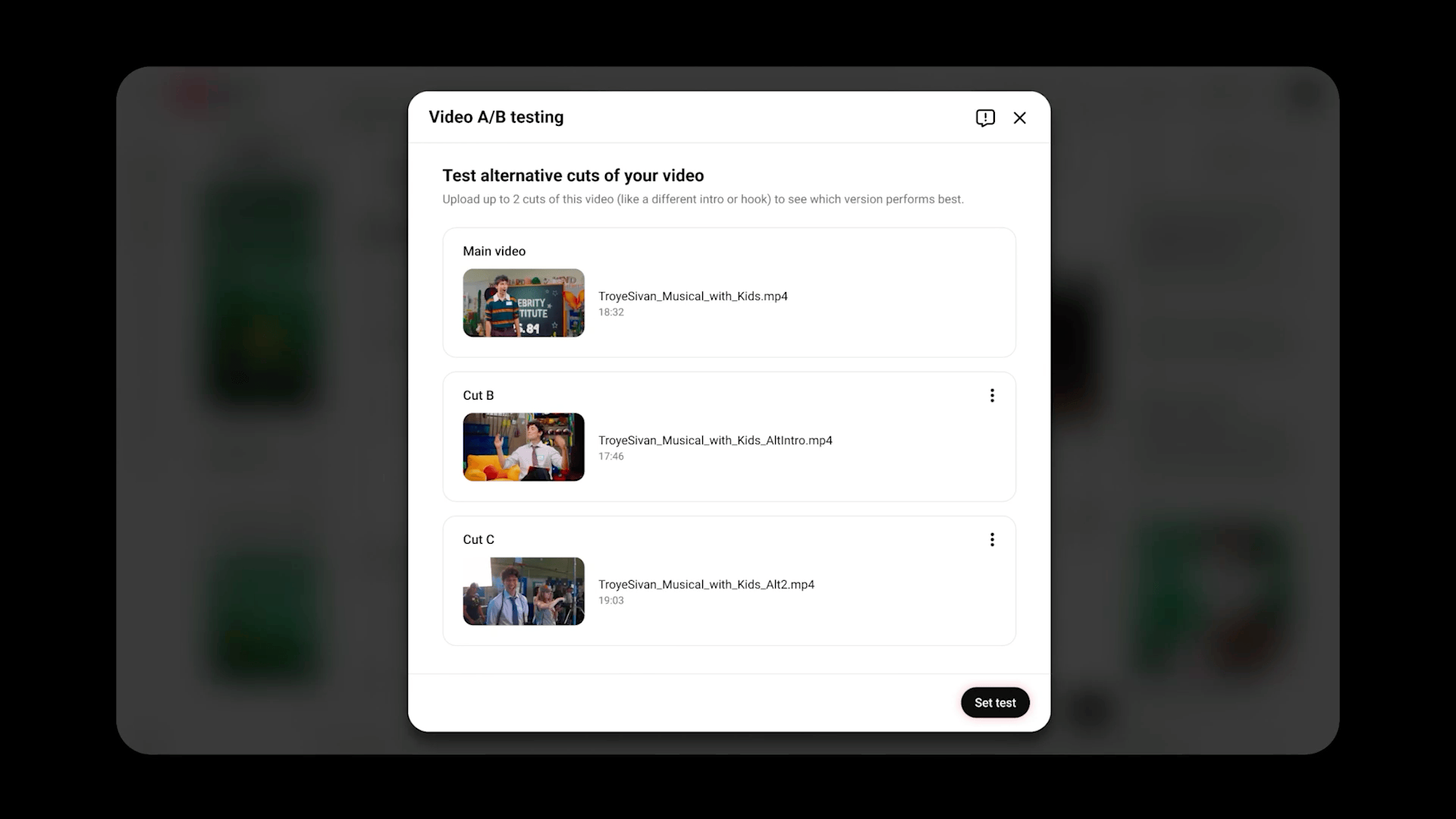
YouTube's own Video A/B testing panel: the main video plus up to two alternative cuts, like a different intro or hook, to see which version performs best. Image: YouTube.
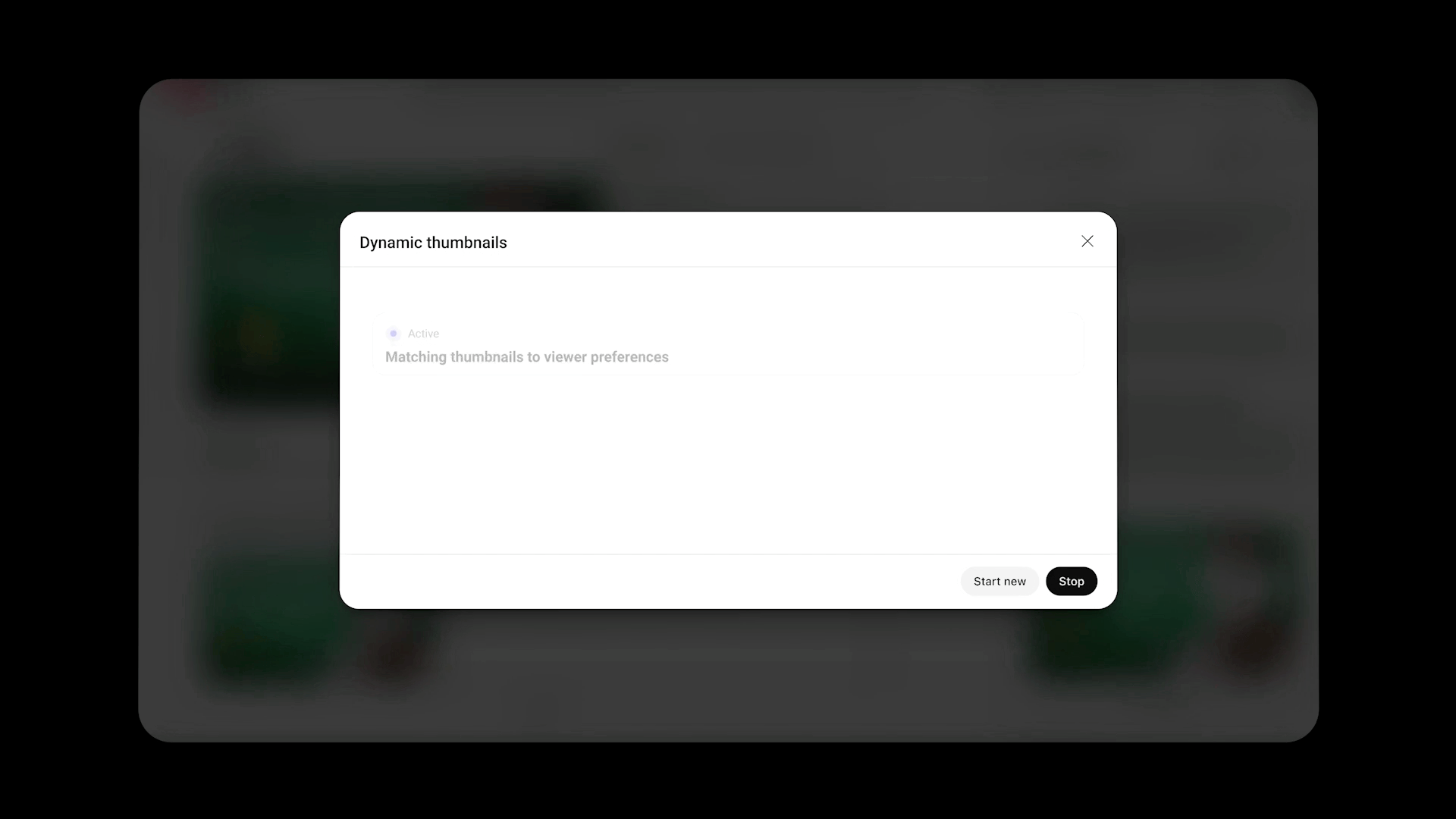
The dynamic thumbnails panel with a test active: "Matching thumbnails to viewer preferences." Image: YouTube.
For AI video creators this is the cheapest lever on the list. Image generation is the most mature part of the stack, so producing three strong candidates costs minutes, and the platform will now tell you which one earns its place. The catch is that the same capability makes a channel's packaging generic: if everyone generates thumbnails the same way from the same prompts, a genre of thumbnail emerges that viewers learn to scroll past. The differentiation moves back to what you show, not how well you rendered it.
Ask Studio stops being a chatbot and becomes a producer
Ask Studio was the through-line of the whole event. It now reads a draft, before publication, and gives advice on pacing, structure and storytelling, proposes titles and thumbnails, and explains why earlier videos performed the way they did. The Verge describes a background agent that watches a back catalogue, spots a video that has taken on new relevance, and suggests refreshing the thumbnail or title to catch the wave, and that will assemble brand pitches by pulling audience and demographic data out of the channel.
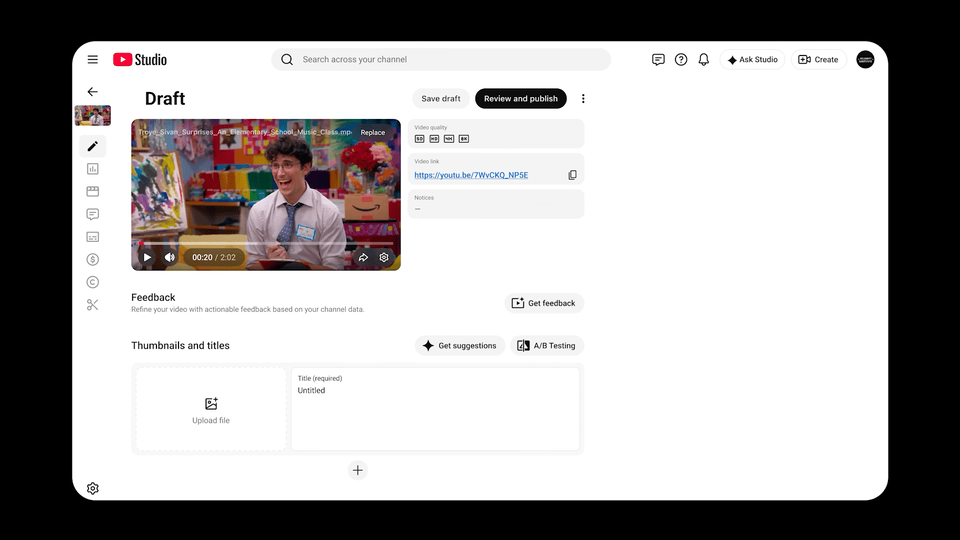
An unpublished draft in YouTube Studio, with a Get feedback button for "actionable feedback based on your channel data" and suggestions and A/B testing for thumbnails and titles. Image: YouTube.
Two consequences matter here. First, the earlier you can get a read on a cut, the less you need to be right the first time, which is a huge advantage for anyone making work where the material is generated rather than shot. Second, the tool is arguing from your own channel's history, which means it will tend to recommend more of what already worked. That is useful for a business and corrosive for a range. Nobody should let a dashboard pick the third act of a career.
Insights, Research, and the outlier as a strategy
YouTube Studio is getting new Insights and Research destinations: Insights to understand past video performance, Research to discover outlier videos that can spark the next piece of content. The Verge's read is the right one, that YouTube is increasingly simply telling creators what to do.
For AI video creators, outliers are a gift and a trap. They are the fastest way to find a subject the audience already wants, with the packaging that worked attached, and they are also how platforms produce sameness. The distinction that holds is between studying an outlier's subject and copying its execution.
Conversational editing moves the cut onto YouTube
YouTube is bringing a conversational editing assistant to Shorts and the YouTube Create app, built on Gemini. You start with suggested prompts or your own, and then keep talking: reorder frames, trim pauses, sync music to the beat, bounce to manual editing when you want it.
The platform's own numbers say this is not a niche: it says hundreds of thousands of channels a day used Gemini's Shorts and Create features in August 2026, and that 72 percent of US video posters aged 14 to 44 have used AI to help them create or edit in the past year. TechCrunch notes the obvious risk, that a single AI mistake can cost a creator credibility, which is why the accuracy bar matters more than the feature list.
Read this against the AI video tool market and the direction is plain. The tools that used to be separate products, the editing cut, the packaging frame, the thumbnail generator, are being folded into the platform that already owns the audience. What remains outside is the generation itself and the judgement about what to make.
Likeness detection, which matters most if you make synthetic people
YouTube is extending likeness detection to the mobile app so creators can enrol, get match alerts and act from a phone, and it says it will begin integrating speaking voice detection with facial detection later this year. YouTube says billions of channels are eligible to sign up for automated deepfake detection and control their visual likeness through the tool.
If you make AI video with synthetic presenters, cloned voices or digital humans, this is the announcement with teeth. The same detection systems that protect a creator's face are the systems that flag a channel built on them, and the direction is more matching, not less. Consent, credit and disclosure stop being ethical garnish and become operational requirements. Anyone building a synthetic persona should be able to document where the reference material came from before the platform asks.
Shopping, now with Amazon and auto-tagging
YouTube Shopping added Amazon in August for eligible US creators, and the event expanded the story: the affiliate program is going to 35 countries by the end of the year, product tags now localise automatically to the viewer's market, and the platform says tags drive more than twice the clicks of description links. Over 1.3 million creators are in the affiliate program, with gross merchandise value up 13 times over two years, and TechCrunch reports YouTube will auto-tag products with AI.
For AI video creators working in product content, this is the most direct monetisation on the list, and auto-tagging means the platform will do the affiliate plumbing. The caveat is attribution: if AI search answers a product question with clips from several creators, the tag and the commission go somewhere, and that somewhere is decided by systems you do not control.
Brand deals become a marketplace, and your archive becomes inventory
YouTube Creator Partnerships is live in 20 countries, with a one-click code letting a brand see a video's performance and put paid media behind it. Dynamic brand segments, still in testing, will let a creator insert a sponsor segment into up to 20 long-form videos at once, target it by region, and attach a shelf with a call-to-action button. YouTube says it is investing hundreds of millions in incentives for agencies that bring deals.
In October 2025, Digiday called the swappable sponsor segment potentially the most disruptive development in the creator economy for 2026, on the grounds that a video's sponsor is no longer burned in for the life of the video: the library becomes sellable inventory, the way a network sells ad time. For an AI video creator, this reframes the back catalogue. Volume that previously looked like a vanity metric becomes a rate card, and a channel with two hundred evergreen videos has two hundred slots.
Shorts series, and the format AI video is already winning
Shorts can now be organised into seasons and episodes with custom thumbnails and sequential playback, rolling out across web, mobile and TV. The numbers behind it are the most striking in the whole event: microdramas passed 6.5 billion views in the first half of 2026, watch time grew more than 50 percent year over year, and microdrama viewing on televisions grew more than 90 percent year over year. YouTube also says more than half of its top 100 creators have TV as their most-watched interface.
This is the format where AI video has already found a real audience, because episodic vertical drama is short, cheap to iterate and tolerant of a synthetic cast. The vexing part is that it is also the format most exposed to everything else in this list. If seasons, thumbnails, hooks and edits are all optimised by the same systems across the whole platform, the microdrama that wins is the one with a story worth staying for.
Live, dubbing and community
The rest, briefly, because each one touches AI production. Live showdowns let creators merge streams into head-to-head competitions, with viewer gifts driving the score. Real-time auto dubbing, piloted early next year, translates live speech as it happens, which is close kin to the dubbing workflows AI channels already use. Watch With expands to long-form video for live reactions. Posts, which more than 300 million users engage with daily, are coming to televisions and into the Shorts feed. AI comment moderation is being tested as an opt-in filter that learns your style.
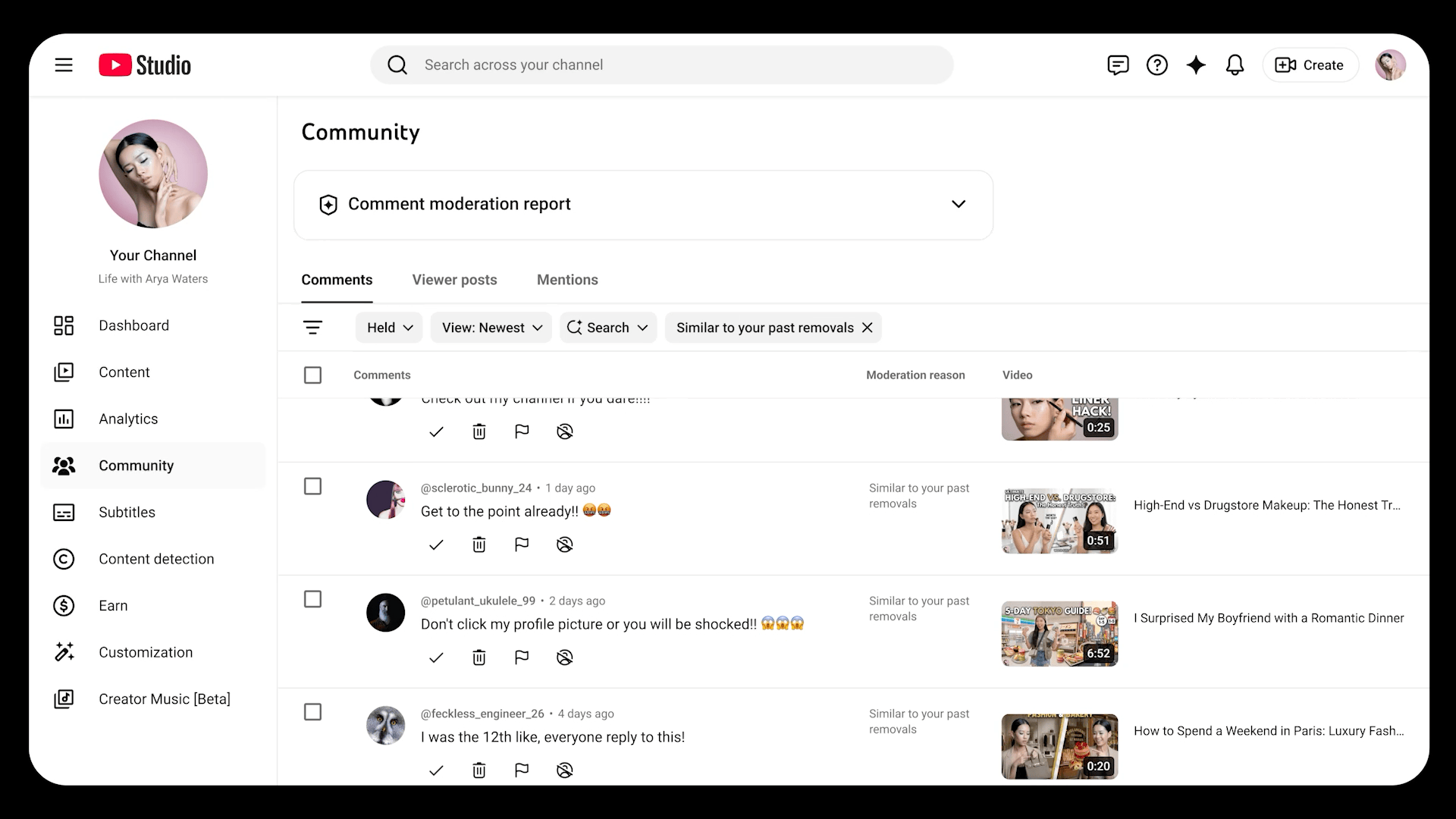
The comment moderation report in Studio, holding comments flagged as "Similar to your past removals." Image: YouTube.
What this adds up to for AI video creators
Four shifts, and they point the same way.
The platform is absorbing the packaging layer. Thumbnails, titles, hooks, edits and pitches are all becoming features of YouTube Studio rather than tasks you own. The differentiator that remains is the work itself: what you choose to make, and whether it is worth watching past the first fifteen seconds.
Variants beat single takes. Video testing, dynamic thumbnails and the background catalog agent all reward creators who can produce multiple versions cheaply. That is a structural advantage for anyone generating their footage, and it is only a real advantage if the versions differ in substance rather than in colour grade.
Compliance is now a production requirement. YouTube says billions of channels are eligible for deepfake detection, likeness detection is moving to phones, and voice matching is coming. Synthetic presenters and cloned voices need documented provenance, and a channel built on other people's faces is one alert away from a problem.
The archive is the asset. Affiliate tags, dynamic brand segments, catalog thumbnails and the outlier research tab all monetise and recycle older videos. For an AI creator, whose output is high volume and long-lived, that is the strongest argument in the event for keeping the library in good order rather than chasing only the next upload.
The tools are the easy part, and they just got easier. What is left is the part no feature ships: knowing what is worth making, and finishing it.
Release card
- Event: Made on YouTube, September 23, 2026
- Video A/B testing: up to three cuts, coming soon per YouTube; from 2027 for Shorts per TechCrunch
- Winner selection: creator's choice, or automatic after seven days, per The Verge
- Dynamic thumbnails: three options, assigned per audience segment
- Ask Studio: draft feedback on desktop now, mobile coming; background catalog review announced
- Insights and Research: renamed and reworked around outliers
- Conversational editing: Shorts and YouTube Create, built on Gemini
- Likeness detection: mobile app, with voice detection to follow later in the year
- Shopping: Amazon live in the US, affiliate program to 35 countries by year end
- Brand segments: in testing, up to 20 long-form videos at once, region targeting
- Shorts series: rolling out now on web, mobile and TV
- Sources: YouTube's own announcement posts, plus The Verge, TechCrunch, Digiday and Marques Brownlee's post on X
Run one test this week: pick your three best-performing old videos and set up a thumbnail A/B test on each, with the tool that has been in Studio since 2024.
Sources
- blog.youtube - the main announcement post, custom feeds, likeness detection, brand and shopping summary
- blog.youtube - Studio tools, Ask Studio, dynamic thumbnails, video A/B testing, conversational editing, comment moderation, likeness detection
- blog.youtube - Creator Partnerships, dynamic brand segments, affiliate numbers, 35-country expansion
- blog.youtube - Shorts series, microdrama view figures, posts engagement, TV share
- blog.youtube - Amazon joins the affiliate program for eligible US creators
- theverge.com - the background agent, the seven-day auto-winner, three versions fed to segments
- techcrunch.com - video testing from 2027 and for Shorts, AI product auto-tagging, live dubbing pilot, creator skepticism
- digiday.com - why swappable sponsor segments change how a video library is priced
- x.com - Marques Brownlee's September 23 post questioning video A/B testing