
Meta Connect 2026: every announcement and its AI video impact
The keynote adds a real-time avatar model that streams at 870 milliseconds, hologram calls on WhatsApp and a pair of VR glasses for $1,299.99.
Key takeaways
- Meta Superintelligence Labs says Muse Realtime Avatar streams 448x768 portrait video at 25 frames per second with about 870 milliseconds of latency, and holds 12 concurrent real-time sessions on one GB200.
- In Meta's own live comparison, raters preferred Muse Realtime Avatar over Runway Characters 78% to 22%, and over HeyGen LiveAvatar 88% to 12%.
- Ray-Ban Meta Audio, the first camera-free pair in the line, costs $349 and ships October 13, while Ray-Ban Meta Gen 3 with a 12MP camera and 3K video costs $449.
- Meta VR Glasses go on sale in spring 2027 for $1,299.99, and Meta's 8K Immersive Sports feeds with 180-degree views start with college football on Meta Quest this year.
Meta used its two-day Connect conference to push a personal AI agent into glasses, onto a Mac and, most interestingly for video, into a live call as a generated face. Muse Realtime Avatar is the piece that matters to anyone making AI video: it turns speech into an expressive, talking, moving avatar in real time, and Meta says it beats the two leading commercial avatar systems in its own tests.
The event ran September 23 and 24. Mark Zuckerberg's keynote covered a new audio-only pair of Ray-Ban glasses, a third generation of the flagship Ray-Ban Meta, a new device called Muse Charm, and Meta VR Glasses at $1,299.99. Here is every announcement, with what each one changes for video.
Muse Realtime Avatar puts a generated face in the call
Meta Superintelligence Labs introduced Muse Realtime Avatar, described in its research post as embodiment technology that turns Muse Realtime Voice into an interactive avatar. It is conditioned on reference media, so a portrait photo, a full-body illustration, even an animal can be brought into a conversation, and Meta says the avatar keeps its appearance and mannerisms coherent from one turn to the next.
The engineering is the story. Muse Realtime Avatar is an audio-driven diffusion transformer that generates video in short causal chunks, feeding the newest generated latents forward as motion context so the computation stays bounded and the generation can run as long as the conversation does. Meta distilled a heavy bidirectional teacher, 40 diffusion steps with three-way classifier-free guidance, which works out to 120 model evaluations per chunk, into a two-step student. That is a 60x reduction in neural function evaluations, and Meta's own chart puts human preference at 55% for the teacher and 45% for the student.
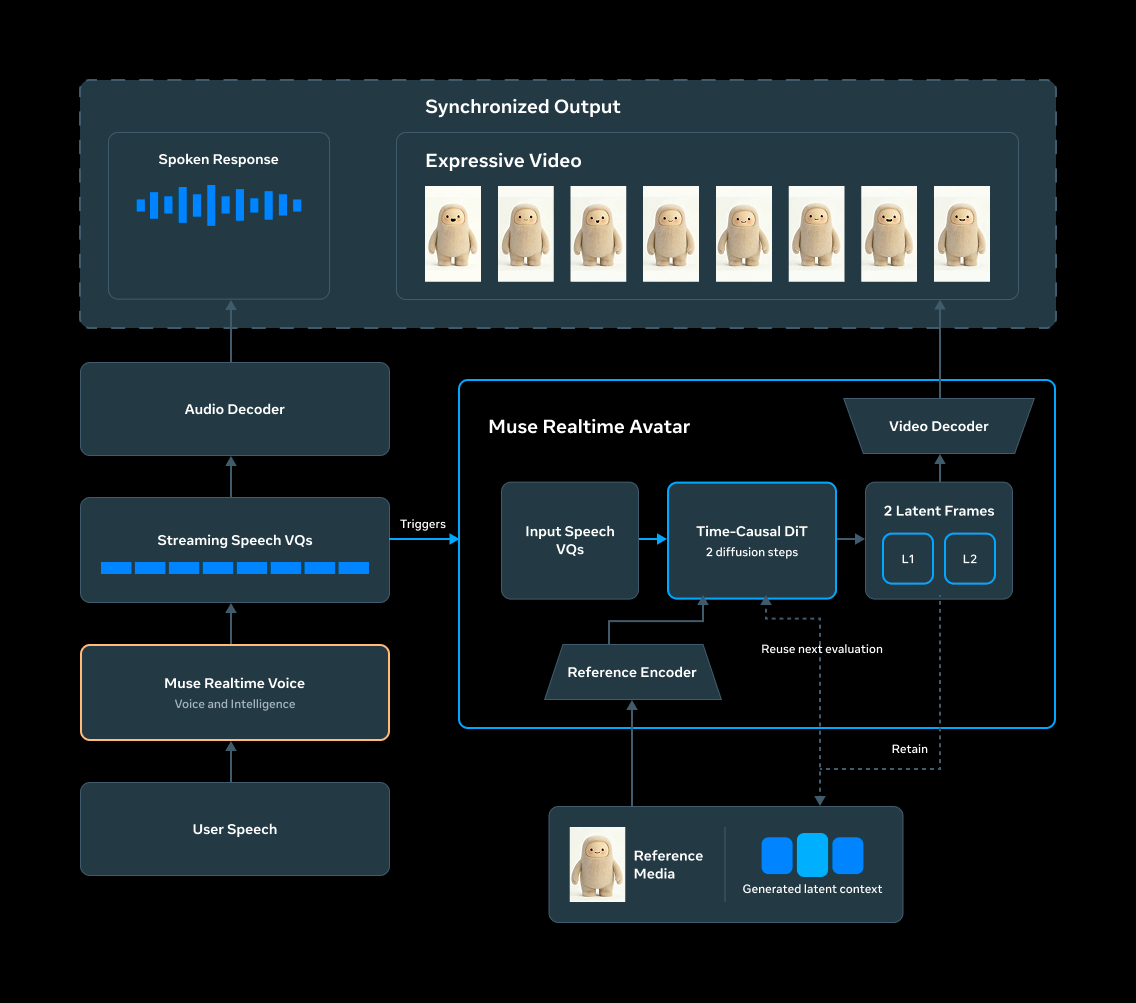
Meta runs its voice model and its avatar model off one speech-token stream, then feeds each generated latent frame forward as motion context so the avatar holds its look across a conversation. Image: Meta AI Research
The serving numbers are what make it a product rather than a demo. Muse Realtime Avatar streams 448x768 portrait video at 25 frames per second with about 870 milliseconds of latency, measured from the end of a user's turn to the first byte of the synchronized voice-and-video response. On a single GB200, one generation step produces eight frames, which is 320 milliseconds of playback, in 20 milliseconds, or 2.5 milliseconds of model time per frame. Meta says the optimizations, including four-bit quantization-aware training, fused kernels and cache-aware routing, raise serving capacity 8x over a two-step BF16 baseline, which is 12 concurrent real-time sessions on one GB200.
The comparison to the competition is Meta's own, and it is pointed. Raters held two to three minute conversations with each system using matched avatar identities, then compared visual quality, synchronization, character consistency and mannerisms. Meta reports that raters preferred Muse Realtime Avatar over Runway Characters 78% to 22%, and over HeyGen LiveAvatar 88% to 12%. Treat those as vendor numbers: the test was run by Meta, on Meta's chosen axes, and Runway and HeyGen have not published a reply. Generated video is watermarked with Meta Video Seal, which Meta says embeds a durable invisible mark without adding latency. Muse is for users 18 and over.
For creators, this is the category moving from novelty to default. Real-time avatars have been a paid tool that a creator chooses; Meta is making one a feature of a consumer agent that already topped the app charts. The bar for what an avatar call should look like just moved to sub-second latency at portrait resolution, and the watermark means Meta is betting platform-scale distribution needs provenance built in from the first frame.
Hologram generates your face into ordinary calls
Meta's second video announcement is the one normal people will meet first. Hologram takes a short self capture in the Meta AI app and builds a photorealistic digital version of your face for hands-free calls from Meta Ray-Ban Display. It is driven entirely by your voice, and the model infers your expression from what you are saying and how you are saying it.
On Meta Ray-Ban Display, Hologram starts in Early Access on WhatsApp for US users later this fall. On Meta VR Glasses it is wider: your hologram appears in front of the other person with spatial audio placing the voice where they are, it works with the calling app you already use, WhatsApp through Zoom, and people joining from a phone or computer see the hologram on their screen too.
That last detail is the one to think about. A generated face arriving inside a third-party call on hardware you did not buy from Meta is a new distribution surface for synthetic video. Meta has not said how a recipient knows the face was generated, and the announcement does not describe a disclosure. The same company's Oversight Board ruled on September 17 that a fabricated video of a Scottish councillor had to come down, and found Meta's rules on deepfakes inadequate to the volume of synthetic content it now faces.
Muse leaves the phone: glasses, email, and your Mac
Muse, the personal agent Meta launched earlier in September, is moving onto Meta's hardware and into your other software. Meta's announcement says Muse comes to the AI glasses in the coming months, activated by saying the agent's name, which gives it a vision-and-voice input channel at hardware scale.
Three more additions matter for people who cut video. Muse gets its own email address, so tasks can be sent to it and answered from the same place. Muse for Mac gains computer use, which lets the agent drive any app on the machine with your permission, so it can keep working on queued tasks while you walk away. Connectors expand to Walmart, Best Buy, American Eagle Outfitters, DICK'S Sporting Goods, Fanatics, Gap, Michael Kors, Sephora, Ulta and Wayfair, with Shop Pay and PayPal for payments, Expedia and Instacart coming, and Notion, Granola, GitHub and Box for work.
An agent that can operate a desktop with permission is the same capability that every AI video tool has been racing toward, because editing means clicking through a timeline. Meta is not shipping a video editor here, and nothing in the announcement says Muse can cut footage. What it ships is the permission model and the habit, and that is the part that decides whether creators let an agent near their projects.
Muse Charm is a pocket device for the agent
Zuckerberg closed with hardware nobody expected: Muse Charm, a palm-sized device with what 9to5Mac describes as a roughly two-inch OLED touchscreen, a customizable Muse character at the center, front and rear cameras, speakers, microphones, 5G and USB-C. 9to5Mac notes the cameras can capture photos and videos, but Bloomberg reports they are there mainly to give Muse visual context rather than to shoot like a phone's, and that the Charm came out of Meta's new design lab led by former Apple interface chief Alan Dye.
Meta says the Charm goes on sale in December, with more details later this year, and has not announced a price; Bloomberg reports it is expected to cost roughly what a smartwatch does. Two Charms placed near each other can recognize and interact with each other.
Charm is a bet that real-time voice plus a camera is a device category, and the character customization is the interesting clue for video. A device built around a customizable agent character is one software update away from rendering that character as an avatar. Meta shipped the model for exactly that on the same day.
The glasses line grows, and one pair has no camera
Meta's eyewear expansion is the widest it has announced. Ray-Ban Meta Audio is the first audio-only model, camera-free, 43 grams, 12 hours of battery with up to 48 more from the case, in 23 color and lens combinations across the Clubmaster and Burbank frames. It costs $349 and ships October 13.
Ray-Ban Meta Gen 3 keeps the camera: 12MP stills, 3K video, a 6-mic array that Meta says cuts more than 90% of background noise, nine hours of battery and a customizable action button, across 27 combinations of the Aviator, Zena and Wayfarer frames, from $449. Meta Glasses adds Capri and Nova shapes, an Ivory colorway with Kylie Jenner at $399, a LISA collection from $399, and the $249 Meta Adventurer, its cheapest pair, with pre-orders open and on sale October 23. Meta says more than 100 glasses options will exist by the end of the year, and the line reaches Singapore, South Korea and Mexico now, with Brazil and the UAE next.
The camera-free model is Meta's answer to the privacy fight over people recording strangers, and it splits the line in two: the cheap, light, all-day pair cannot feed video, and capture stays a premium feature. Meta AI glasses also become the first consumer devices that capture video in Dolby Atmos with 360-degree spatial sound, which Meta says arrives later this year. For anyone generating or editing video, the input layer just got better audio at the exact moment the distribution layer, an agent that watches what you watch, got louder.
Meta VR Glasses: a cinema in 100 grams for $1,299.99
The headline hardware was Meta VR Glasses, a two-part system that puts sensors and displays in eyewear weighing about 100 grams and compute, battery and storage in a pocket puck. The Verge, which tried them, notes that is far lighter than the 515-gram Quest 3. They run a 5K Infinite Display built on micro-OLED panels at 37 pixels per degree, with Dolby Vision and Dolby Atmos spatial audio in the frames, and they are the first IMAX Enhanced certified VR device. Qualcomm's Snapdragon Reality Elite powers them. The puck gives up to three hours of media playback and takes 45W charging.
Content is where this becomes a video story. Immersive Sports with ESPN delivers 8K streaming with 180-degree views, starting with college football this year on Meta Quest, and Meta plans more than 100 immersive live sports events a year through MLB, NBC Sports, TNT Sports and UFC. Disney+ subscribers in select countries get 3D titles from November, with VR Enhanced versions of films like Avengers: Infinity War and Star Wars: A New Hope in the Disney Immersive Cinema by ILM app, and Meta is working with James Cameron and Lightstorm Vision on first-time-in-3D blockbusters in 2027. Meta says hundreds of movies will be rentable or buyable in the US later this year, with thousands of titles internationally at launch. VR Glasses cost $1,299.99 and arrive in spring 2027.
A device that makes 3D and 180-degree footage mainstream creates a second deliverable next to the flat 16:9 cut, and an 8K 180-degree sports feed is a workflow problem that creators will be asked to solve before they are asked to make it. Cameron's involvement is the tell that the format is being taken seriously by people who control the content.
Everything else from the keynote
The rest of the announcement list, in one place. Meta Ray-Ban Display can now be ordered online in the US for $799 and expands to the UK, Canada, France, Italy and Germany, with cycling and transit directions later this month in the US and Canada, walking directions that name landmarks instead of street names, a new Explore app on the glasses, a fuller calendar, mirrored phone notifications, Threads community feeds and photo editing on the display. Hearing enhancement, an FDA-cleared software feature for adults 18 and over with perceived mild to moderate hearing loss, comes to supported glasses in the US later this year for $149.99 or with a Meta One subscription. Meta AI glasses add guided running and cycling workouts, nutrition tracking with personalized insights, and a shopping assistant that identifies products, prices and reviews. On the entertainment side, Beat Saber gets its biggest update ever next spring with a new Flux mode and 35 songs, Supernatural returns this fall, and the VR slate adds Payday: Aces High, Tetris Effect: Mixed Realities, Two Point Hospital, Dragon Grove, Cardmada, Dice Throne Digital and a VR debut for Phoenix Wright: Ace Attorney, plus a Draymond Green docuseries called Open Season on September 29.
What Connect 2026 means for AI video
Three things changed for creators this week. Real-time avatar video is now a platform feature, not a paid add-on: Meta is shipping sub-second latency at 448x768 inside an app that 9to5Mac reported had risen to the top of the US App Store and Google Play within days of launch, and it is publishing benchmark numbers against the two companies that sell avatar calls for a living. That puts Runway Characters and HeyGen LiveAvatar in a comparison they did not choose.
Second, generation is being metered. Meta One, launched September 15, puts higher volumes of Muse image and video generation behind paid bundles that start at $7.99 a month, within a Meta One range that runs from $2.99 to $499, and the Connect features sit on top of that ladder. Meta still has not published the numeric caps. If you build a workflow on Muse video generation, you are building on an allowance that can change by country and surface without notice.
Third, the loop closed. Meta now owns capture, glasses with 12MP cameras and Dolby Atmos sound; distribution, glasses, VR, Instagram and WhatsApp; generation, Muse image and video models; the meter, Meta One; and provenance, Video Seal on generated avatar video. Few companies have ever held every step of a video pipeline at once, and the only piece Meta deliberately kept out this week was the camera on its cheapest pair.
Muse is a free app for iPhone and Android, and the new avatar conversations are inside it. Ray-Ban Meta Audio pre-orders start at $349 and ship October 13, Ray-Ban Meta Gen 3 is on sale now from $449, and Meta VR Glasses arrive in spring 2027 for $1,299.99.
Sources
- meta.com - Meta's full announcement list, Muse features, Charm, glasses lineup, VR Glasses, Beat Saber
- research.meta.ai - Muse Realtime Avatar architecture, distillation, latency, concurrency, evaluation, Video Seal
- about.fb.com - hologram calls, navigation, Explore, Dolby Atmos capture, markets
- about.fb.com - VR Glasses specs, price, date, IMAX Enhanced, immersive sports, film partners
- about.fb.com - Ray-Ban Meta Audio price and date, Gen 3, Meta Glasses styles, markets
- engadget.com - $799 Display ordering, game list, movie and sports details
- theverge.com - Muse Charm hardware description, VR Glasses hands-on weight comparison
- 9to5mac.com - Charm specs and December sale, Audio availability date, Muse app chart position
- aichatdaily.com - Muse downloads outpacing ChatGPT in its first 12 days
- ai.meta.com - Muse Image and Muse Video, the video model behind the generation features
- sloptvnews.com - Meta One tiers that meter Muse image and video generation
- bloomberg.com - Bloomberg on the Charm's design lab and its camera use (paywalled; read via its own takeaway line and Business Insider's account of it)
- theverge.com - The Verge hands-on: 100g against the Quest 3's 515g