
Nvidia's $4,999 DGX Spark runs some AI video models, not all
NVIDIA's six OEM partners start selling the 64GB box on October 23, and two units linked by a QSFP cable pool to 128GB for models up to 200 billion parameters.
Key takeaways
- NVIDIA's 64GB DGX Spark went on sale on October 23, 2026, from Acer, ASUS, Dell, Gigabyte, HP and MSI, starting at $4,999, per NVIDIA's own announcement.
- The 64GB configuration keeps the GB10 Grace Blackwell Superchip and DGX OS and runs models up to 100 billion parameters; two units linked by a QSFP cable pool to 128GB and up to 200 billion parameters.
- LTX-2.5 ships open weights at 22 billion parameters with a listed minimum of 16GB of VRAM, while the maker of Wan 2.2 documents at least 80GB of VRAM for its 14B single-GPU command.
- The MiniMax H3 Community License excludes the United States, the United Kingdom, the European Union and South Korea from its applicable territory.
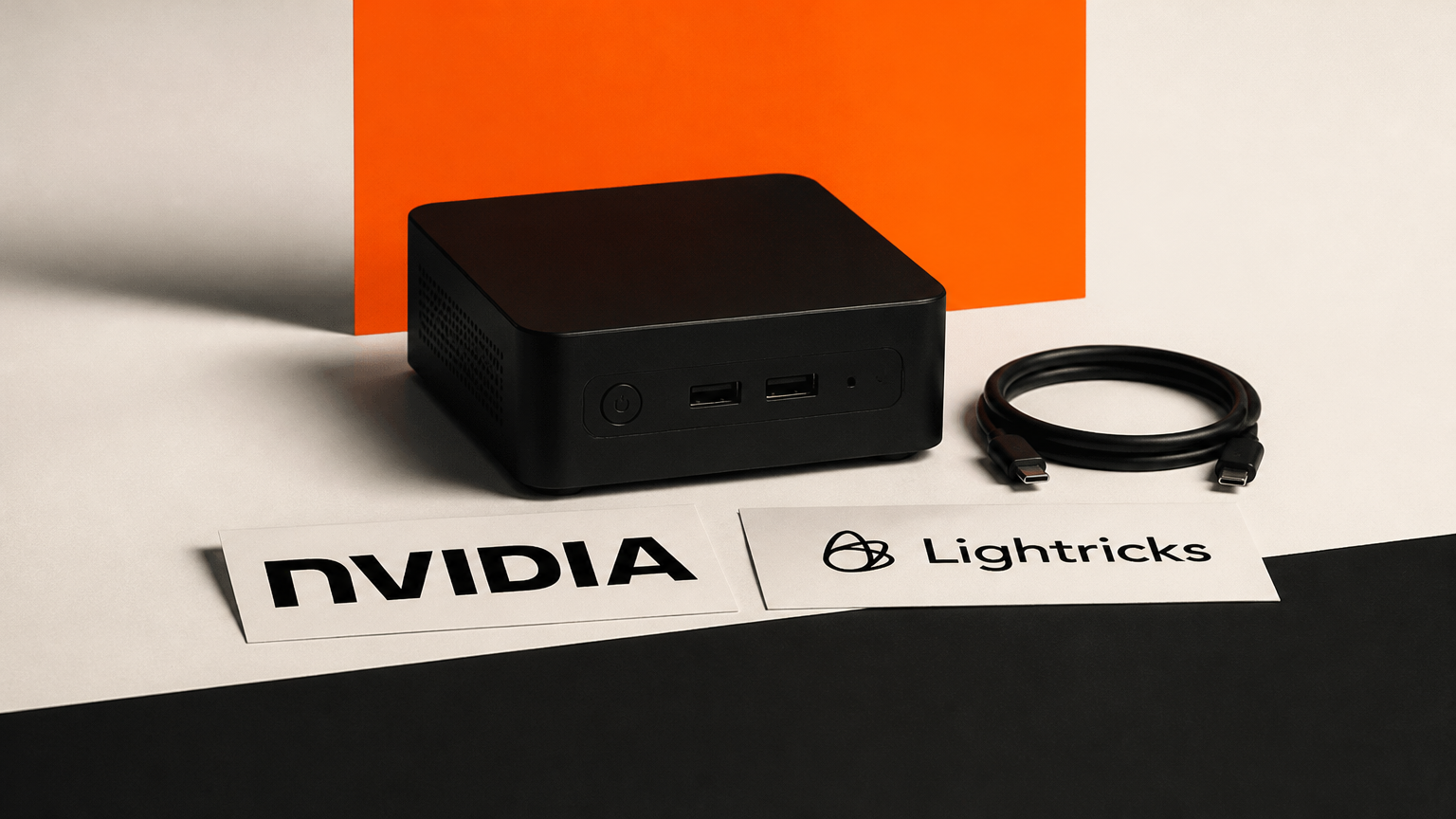
The 64GB NVIDIA DGX Spark went on sale on Friday, October 23, 2026, from Acer, ASUS, Dell, Gigabyte, HP and MSI, starting at $4,999, NVIDIA said. For a video creator weighing a local box, the useful question is narrower than the launch copy: which open-weight video models actually fit in 64GB of unified memory.
What the 64GB DGX Spark actually is
The 64GB configuration keeps the GB10 Grace Blackwell Superchip, DGX OS and the NVIDIA AI software stack from the 128GB model, and NVIDIA says it runs models up to 100 billion parameters. Two units connected by a QSFP cable pool their memory to 128GB and up to 200 billion parameters, with twice the memory bandwidth and up to 1.7x the performance of a single unit in NVIDIA's Qwen 3.8 27B test.
The product page lists 64GB of LPDDR5X unified memory, 273 GB/s of bandwidth, up to 1 petaFLOP of FP4 compute and ConnectX-7 networking at 200 Gbps, with up to four systems clustering. The 64GB box is sold only through the OEM partners. The 128GB model's price rose to $6,950, The Register reported on October 2, 2026.
Which open video models fit
Wan 2.2 (Alibaba). Wan 2.2's weights sit on Hugging Face under Apache 2.0. The A14B text-to-video model is a mixture-of-experts build with two experts of about 14 billion parameters each, 27 billion total and 14 billion active per step. The model card's single-GPU command notes it can run on a GPU with at least 80GB of VRAM, more than the Spark offers. The smaller TI2V-5B model is the desktop option: the same page says it generates 720p at 24 fps and runs on consumer cards such as an RTX 4090, producing a 5-second 720p clip in under nine minutes on one consumer GPU.
LTX-2.5 (Lightricks). LTX-2.5 fits most comfortably. Its model page lists a 16GB minimum VRAM, native 4K HDR and RAW support, and a license that is free under $10 million in annual revenue with no mandatory branding. The weights ship as a 22 billion-parameter transformer plus a Gemma 4 12B text encoder, with documented low-VRAM flags for offloading to the CPU.
MiniMax H3-Base. MiniMax open-sourced H3 in early August 2026. Its release post says the open part is H3-Base, a 33 billion-parameter dense transformer, and that two modules, H3-Context-IR and H3-Regenerate-2K, are left out, so the 2K path runs through MiniMax's API. The local serving example uses four GPUs. The larger obstacle for a US buyer is the license: the MiniMax H3 Community License defines the applicable territory as worldwide excluding the European Union, the United Kingdom, the Republic of Korea and the United States.
Matrix-Game 4.0 (Skywork AI). Matrix-Game 4.0 is Apache-2.0 and built on Wan 2.2's 5B model, according to its Hugging Face model card. Its technical report reports 480p gameplay at 60 fps on a single RTX 5090, with 112 ms from a key press to the first reacting frame and about 18.2 GiB of peak memory at one denoising step, a figure well inside the Spark's 64GB.
What it means for a local video workflow
The 64GB Spark's practical ceiling is memory and licensing, not compute. The 5B to 22B tier, LTX-2.5, Wan 2.2's TI2V-5B and Matrix-Game 4.0, fits one unit. Wan 2.2's 14B path and MiniMax's H3-Base system are where a single box runs out, and H3-Base is barred to US users by its license regardless of hardware. Clustering two units doubles memory to 128GB and lifts NVIDIA's stated parameter ceiling to 200 billion, which is the upgrade path when a project outgrows one box.
One 64GB Spark covers the 22B-and-under tier; anything at Wan 2.2's 14B scale or larger needs the 128GB cluster, and MiniMax H3-Base is off the table for US deployments under its current license.
Sources
- blogs.nvidia.com - NVIDIA's own post: October 23 availability, the six OEM partners, $4,999, the 100B and 200B parameter claims and the 1.7x Qwen 3.8 27B test
- nvidia.com - DGX Spark product page: 64GB and 128GB memory options, 273 GB/s bandwidth, 1 PFLOP FP4, ConnectX-7 at 200 Gbps, four-system clustering
- theregister.com - The Register: the 128GB model's rise to $6,950 and the unchanged 273 GB/s bandwidth
- huggingface.co - Wan 2.2 model card: Apache 2.0, the MoE parameter counts, the 80GB VRAM single-GPU note and TI2V-5B at 720p/24fps on a 4090
- ltx.io - LTX-2.5 model page: open weights, 16GB minimum VRAM, native 4K HDR, free under $10M annual revenue
- huggingface.co - LTX-2.5 weights: the 22B transformer, Gemma 4 12B encoder and low-VRAM offload flags
- minimax.io - MiniMax release post: H3-Base as a 33B dense transformer, the modules left out of the release and the four-GPU serving example
- huggingface.co - MiniMax H3 Community License: the excluded territories
- github.com - Matrix-Game 4.0 README: Apache-2.0 and the RTX 5090, 5080 and 5070 Ti single-GPU inference paths
- huggingface.co - Matrix-Game 4.0 model card: base model alibaba-pai/Wan2.2-Fun-5B-Control and the shared Wan2.2 VAE
- matrix-game-v4-0.github.io - Matrix-Game 4.0 technical report: 480p at 60 fps on one RTX 5090, 112 ms latency and 18.2 GiB peak memory