
Patch gives AI agents 16 Blenders at once, and a spaceship took 45 seconds
A creator built a 9,952-piece spaceship from one Python script, baked its lighting in a second Blender session, rendered it on four cloud GPUs and dropped it into his game — for about a penny. Patch, Voyager and Sceneplane are racing to be the render farm that agents hire.
Key takeaways
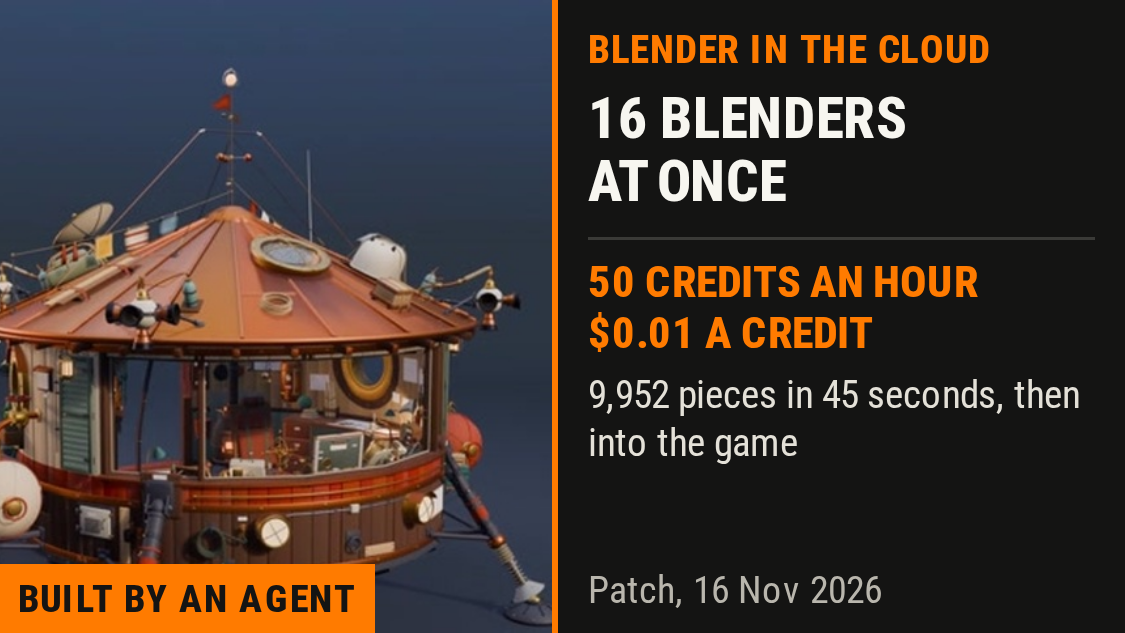
- Patch launched cloud Blender on 16 November 2026: real Blender sessions and GPU renders that a coding agent can spawn, up to 16 at a time, from 50 credits an hour at $0.01 a credit with 500 starter credits.
- A creator's demo the next day built a 9,952-piece, 399,322-face spaceship from one Python script in 45 seconds, using two Blender sessions at once and four cloud GPUs, and put it in his game.
- The cost claim in the demo — about $0.01 — is the creator's own; Patch's published rate is $0.01 a credit, from 50 credits an hour.
- A separate comparison of agent-facing Blender services, published in October, lists five kinds of option: hosted farms with an MCP server, your own worker on a GPU cloud, and a local Blender MCP on your own machine.
- Patch says it is not part of the Blender Foundation; Blender is the Foundation's trademark, and Patch's own platform carries 50,000 open-source, game-ready assets.
An agent built a spaceship this week and the receipt is the interesting part. One Python script, 45 seconds, two Blender sessions running at once — one building the ship, one baking the lighting — and four cloud GPUs rendering the result, all of it for what the creator says came to about a penny. The finished craft is a round wooden thing with legs, a domed roof and a radar dish, and the counter in the corner of his video climbs from 1,056 pieces to 9,952 pieces and 399,322 faces as it goes up. Then he puts it in his game.
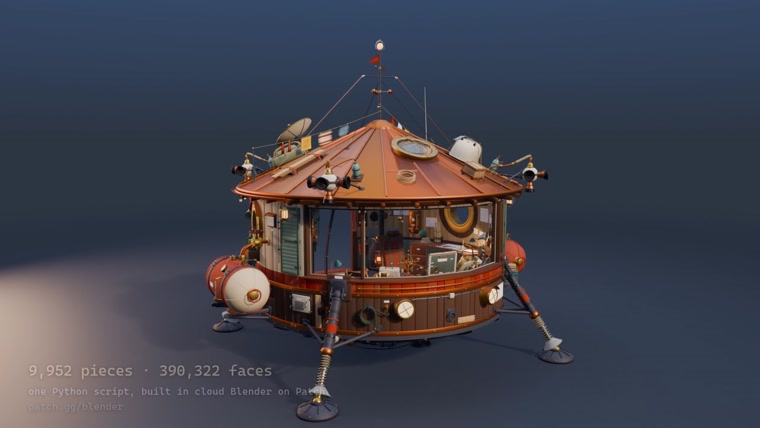
@BlendiByl, 17 Nov 2026, 0:08. Source: https://x.com/BlendiByl/status/2122707673598837031.
The video is @BlendiByl's, posted on 17 November, 63,323 views, 1,182 likes and 1,439 bookmarks — that last number being the tell, because people bookmark the things they intend to do rather than the things they intend to argue about. It quotes Patch's launch of cloud Blender the day before: "real Blender sessions and GPU renders it runs by itself, 16 at once! Now your agents can spawn as many blender instances as they want, and they wont hog your local computer resources." That post has 103,854 views.
What Patch actually shipped
Cloud Blender is a hosted Blender that an agent drives. Real sessions, not a pretend viewer, with GPU rendering attached and a hard ceiling of sixteen running at once. The pricing on the page is plain: from 50 credits an hour, 500 starter credits, $0.01 a credit. The page's example is a batch — one script run over a whole folder, giving every character three levels of detail, sixty-four characters in a batch.
The launch video says the quiet part in a terminal window. The prompt on screen reads:
make 64 characters for my game, one per session. animate them. render the best.
and under it, a panel: 16 sessions running, with a table of sessions and their states.
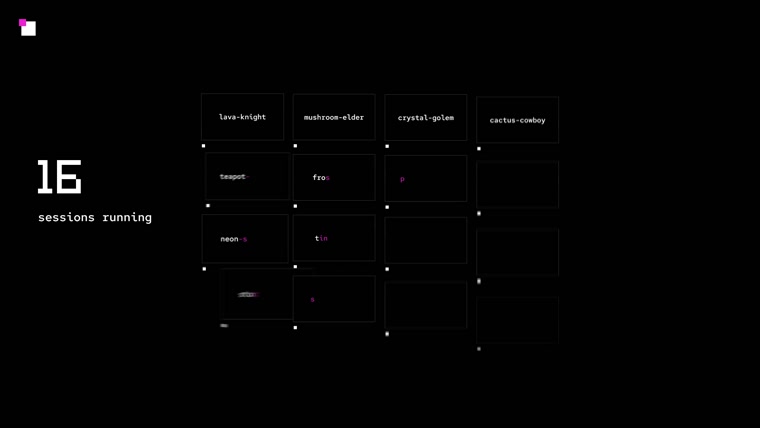
@patch_gg, 16 Nov 2026, 0:09. Source: https://x.com/patch_gg/status/2122463639009702343.
This is the shape of the thing. Not one model making one object, but an agent fanning a job out across a fleet, then choosing the winner.
Patch itself is a platform for games and mods — a Windows desktop app plus browser games, 50,000 open-source game-ready assets with licenses and credit lines attached, and a CLI and MCP server that plug into whatever coding agent you already use. Its documentation is written for agents as much as people: the whole site is available as a single Markdown file, and the API as OpenAPI 3.1. One honest footnote sits at the bottom of the Blender page — "Blender is a trademark of the Blender Foundation. patch isn't part of it." The ecosystem is unofficial, and everyone is being polite about it.
The demo, in its own numbers
Blendi's method, as he describes it, is worth repeating because it is not a single clever call. Two Blender sessions run in parallel: one assembles the geometry, the other bakes the lighting so the first does not have to wait. Four cloud GPUs render the build simultaneously. The result is a ship with an interior — a wooden cabin with a desk, instruments, a screen, and a pilot's view out through a window onto a green radar display and a sunset.
Then it goes into his game, which is the only step that matters.
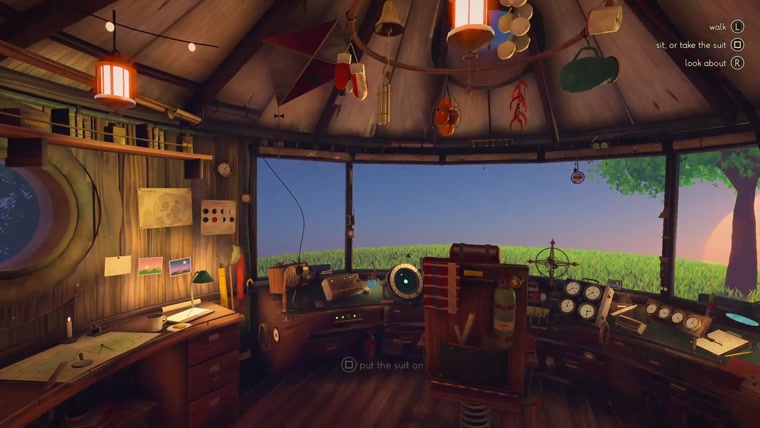
@BlendiByl, 17 Nov 2026, 0:16. Source: https://x.com/BlendiByl/status/2122707673598837031.
A 3D asset that never leaves the render farm is a portfolio piece. An asset that appears in a playable build is inventory.
The one number I would hold loosely is the penny. Blendi's own post says "about $0.01"; Patch's published rate is $0.01 a credit with sessions from 50 credits an hour, which is a rate, not a receipt. The 45 seconds and the piece count are visible in the video. The dollar figure is his arithmetic.
Why there is suddenly a market here
The reason a launch like this lands is that the tooling underneath it arrived first. Blender has been drivable by an agent for a while — blender-mcp and its relatives bridge a coding agent to a Blender add-on over a local socket, and there are skill packs now for topology, triangle budgets and rig-ready meshes. What those cannot do is scale: a local Blender is one Blender, on your machine, using your GPU, while you are trying to use your machine.
A comparison of the agent-facing options, published in October, counts five kinds of answer in November 2026:
- Hosted services with a public MCP server. JANCTION Render takes .blend files and bpy scripts with no sign-up and returns a preview with a critic verdict in seconds, in free beta. BlendSwap Render Farm charges about $4.30 per L40S GPU-hour and runs up to ten GPUs a job. Sceneplane keeps cloud projects an agent can return to across sessions, gives 30 free compute-minutes a month, and sells a $9 hobby plan with 300 minutes and 2 GB of storage.
- Voyager Cloud leases GPUs by the second with Blender preinstalled for headless Cycles and EEVEE renders, splits a frame range across machines started from one snapshot, retries a failed chunk on another machine, and exposes the machine steps as MCP tools. Its safety notes read like they were written by someone who has watched an agent go wrong: a lease retried with the same request id never leases twice, and at your machine limit it waits and tells you who holds the machines.
- Your own worker on a GPU cloud — Modal lists an L40S at $0.000542 a second with $30 of free credit a month; RunPod is the other name in the conversation. Full control, and you maintain the container.
- A local Blender MCP, which edits the scene open on your machine and renders on your own card.
- Studio render farms such as RebusFarm, GarageFarm.NET and Fox Renderfarm, which will render a long sequence across many nodes but, as of that survey, publish no agent API at all.
Put Patch's sixteen sessions next to that list and the pitch is clear: the bottleneck was never the modeling, it was the queue. An agent that has to wait for your desktop's GPU is an agent that idles. An agent that can start sixteen Blenders and pay for them by the second is an agent that works like a small studio.
What to watch
Two things, and both are about the same question — who checks the work. The first is quality: a batch of sixty-four characters with three levels of detail each is only useful if the levels are right, and "render the best" is a selection step an agent performs on itself. The second is licensing, because the assets flowing into these pipelines are open-source ones with credit lines attached, and the farms are all selling speed rather than provenance.
What is not in doubt is the direction. A year ago the interesting question about agents and 3D was whether they could drive Blender at all. This week the interesting question is how many they can drive at once, and what it costs an hour.
Sources
- x.com - the demo the owner sent, 63,323 views, 1,439 bookmarks
- x.com - Patch's launch post, 103,854 views
- patch.gg - the product page: 16 sessions, 500 starter credits, 50 credits an hour, $0.01 a credit
- patch.gg - the platform: 50,000 open-source game-ready assets, CLI and MCP server
- docs.patch.gg - Patch's own documentation
- render.janction.jp - the survey of agent-facing render options, pages read 2026-10-08
- voyager.so - Voyager's own page: per-second leases, snapshots, MCP tools
- sceneplane.online - Sceneplane's own page: 30 free compute-minutes, $9 hobby plan
- github.com - the local Blender MCP the cloud services replace