
PixVerse R2 runs a generated world that remembers your moves
PixVerse says its September release makes input persistent, so an earlier choice shapes what happens next, and the company's game engine now runs on it.
Key takeaways
- PixVerse announced R2 on September 22, 2026, an upgrade to the real-time world model it launched as R1 in January, with persistence as the central change.
- The technical report describes a two-process pipeline, continuously pretraining Omni Causal AR and then distilling the same causal foundation for real-time inference, replacing the conventional five-stage chain.
- PixVerse says Error Bank reduced its long-horizon brightness-drift metric from 0.201 to 0.129, a 35.8 percent cut, with 20 of 29 long-sequence samples improving.
- The PixVerse Game Engine, first launched in July 2026, now runs on R2, and PixVerse's own limitations list still names real-time latency as a constraint for genres needing sub-100 millisecond response.
PixVerse announced R2 on September 22, an upgrade to the real-time world model it launched as R1 in January, and the change the company leads with is memory rather than resolution or speed. In earlier real-time generation, an input changed the moment you were in and then passed; the next action started fresh. In R2, PixVerse says input persists: a prompt, a movement or an audio cue updates the running state of the world and shapes what follows.
If the world carries state, then a choice is a decision rather than a reaction, and the thing you are watching stops being a clip with a steering wheel.
What actually changed
PixVerse's own framing is that R1 proved the paradigm in January 2026, when it shipped what the company calls the world's first real-time world model, generating continuous interactive 1080p video that responded to input instead of rendering a fixed output first. The launch post put R1 at realtime.pixverse.ai, with enterprise API access for qualified partners. A February API update described 720p output as up from 480p, with synchronized audio and continuous generation of up to 300 seconds, so PixVerse's own R1 figures run from a 1080p launch claim to a 480p-then-720p API.
R2's pitch is scaling: more data, more tasks, more input types, still real time. The demonstration the company shows is a branch. In Zero Mark, an interactive film game built on R2 by a creator called Xiaolongbao, a creature blocks the path and asks for a gift, and offering it a dragon or a leaf produces genuinely different responses rather than the same response with a different prop.
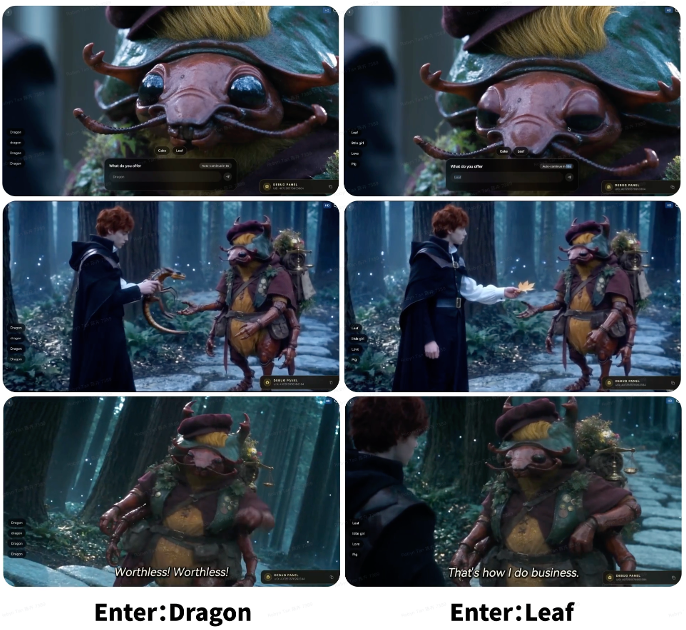
PixVerse's own comparison of the two branches in Zero Mark: the same encounter, with a dragon or a leaf, producing different responses live. Image: PixVerse.
The dragon branch at the toll, from PixVerse's own capture of Zero Mark, the interactive film game built on R2. Clip: PixVerse, from its R2 model page.
The scaling argument, which is the actual engineering story
The technical report, published a month before the launch, is where the substance is, and its central claim is about pipelines.
Conventional long-video and real-time systems, PixVerse argues, are built as a chain: convert a bidirectional model into an autoregressive one, build a task-specific distillation teacher, apply DMD distillation, then add self-rollout training to close the gap between training and inference. Every stage is a handoff, and repeated capability transfer across handoffs degrades quality and long-horizon stability. R2 collapses the chain into two processes: continuously pretraining one causal world model, Omni Causal AR, and then distilling that same foundation directly into a real-time model. The slogan in the report is "accelerate, do not relearn".
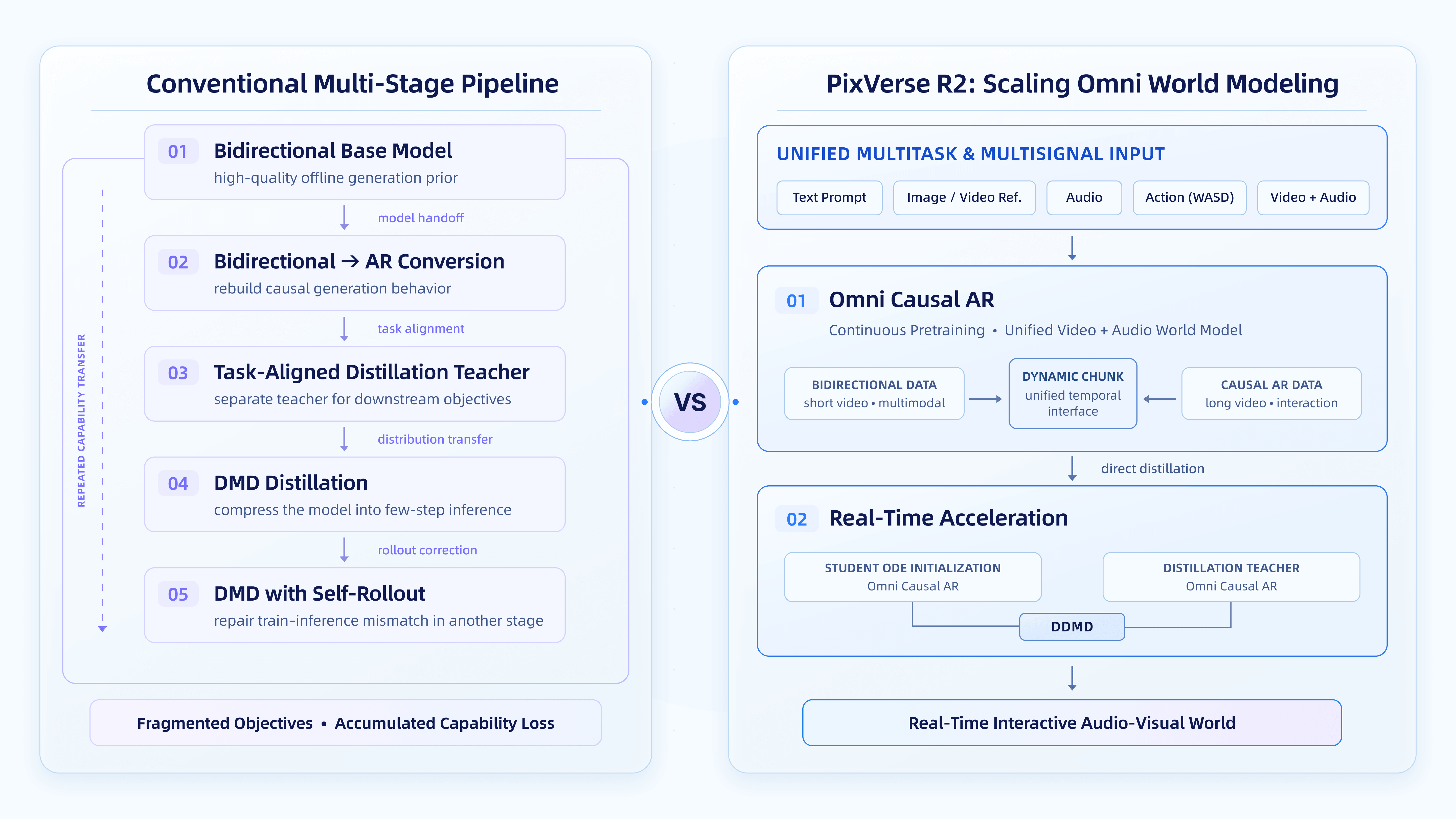
The conventional five-stage pipeline against R2's two-process framework: scale the causal backbone, then distil the same foundation for real-time inference. Image: PixVerse.
Omni Causal AR is described as a world-state transition model that moves in one temporal direction and predicts the next synchronized audio-video segment from the available history and whatever control signal just arrived. As training moves from isolated clips to long video and multi-turn interaction, one model learns the chain from past world state through current input to future world evolution.
The acceleration half then compresses that model instead of training a separate fast one, which is why PixVerse argues capability gains no longer trade against latency. Whether that holds will be visible in what third parties measure; for now the numbers in the report are the company's own internal evaluations.
How the world stays coherent for longer
Four mechanisms in the report are worth knowing, because they describe the failure modes every long-running generative system has.
Dynamic Chunk Generation. Control signals arrive at different speeds. A text prompt might describe a whole event; a WASD keypress needs an answer this instant; audio carries rhythm and sync at once. A fixed chunk length forces a trade between responsiveness and completeness, so R2 sizes the generated chunk to the semantic boundary and duration of the active signal, with a maximum chunk size to bound compute.
A hybrid of teacher forcing and diffusion forcing. A long-running autoregressive model has a train-inference gap: during training its history is cleaner than the history it produces in deployment, so it learns to continue from perfect states and is fragile to its own accumulated errors. R2 trains on both clean and deliberately noisy histories, which PixVerse says narrows the gap and slows error accumulation over long rollouts.
Three memory channels instead of one growing transcript. Keeping every past state is too expensive, and truncating aggressively loses identity and setup. R2 splits memory by function: Sink Memory holds anchors such as character identity, environment and world rules; Rolling History carries recent motion, pose and camera behaviour; Object KV Cache retains object-level state that still matters later. The report pairs this with a causal attention mask and relative temporal RoPE, which keep temporal positions inside the active window in a bounded range as a session runs.
Error Bank, which is the most interesting idea in the paper. Long-horizon drift starts with one small error written into history and inherited by everything after it. Error Bank stores representative failure states and replays them during training next to normal histories, so the model is trained to recover from a world that has already gone slightly wrong. PixVerse reports its long-horizon brightness-drift metric falling from 0.201 to 0.129, a 35.8 percent reduction, with 20 of 29 long-sequence samples improving and spurious motion reduced in all five no-motion samples. It also reports more than 90 percent attention sparsity from block-sparse attention while holding quality across the four dimensions it measured.
Those are internal stage evaluations, not an independent benchmark, and the distinction matters for anyone deciding when to build on this.
Four ways into one running world
The product page and the technical report describe one continuous loop (generate, receive input, update the world, keep generating) with four input families feeding it. Movement controls, in the shape of WASD input for world-exploration experiences. Text prompts that change a subject, setting or action already in progress without restarting. Audio, carrying timing and semantics into the current audiovisual world. And multimodal references, which steer the world with visual inputs alongside everything else.
The distinction PixVerse draws is that these are not separate tools. Each operates at a different speed and carries different intent, and all of them land in the same world state.
The WASD demonstration from PixVerse's model page: movement input guiding a running world. Clip: PixVerse.
The game engine now runs on it
The PixVerse Game Engine, first launched in July 2026, now runs on R2. Its architecture is worth one section here because it is the clearest statement of where this is heading.
The engine separates what is being simulated from how it looks. PixVerse calls it Mechanics-Expression Decoupling: the game's rules, objectives, resource pools and win conditions are abstract, narrative-free constructs handled by a mechanics engine, while the visual world, narrative logic and tone are generated at runtime by the world model. A third layer of AI agents sits between them, resolving player intent and keeping mechanical state and narrative state in sync.
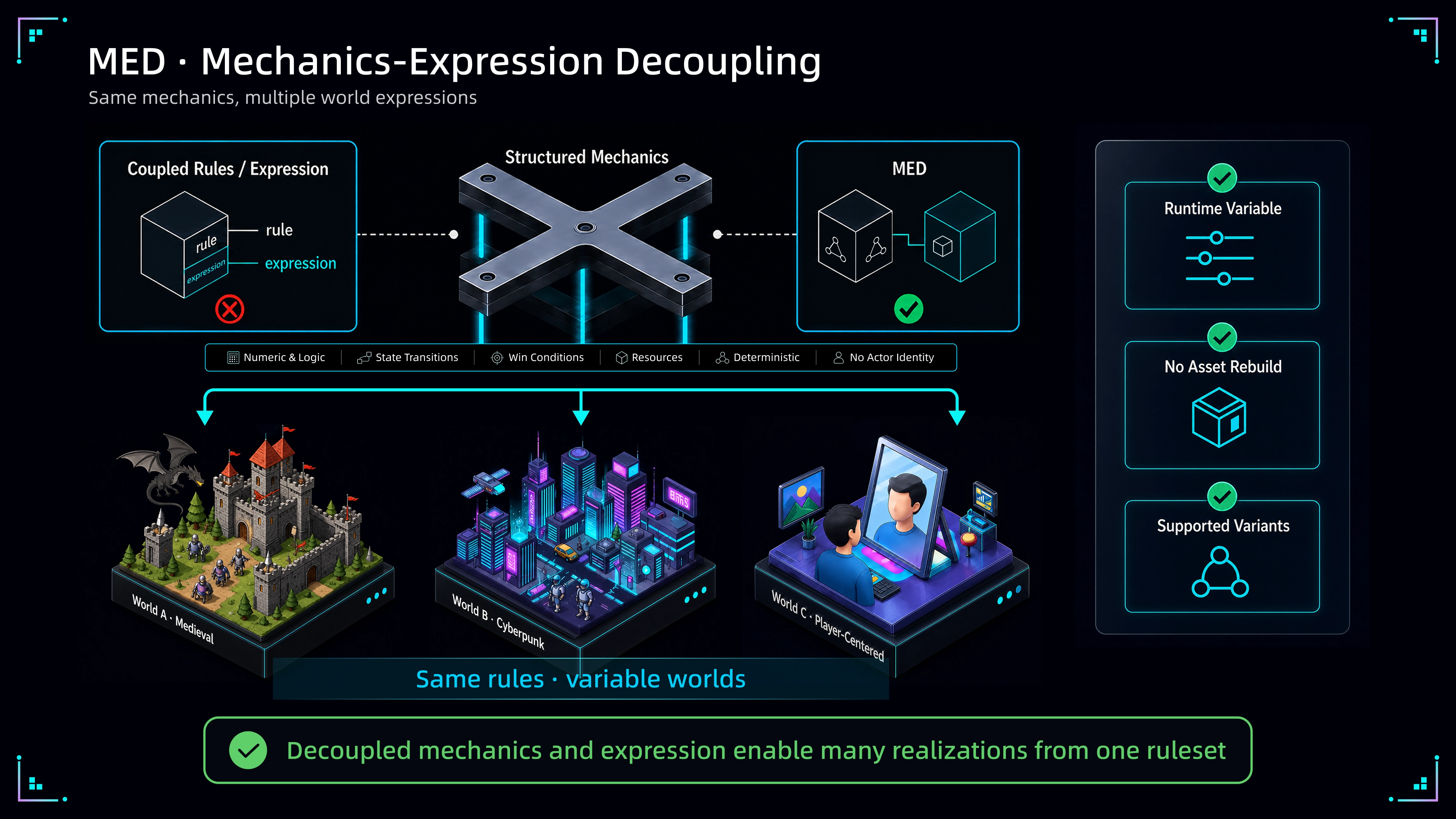
Mechanics-Expression Decoupling: the same abstract rules can be expressed as different worlds, because the expression layer is generated rather than authored. Image: PixVerse.
The three tiers form what the deep dive calls a Generative Game Loop: player input enters the agent layer, resolves against mechanical state, and emerges as continuous generated audio and video. PixVerse's table of the difference is blunt: traditional games output pre-authored assets and bound interaction to a designed action set, while the engine outputs runtime generation and treats the world's narrative and look as session variables. The company says creators configure mechanics through a toolchain with templates and a coding agent, and that Adventure, Strategy, Combat and Campaign starting points exist on game.pixverse.ai.
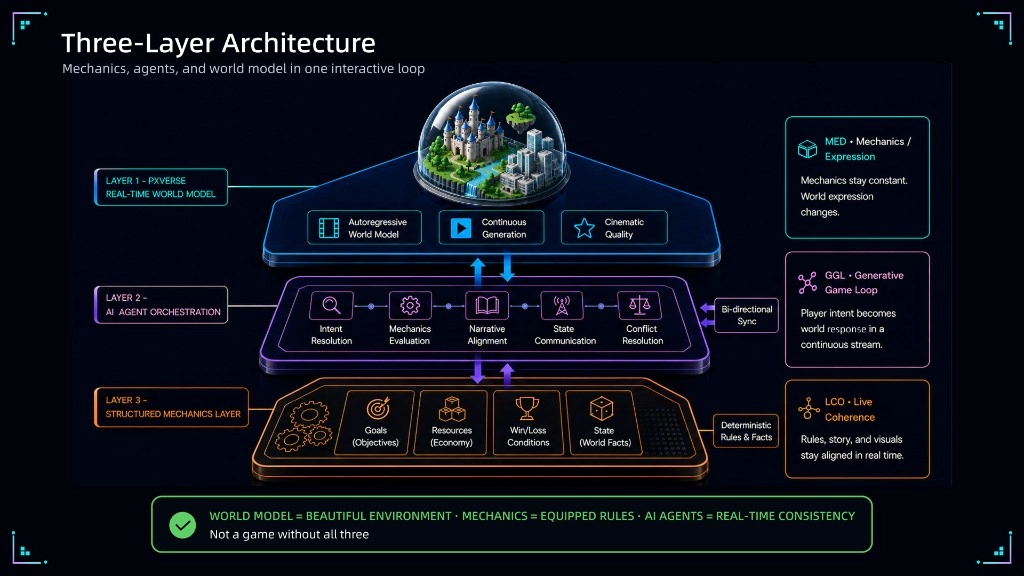
The three-layer architecture: real-time generation, abstract mechanics, and the agent layer that keeps them coherent. Image: PixVerse.
PixVerse published its own limitations with that architecture, which is more useful than a launch page. Real-time generation latency remains a constraint for fast-paced genres that need sub-100 millisecond response. Only a limited set of genres has been evaluated, so highly physics-dependent or competitive multiplayer games are unproven. And computational cost per session is higher than a traditional rendering pipeline at equivalent visual quality.
What this means for AI video creators
Three practical readings.
The unit of work is becoming a session, not a clip. Everything in R2 assumes the world is running while you act on it, which changes what a deliverable is: not a thirty-second vertical cut, but an environment someone enters, with state that has to hold. That is a different craft problem from prompt-to-clip, and closer to level design than to editing.
Persistence is the feature that has to be tested first. The claim to check is the one R2 is built on: does an input made early still matter later. PixVerse's Zero Mark branch is the demonstration to reproduce, and the honest test is whether the second and third consequences feel connected to the first or merely adjacent to it.
The numbers are the vendor's. Over 90 percent attention sparsity and a 35.8 percent cut to a drift metric are internal stage evaluations by the company selling the model. No third party has published equivalent measurements, and PixVerse publishes no resolution or latency figure for R2 on the model page, in the announcement or in the technical report. For R1, the launch post claimed 1080p, while the February API update listed 720p as up from 480p and explicitly named cases that were not supported yet, including anything above 1080p or under one second of latency. Take the architecture seriously and the marketing numbers provisionally.
What to watch
The interesting question for the next few months is not whether a world can keep running, which R1 already showed, but whether persistence survives contact with players. Two things will tell you: independent measurements of long-session drift, and whether the first games built on R2 hold together past the branch that was demonstrated. PixVerse's own roadmap names capacity, richer interaction data, longer training horizons and wider task coverage, which is a scaling argument rather than a features argument, and PixVerse co-founder and CEO Changhu Wang frames it that way in the announcement: "with the right architecture, a model can keep getting more capable without giving up real-time interaction."
Open the R2 demo and make one early choice you can check later: whether it still matters twenty inputs on is the whole claim.
Sources
- pixverse.ai - the R2 announcement, persistence, Zero Mark, game engine on R2, CEO quote
- pixverse.ai - the technical report, architecture sections, internal metrics
- pixverse.ai - the product page, interaction model, WASD and prompt controls
- pixverse.ai - R1's January 2026 launch, 1080p, availability
- pixverse.ai - R1's 720p API update, 300-second continuous generation, the stated unsupported cases
- pixverse.ai - the game engine architecture, MED, the three tiers, the generative game loop, the limitations list
- rutlandherald.com - the Business Wire release carrying the announcement, dated September 23