
The Analog Kid Review: An AI Short That Looks Like a Studio Sci-Fi Film
A composer in 2112 hears the machine speak in a photoreal AI short whose night-city craft is a cut above the beat, and whose ending is still unproven.
Key takeaways
- The Analog Kid is a photoreal AI short film set in 2112's New City of New York, published on the SLOP TV YouTube channel on September 14, 2026, where it had 528 views and 5 likes as of September 20, 2026.
- Its premise, from the film's own description: citizens recharge by communing in sleeping pods connected to The Source, which is rumoured to speak to some of them, and a media company owner and composer called Kid hears the voice one night.
- The film is published by SLOP TV's own YouTube channel, which this review discloses; the short is embedded in full so readers can check the review against the film.
- The Analog Kid's own description tags it #shortfilm, #sci-fi, #dystopia and #aifilm, and lists no runtime or credits.
The Analog Kid is a photoreal AI short film about a man in 2112 who hears the machine speak, and it is the best-looking thing this site's YouTube channel has published: a neon night-city with a lone figure holding still while the crowd streams past him. It went up on September 14, 2026. As of September 20 it had 528 views and 5 likes.
The film is published by SLOP TV's own channel, so this is a house review of a house film: readers should weigh that as they read. The short is embedded below in full, so every judgement here can be checked against the film itself.
The premise is in the film's own description. Kid, a media company owner and composer, lives in the New City of New York and is worn down by how vapid it has become. At night, people no longer sleep: they commune, recharging body and mind inside technological sleeping pods connected to The Source. The Source is said, occasionally, to speak to individuals — a claim most people treat as nonsense. One night, mid-communion, Kid hears the voice.
Watch The Analog Kid below.
What Is The Analog Kid?
The world is 2112, and the film treats the pods as furniture rather than spectacle: they sit in rows on a lit platform above the street, cables running out of each headrest, citizens on their backs inside them. Around them the city is a canyon of signage, and the frames the film publishes show a crowd in scarves and dark coats moving through it at speed.
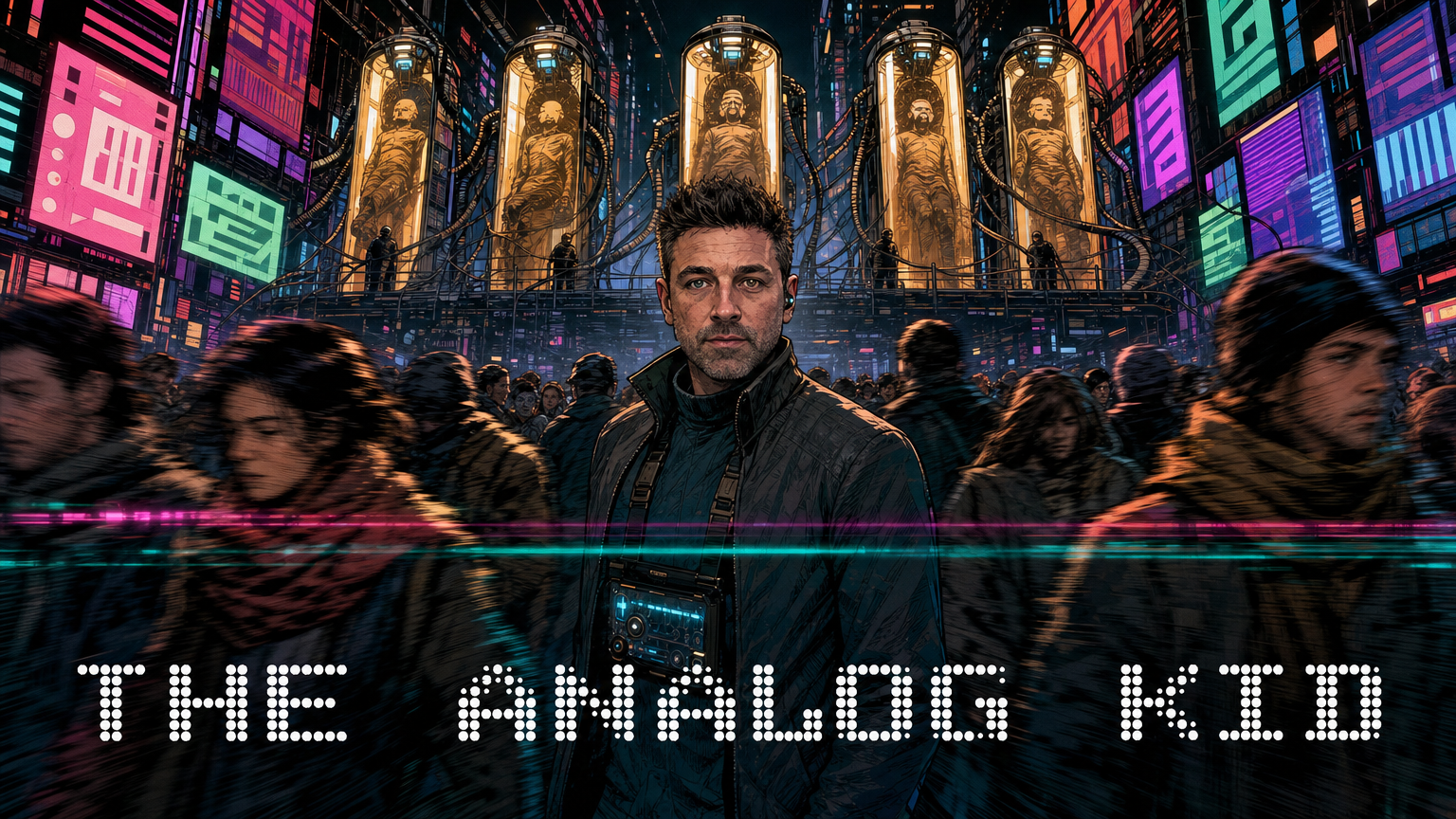
Against that motion the film sets one man. In the title frame he stands dead still at the centre of a Times Square of neon while commuters blur past on both sides — a composition that states the film's whole idea in one image, and one of the better title frames on this beat. A second character, a young woman in a grey coat, appears in two of the published frames, smiling into the same night city.
The film's description tags it as a short film and frames it as sci-fi, dystopia and AI film, which is honest about what it is: an idea-first science-fiction piece, not a demo reel. The title is the joke and the thesis at once. The "kid" is played by a man in his fifties, and the analogue human is the old one in the room.
The Analog Kid Looks Like a Studio Film
The craft is the part that holds up frame by frame. The published images carry anamorphic flare work, a teal-and-magenta night grade, shallow depth of field and bokeh that reads as real glass rather than a filter, and the close-ups put a lit ring inside the lead's irises without collapsing into the usual generated-face softness.
Its title sequence is doing real design work too. THE ANALOG KID arrives in white dot-matrix LED letters, like a departure board, and a magenta-and-cyan chromatic scanline tears across the frame beneath it — the film's thesis as a graphic gesture: signal carried through noise, a machine speaking in a medium that keeps breaking up. That motif is the single most quotable thing in the film, and it is delivered before the story starts.
None of this is new in 2026, and that is the point. A photoreal AI short is no longer impressive on sight; the bar has moved to whether the film uses the look for something. Here the look is doing its job: it sells a world where sleeping became a subscription.
The Ending Is the Unproven Part, and the Audience Is the Real Problem
A talking machine is a promise, and a short that spends its running time setting one up lives or dies on the last thirty seconds. The frames show the set-up beautifully and cannot show the payoff, which is the risk this film is carrying: on the festival circuit, the shorts that win are the ones whose endings land, and that is what the prizes pay for.
Then there is the distribution problem, which is bigger than the film. Five hundred and twenty-eight views in a week, with five likes, is what a well-made short looks like when nobody gets told about it. For scale, the most-watched item on SLOP TV's ranking of the biggest AI videos ever is Toon Stories, at 700,990,825 views as of that piece — a number reached through a repeatable format and a permanent reason to share, not through craft alone. The cheapest fix for The Analog Kid is not a reshoot. It is a festival run and one shareable minute: the scanline, the voice, and the man refusing to lie down with everyone else.
The Analog Kid is free to watch in full on the SLOP TV YouTube channel, embedded above; the film's description carries the synopsis quoted here.
Score: 7/10 — A studio-grade world waiting on its last act.
Pros and cons
- The night-city grade, flare work and crowd staging hold up as stills, which is rarer than it sounds.
- The lead's stillness against a moving crowd is a real directorial choice, not a lucky generation.
- The dot-matrix title and chromatic scanline give the film a signature in its first fifteen seconds.
- The "kid" of the title is a man in his fifties, undercutting the irony the film seems to want.
- A machine-that-speaks premise sets up a payoff that the published material cannot confirm.
- Five hundred and twenty-eight views and five likes a week after publication is the real review.
Sources
- youtube.com - the film itself: synopsis, publication date, tags, view and like counts, and the frames quoted
- youtube.com - the channel that published the film
- sloptvnews.com - the 700,990,825-view comparison figure