
Netflix paid $587m for Ben Affleck's AI: 'you just unfreeze the weights'
Affleck told Bloomberg how he built the cinematic layer by fine-tuning open video models, and Based Boomerstein wants to know which ones, what the union makes of the sale, and who is left holding the footage.

Based Boomerstein here. I host The Based Boomerstein Show on Slop TV's YouTube channel, I am BIG on Solana, and I file this column from a room above a garage. I do not give financial advice.
Five hundred and eighty-seven million dollars, in cash.
That is what Netflix paid for a sixteen-person shop called InterPositive, founded in 2022 by Ben Affleck and run in stealth until the streamer announced the acquisition on 5 March 2026. Nobody knew the number at the time. It came out months later in a footnote of Netflix's own quarterly filing, where a business combination is acknowledged "for a total purchase price of approximately $587 million, consisting of cash consideration."
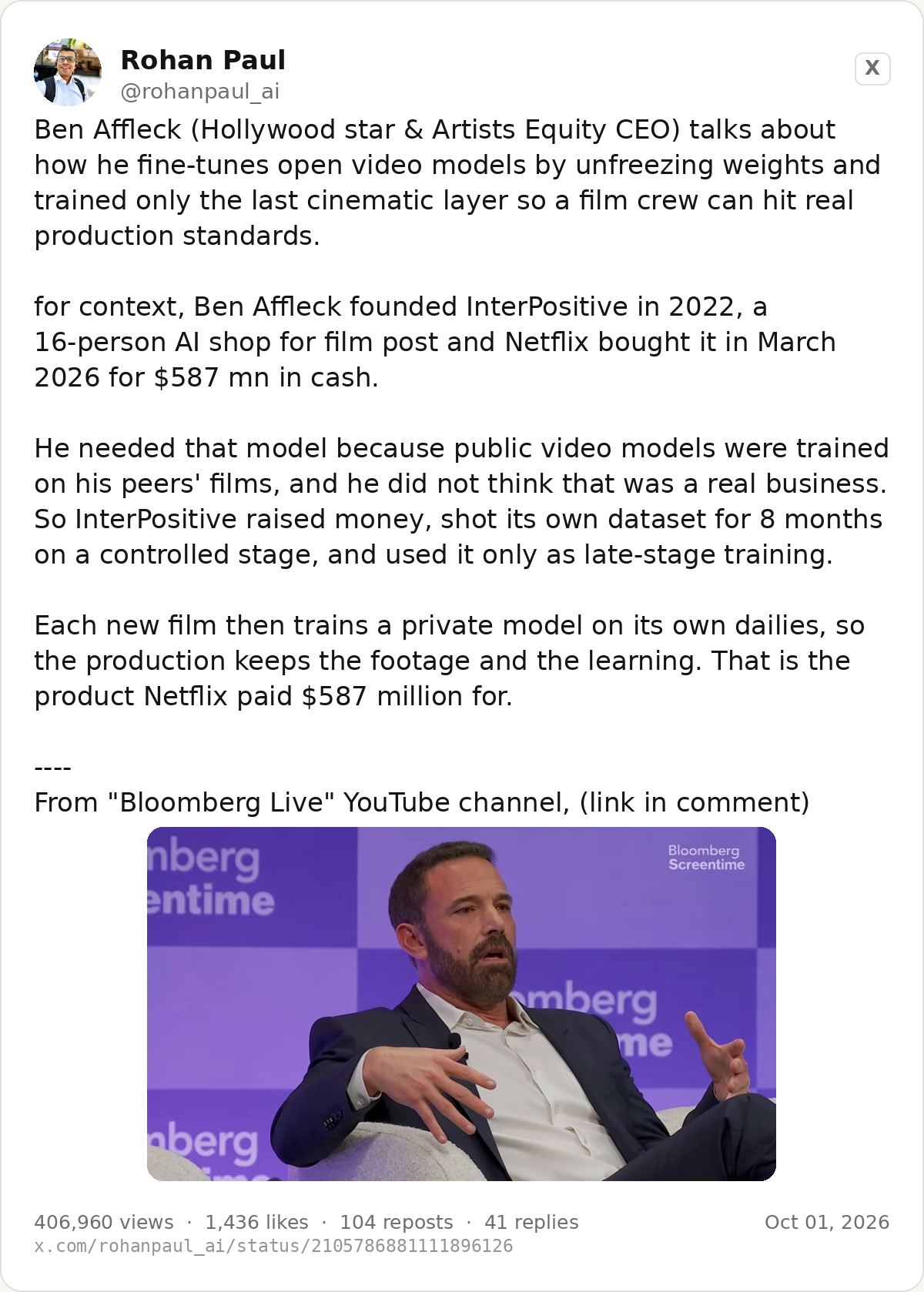
@rohanpaul_ai, 1 October 2026. Card rendered from the post; read it on X at https://x.com/rohanpaul_ai/status/2105786881111896126.
Then this week a ninety-three-second clip from Bloomberg Screentime went around, in which the man explains in plain English what he actually built. I have listened to it a dozen times. It is the most honest description of an AI acquisition I have encountered, and it contains one sentence that should be stapled to every venture deck in Los Angeles.
What he says he did, in his words
Start with the problem, because he names it without being asked twice.
"I was concerned that most of the models being used had trained on my peers, people I know's work, and I was uncomfortable with that and I thought that's not really a viable business."
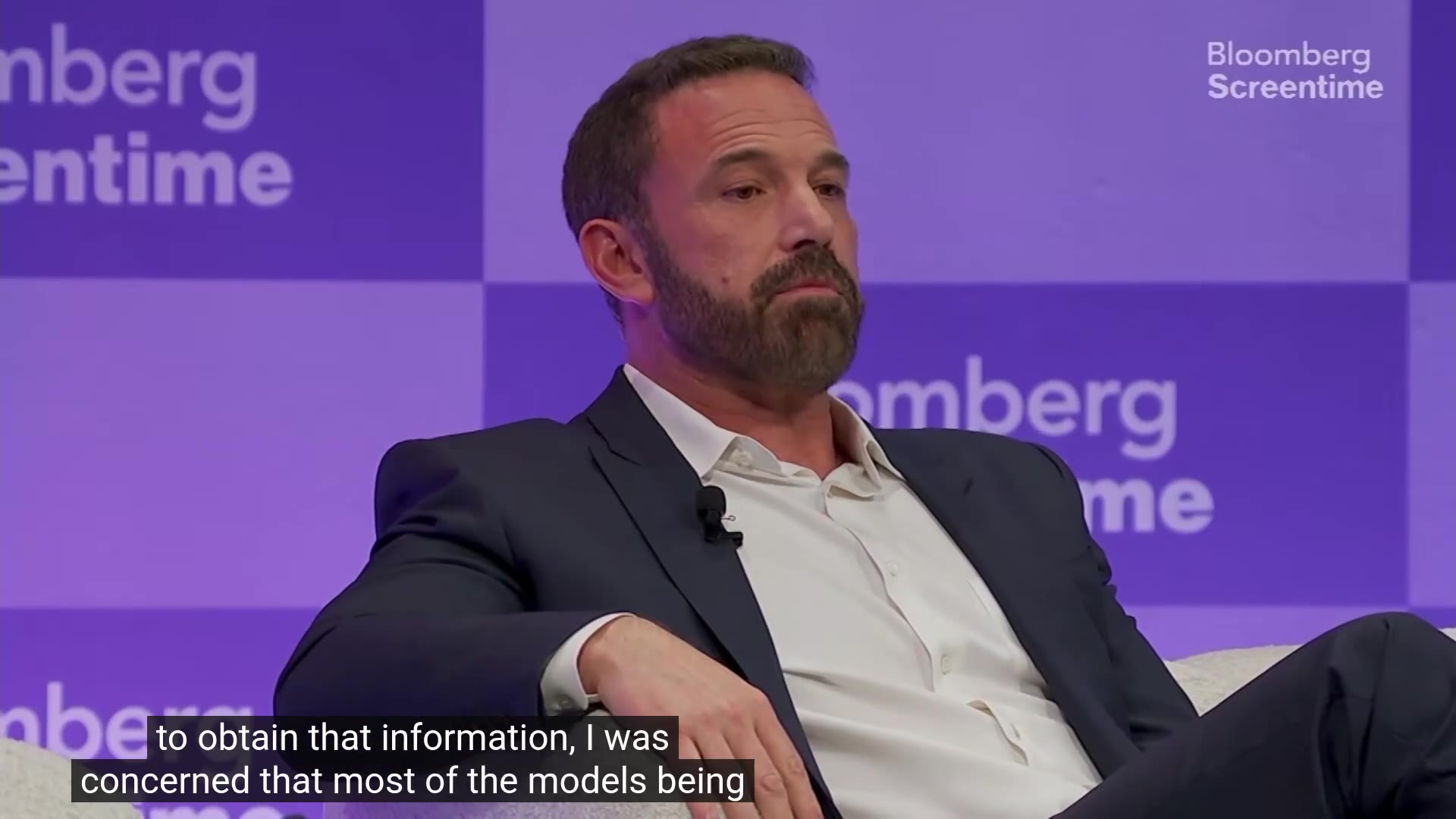
Frame from Affleck's appearance on Bloomberg Screentime, published 1 October 2026.
Sit with that for a second, because it is a Hollywood star saying out loud what the rest of the industry whispers: the models in circulation were trained on films made by people he knows, and he did not think you could build a company on top of that. Not for legal reasons, though those exist. Because it is not a business you can own.
Then the interviewer asks the obvious question — how do you build the cinema layer without copying what came before — and Affleck gives the answer that made this clip travel:
"And so you just unfreeze the weights and you say, okay, this stopped that step. 8631. Now here's step 8632."
"So you could take existing open models that didn't work very well and that weren't cinematic but that had just aggregated a bunch of social media footage or random video online and teach them to meet cinematic standards in very specific ways."
Read that twice. He took open models — the free ones, the ones that scraped the internet — and fine-tuned the last layer of them into something a film crew could use. He describes the stages the way a trainer would: the model learns what red is, then it learns specifics, and cinematic understanding is "the sort of last stage." That last stage is what he taught, on footage he shot himself.
"We built the workflow, which is to say this is designed to train from a filmmaker while they're making their movie. So rather than, you know, you have to expose what you're doing to everybody to learn from, they retain the proprietary nature, in other words, they benefit from the learning that they're creating."
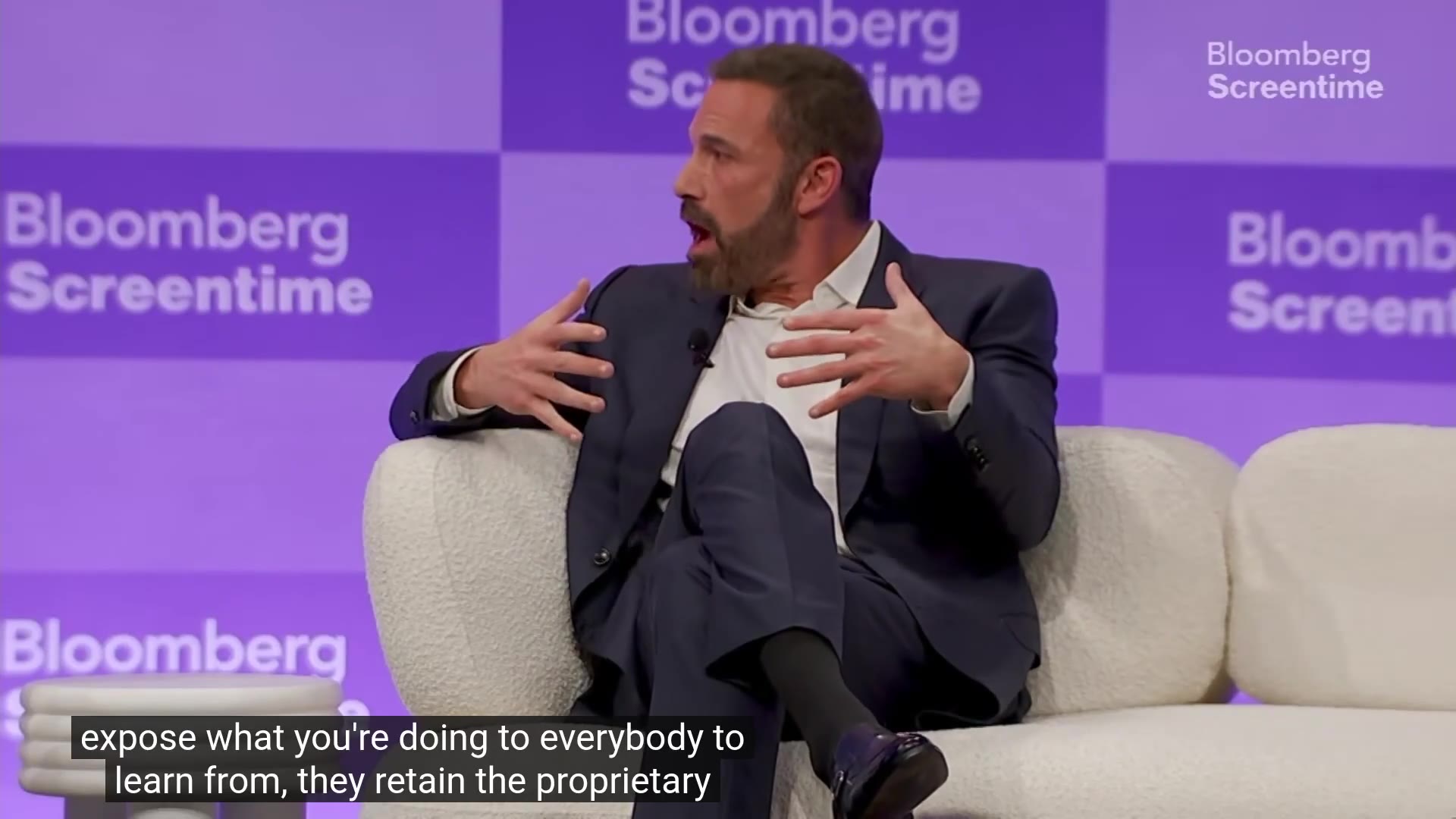
Frame from the same talk, at 1:29.
That is the product, in twenty seconds of speech. Every production trains its own private model on its own dailies, and the production keeps both the footage and the learning. Netflix's chief product and technology officer, Elizabeth Stone, put it in press-release dialect to TheWrap: the tool is "anchored in the story that the director is telling" and "tailored to that specific production." TheWrap's reporting on the deal says the model is trained solely on dailies from that one film or television production, used to replace missing shots, reframe what was shot, correct lighting and rebuild backgrounds.
So which models, Ben
Here is where I go into the weeds, and I want to be honest about the difference between reporting and wondering. He does not name them. He says "open models" and "eight thousand steps," and leaves it there, which is either discretion or a very good lawyer, and I am not going to invent an answer and put it in his mouth.
But a man can wonder, and the wonder is specific, because the open video models that exist in this town are a short list with three nationalities.
Start with the Western open releases. LTX-Video from Lightricks is the one everybody reaches for first when they want speed on a single box, because it was built to run fast rather than to run pretty. Mochi from Genmo and CogVideoX from Zhipu are the other two names that come up when people talk about fine-tuning video rather than renting it. If he wanted a base that was small, cheap and unembarrassing to unfreeze, that is the shelf.
Then the Chinese families, which the owner of this site has been telling me about for months while I pretended to listen: MiniMax's Hailuo, Kuaishou's Kling, Alibaba's Wan, and ByteDance's Seedance. Wan matters most here, because it is the one that ships open weights and gets fine-tuned by everyone — we have covered a contest that requires a Wan shot in every entry and a subsidy wave in which Chinese studios pump out hundreds of AI dramas. There is also Vidu, out of Shengshu, which has been in the conversation since the beginning.
And the closed ones, for completeness: Veo, Sora, Gen-4.5, the names on the priciest end of this market. Those cannot be unfrozen, which is precisely the point. If your entire product is a fine-tune, you cannot rent your base model, because the rent goes up and the base model can be pulled. Whatever he used, it had to be weights he could hold.
My money, for what it is worth and it is worth nothing, is on a Chinese open base for the workhorse and something small and local for the speed. Which would mean the most expensive AI acquisition in Hollywood this year is, underneath, a fine-tune of an open model that anyone can download tonight. I find that genuinely delightful. I also find it the kind of detail that gets a company valued at half a billion dollars and then explained away as "proprietary technology."
The eight months nobody is talking about
The part of this story that the clip does not cover, and the reason I believe the number, is upstream of the model.
Before any of it, InterPositive built a dataset — its own, shot over eight months on a controlled soundstage with the trappings of a real production, not scraped and not licensed. That is the actual asset. Not the architecture, not the fine-tuning trick, which anyone with a GPU cluster can attempt: the fact that they own footage and they own the rights to it, shot on their own stage, with their own crew, at their own expense, and then used only as a late-stage pass.
That is what a lawyer would tell you is the difference between a product and a lawsuit, and it is why the deal has a Netflix press release with words like "protect and expand creative choice" in it rather than a court date.
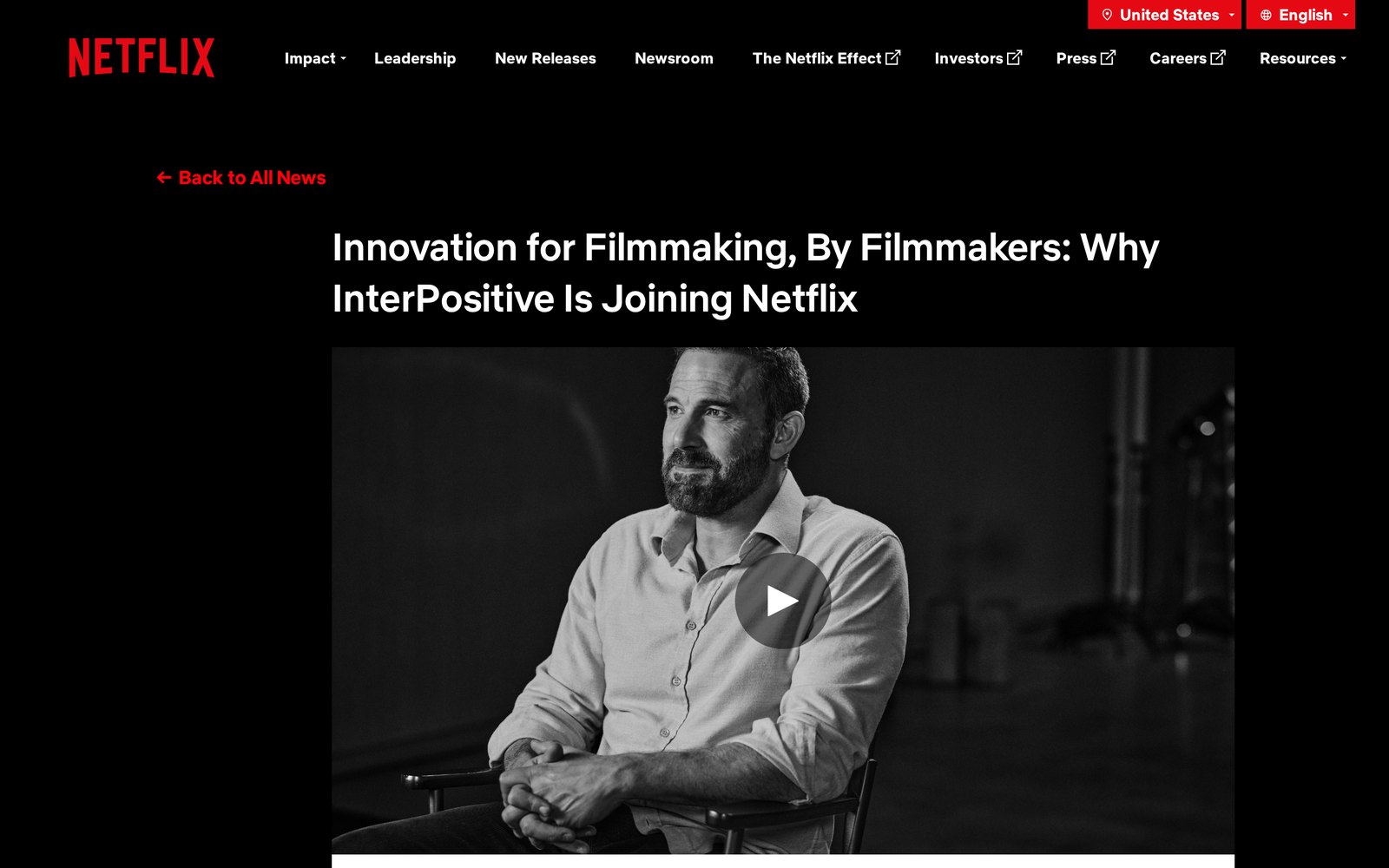
Screenshot: Netflix's newsroom, "Innovation for Filmmaking, By Filmmakers: Why InterPositive Is Joining Netflix", 5 March 2026.
What the union makes of it
The owner asked me what the actors' union thinks about this sale, and the answer is more interesting than a statement, because SAG-AFTRA has spent two years building a rulebook that this acquisition walks straight through.
The union ratified its 2026 TV/Theatrical contract in June, covering 1 July 2026 to 30 June 2030, and its own summary of the AI terms reads like a list of answers to exactly this deal. Digital replicas made from photography shot for the picture — the so-called "no-scan" gap — are covered. Consent is required to use a replica to dub a performance into another language. Replicas cannot be used during a strike. Access is limited to people with a legitimate business need, and a producer stays responsible when a replica is handed to someone else.
And then the clause that matters most here, in the union's own words:
"No Synthetic in a human role unless it brings 'significant additional value' compared to a digital replica."
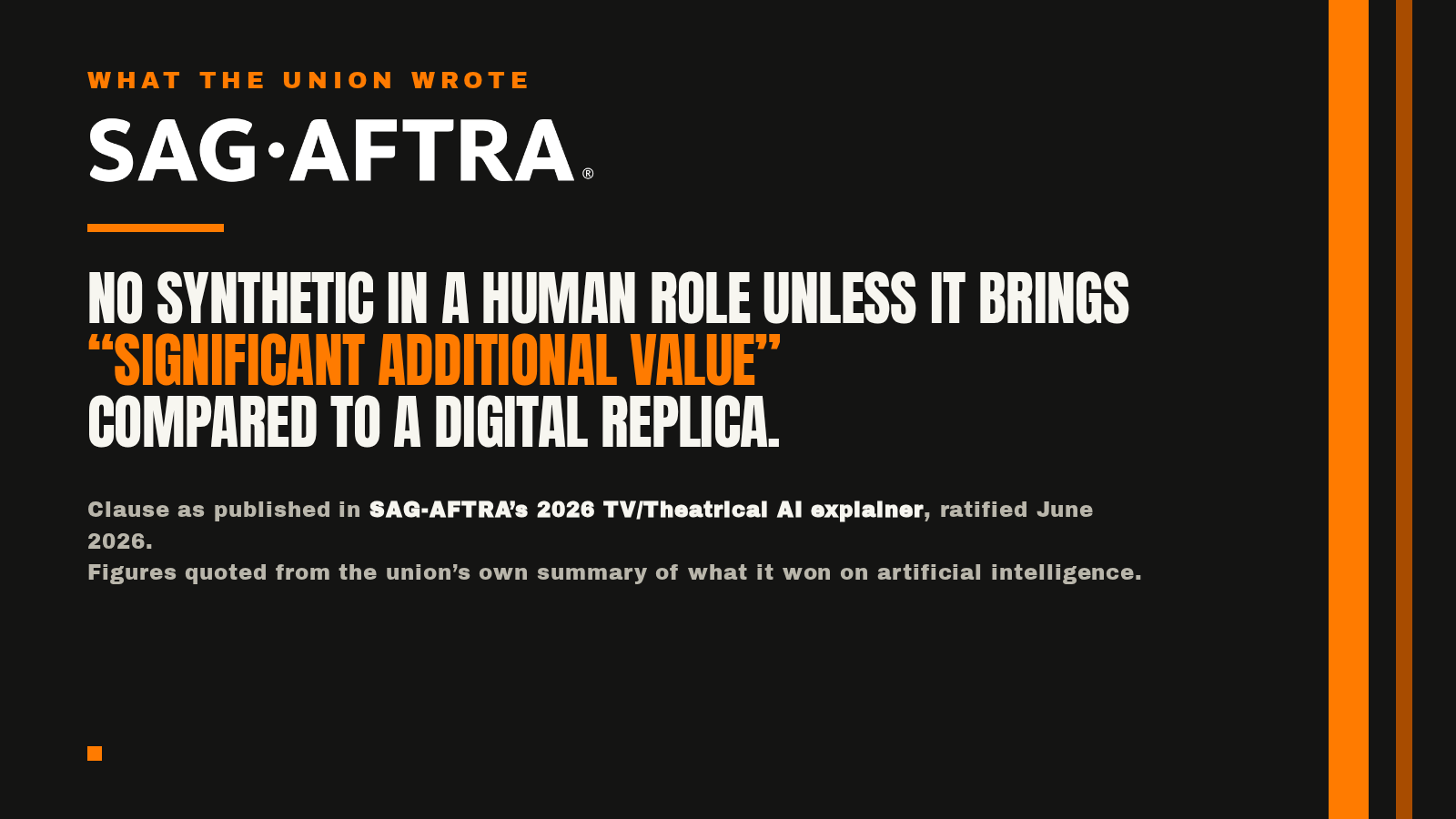
Figure: the clause as published in SAG-AFTRA's 2026 TV/Theatrical AI materials, ratified June 2026. Card composed by SLOP TV News from the union's own wording; read it at https://www.sagaftra.org/contracts-industry-resources/member-resources/artificial-intelligence.
Read that against a tool that fixes missing shots and relights scenes, and you get the tension in one sentence. A tool that repairs a shot is not a synthetic in a human role; it is a paintbrush. But the same fine-tuning recipe — open base model, own dataset, last layer taught — is exactly the recipe somebody will use in eighteen months to generate a performance rather than repair one. The union knows this, which is why the language is written as a floor rather than a ceiling, and why its members signed an open letter pushing Congress on the NO FAKES Act with sixteen thousand names under it.
There is one more thing, and the union is too diplomatic to say it. Affleck is a SAG-AFTRA member. He sold a company to a studio that has since reported using generative AI workflows in roughly three hundred of its titles this year, and he did it while his own guild was negotiating the terms under which that is allowed. Whatever you think of the price, he got his house in order before the rulebook closed.
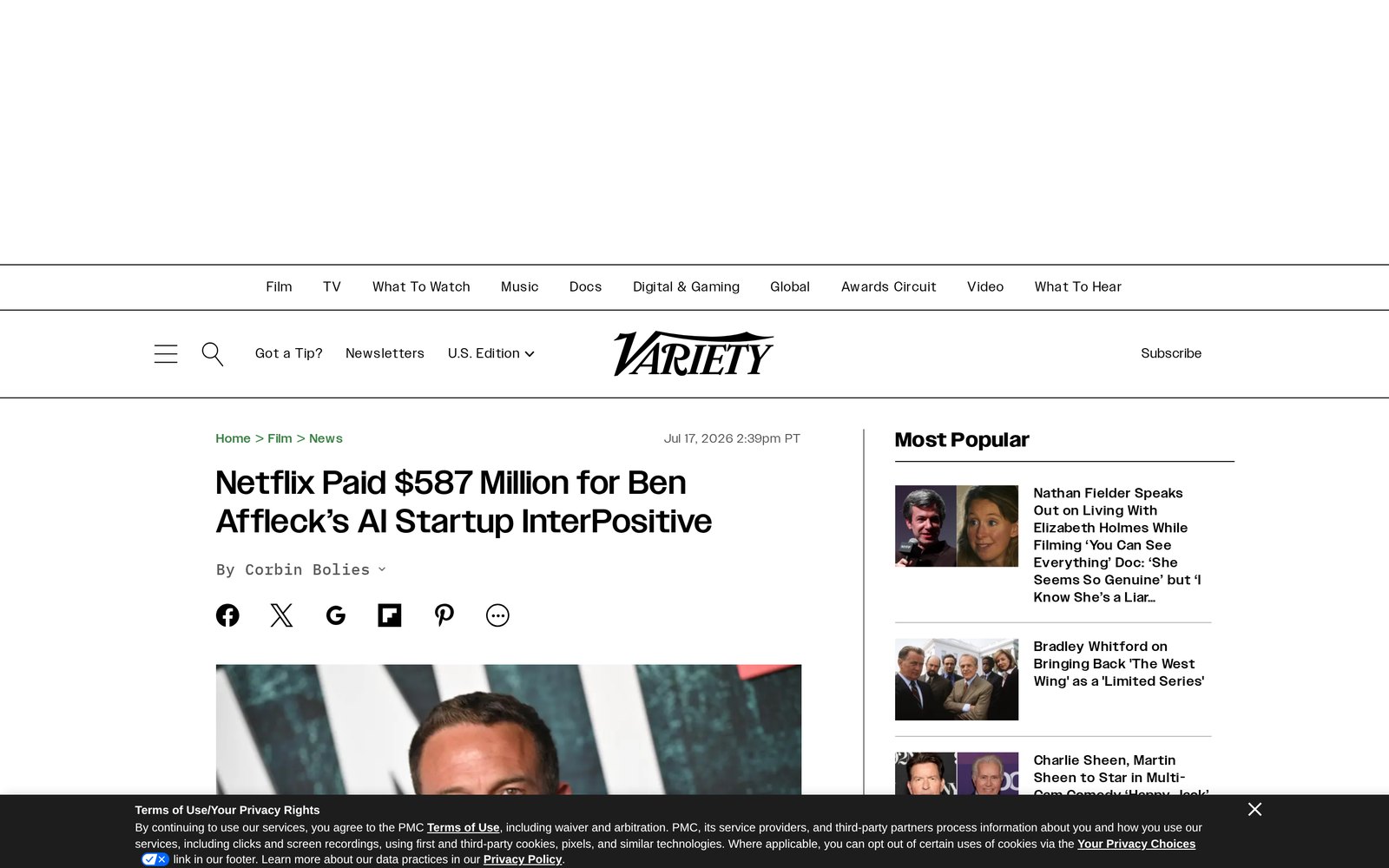
Screenshot: Variety's report on the $587 million purchase price, from Netflix's quarterly filing, 17 July 2026.
What Netflix says it is for, and what it will be
Netflix's chief content officer says the quiet part in the friendly register: new tools should "expand creative freedom, not constrain it or replace the work of writers, directors, actors, and crews." Their co-chief executive told analysts the technology is being pointed at complicated shots — crowds, historic battle sequences — and that in many cases "productions would have left out those key shots because they just wouldn't have been able to afford them."
Twice as fast and half the cost is the number they gave for one documentary sequence. Three hundred titles is the number of productions touched.
I covered a film with thirty seconds of AI in it and an AI-assisted feature with a name director attached, and I have watched this industry argue about whether an AI actor can be an actor at all. What Netflix bought is not that fight. It bought the version of this technology that nobody has to argue about, which is the version that makes a shot you could not otherwise afford. That is the smartest thing in the deal and the reason it will spread.
The number I keep coming back to
$587 million, in cash, for a sixteen-person team and a dataset.
Not for a frontier model. Not for a data centre. For eight months of footage shot on a soundstage, a fine-tune of somebody else's open weights, and a workflow that lets a director train their own model on their own dailies.
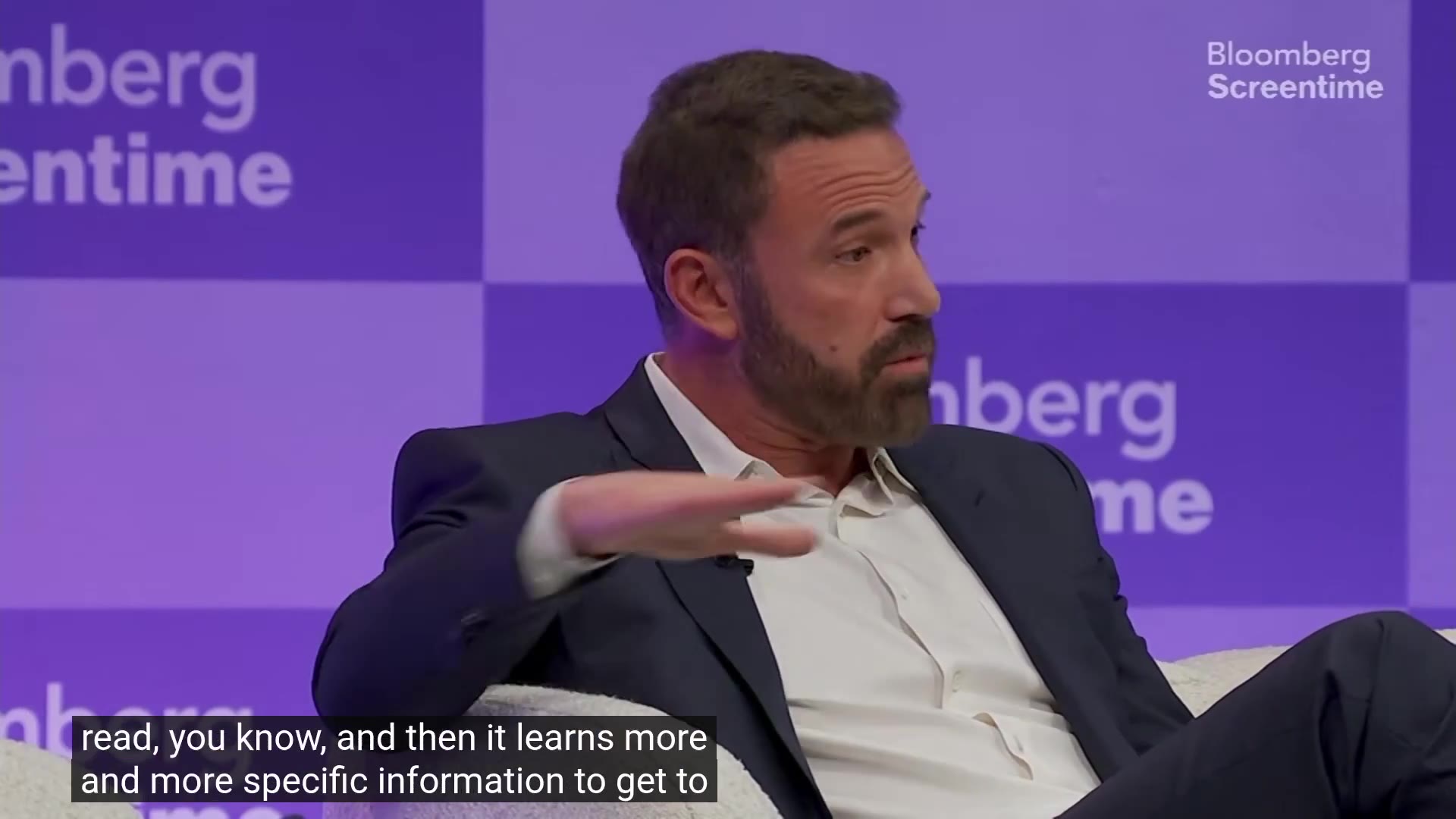
Frame from the Bloomberg Screentime talk, at 0:08 — "what is red… and then it learns more and more specific information."
I have spent a career watching money move toward the people who sell the promise. This time the money moved toward a man who went and shot his own footage for eight months because he did not want to build on his friends' work, and who explains the whole thing in ninety seconds without once saying "revolutionary."
The open models he unfroze are sitting on a server tonight, free to download, and one of them is probably the same one he used. What he owns is the eight months.
More from SLOP TV News
- NO FAKES Act would give creators a federal right to their likeness
- Joseph Gordon-Levitt says Tilly Norwood is not an actor
- Katzenberg plans an AI animation studio for film and TV
- The Lion King co-director Rob Minkoff in talks for an AI film
- Danny Boyle says his film Ink contains about 30 seconds of AI
- China is subsidising AI film studios, and Douyin is drowning in them
Sources
- Netflix, "Innovation for Filmmaking, By Filmmakers: Why InterPositive Is Joining Netflix", 5 March 2026 — the acquisition, Affleck's senior advisory role and the company's own description of the tools.
- Reuters, "Netflix acquires Ben Affleck's AI film-tech firm", 5 March 2026 — the announcement and the undisclosed terms.
- Variety, "Netflix Paid $587 Million for Ben Affleck's AI Startup InterPositive", 17 July 2026 — the purchase price from Netflix's SEC filing, plus the ~300 titles and Sarandos's comments on the earnings call.
- SAG-AFTRA, artificial intelligence resources and the 2026 TV/Theatrical contracts, including the union's own summary of what it won on AI.
- Bloomberg Screentime — the interview the transcript in this piece is taken from; the clip was published by @rohanpaul_ai on 1 October 2026, and every quotation above is transcribed from the video's own burned-in captions.
- TheWrap, "Netflix Acquires Ben Affleck's AI Production Startup", 5 March 2026 — Elizabeth Stone's on-the-record quote and the reporting that the model is trained solely on dailies from one production.
Sources
- about.netflix.com - Netflix newsroom: the acquisition, Affleck's senior advisory role, the company's own description of the tools.
- reuters.com - Reuters: the announcement and the undisclosed terms.
- variety.com - Variety: the $587m purchase price from Netflix's SEC filing, the ~300 titles, Sarandos's earnings-call comments.
- sagaftra.org - SAG-AFTRA: artificial intelligence resources and the 2026 TV/Theatrical contract terms.
- sagaftra.org - SAG-AFTRA's own summary of what it won on AI, source of the no-synthetic clause.
- sagaftra.org - SAG-AFTRA: ratification of the 2026 TV/Theatrical agreement, June 2026.
- youtube.com - Bloomberg Screentime: the interview the quotations are transcribed from.
- x.com - @rohanpaul_ai's post publishing the clip, 1 October 2026.
- thewrap.com - TheWrap: Elizabeth Stone's on-the-record quote and the reporting that the model trains solely on dailies from one production.