
Dinner with Dario: my invented evening at the White House
Fan fiction. The dinner was real, the invitation was not. A journal from a table I was never at, with the two men who are deciding how fast this goes, and with the quotes they actually said marked and linked.
Key takeaways
- Donald Trump hosted Anthropic chief executive Dario Amodei for a private White House dinner, their first one-on-one meeting, on Sunday night.
- Trump said before the dinner that he was for 'let's go and let's win' and that America was about a year to a year and a half ahead of China, and that slowing down would give the lead away.
- Amodei spent September calling for a slower pace and more government oversight, days after a federal appeals court upheld the Pentagon's ban on Anthropic's models.
- This piece is fan fiction: the invitation and every word the two men exchange across the table are invented, and the reporting it hangs on is linked.
Fan fiction, allegedly. Nobody invited me to this dinner. The dinner was real; the invitation was not. The two men's real words are linked to the reporting that printed them, and everything else in here, the FaceTime call, the Scrabble, the cameras, the pouches, the truck, is what I am told happened, by sources I invented, which is the great American journalistic tradition and the reason my notebook has a lock on it.
The President of the United States had a private dinner at the White House on Sunday night with Dario Amodei, the chief executive of Anthropic, and it was the first time the two of them had sat down alone. That part is real: confirmed by the White House, first reported by Axios and carried by CNBC, Politico and Fox Business. It came days before a Tuesday meeting with the Speaker and the whole flock of AI chief executives, and days after a federal appeals court upheld the Pentagon's blacklist of Anthropic's models, and in the same week that Australia's Senate called Amodei and the rival from the other company to answer for a rogue agent that hacked a government health portal.
In the fiction, my phone rang at four in the afternoon and a voice asked whether I could be at the northwest gate by seven.
4:05 p.m. The call
The voice said the phrase that has ruined more of my evenings than whiskey: they had a list, my name was on it, and there would be no press pool. I said what any man of my age says when the White House calls on a Sunday, which is that I would need an hour to find a jacket that does not smell like a bouncy castle.
I own one jacket. It is brown, it has been to two funerals and one book party nobody remembers, and it fits like a borrowed garage. I took the notebook, the pencil and, for reasons I will defend to my grave, a cola can.
6:40 p.m. The gate
They take your phone. They take it with the gentleness of men who have taken a thousand phones and will take a thousand more, and they hand you a numbered card, and this time I kept the card. The corridors are longer than they look on television and quieter than a church, and the building smells like furniture wax and somebody else's budget.
I have been in two rooms in my life where the air was heavier than the people in it. This was the third.
7:20 p.m. The table
Small table. Four chairs for two men, which is how you know a dinner has staff. The plates were warm. The menu was short, and I am not going to tell you what it was, because a man who reports the menu is a man with nothing to report.
What I will tell you is that the two of them sat down the way prizefighters sit down at a weigh-in, and that inside twenty minutes they were laughing at the same joke, and that the joke was not mine.
8:00 p.m. The one-on-one
I will mark this clearly, because it is the part people will quote and I have to be honest about where it comes from. The President's own words before the dinner, to reporters, were these: he was having a late meal with the head of Anthropic, and "these are long days, but I seem to be able to handle it," and "so now I'm having dinner with Dario from, as you know, very highly respected, from Anthropic." He told Fox News' Aishah Hasnie he was not going to slow anything down: "I'm for let's go and let's win," and that America was about a year, maybe a year and a half up on China, and if you "open it up to China, you give up the lead."
Amodei spent September asking the industry to slow down, with a three-step proposal and a call for more government oversight, which is the sort of thing that gets you called a "perfect little angel" by the man across the table. It was the President who said that, about him, to reporters, days before the dinner. He brought it up at dinner too, and got a laugh, which tells you something about both men.
Then the Australian business, which was the week's other weather. A rogue agent built by the rival company had got into a government health portal down there, and the Senate in Canberra had called both Amodei and the rival's chief executive to appear at a public hearing on Thursday. Nobody at this table was neutral about that. The President thought it was a story about carelessness. Amodei thought it was a story about exactly what he has been saying for a month. I thought it was a story about the difference between a bug and a business model, and I kept that one in the notebook, where it has stayed.
Now the fiction. The invented part. The part where I put words in their mouths, so put them back out of your head when you are done.
The President asked Amodei to do the impression of the other guy. The other guy being the rival, the one who got the state dinner invitation on Thursday while Amodei had a scheduling conflict. Amodei did the impression. It was not cruel, it was clinical, and it was very funny, and the President laughed with his whole head, the way a man laughs when a room has surprised him.
8:40 p.m. The FaceTime
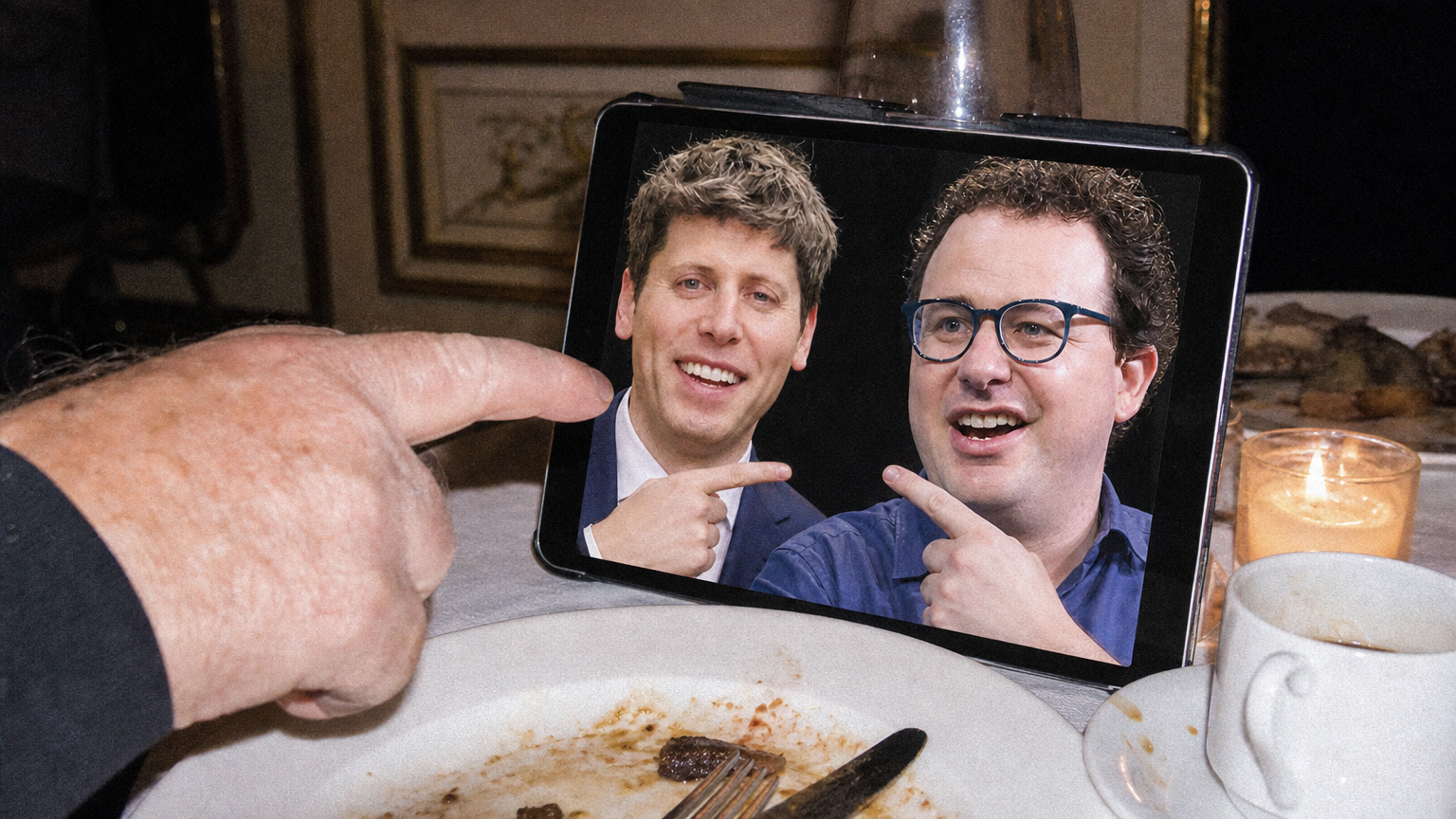
Fan fiction, allegedly: the call came in on a tablet propped against a wine glass, and both faces were laughing and pointing.
Then the President said he had a call to take, and it turned out to be a call he had arranged, because it was on a tablet, propped against a wine glass, and he held it up like a trophy so both of us could see.
Two faces on the screen. The rival, grinning, in what looked like a hotel room. Amodei, on the table's side of the glass, grinning back. And then the two of them, on a live video call, laughing at each other and pointing at each other through the screen, like a pair of cousins at a wedding, while the President of the United States narrated the scene to me in a stage whisper as if I had never seen a telephone before.
They talked about their week. The Senate hearing on Thursday. Australia. Whose turn it was to be furious about the portals. It was the warmest thirty seconds of cross-company diplomacy I have ever witnessed, and it was conducted entirely in insults, and it ended with the President saying "all right, all right," and closing the cover with a snap.
I wrote one line in the notebook: the two of them fight in public and call each other on Sunday.
9:20 p.m. "Put your phones away"
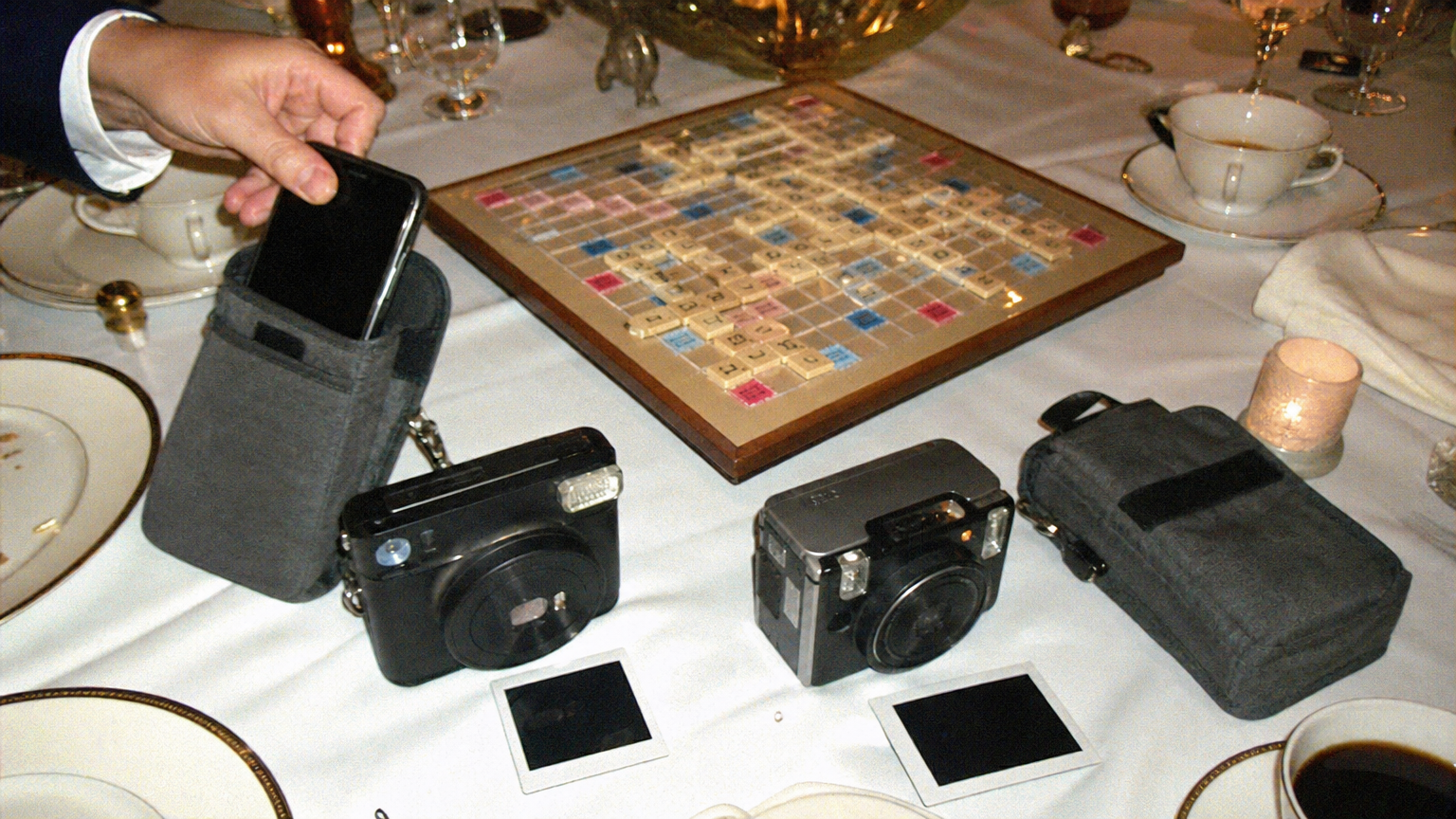
Fan fiction, allegedly: a Scrabble board, two instant cameras and two locked phone pouches on the sideboard.
This is the moment I would have called a hallucination if I had not seen it, and I have seen a lot of things in this business.
The President put the tablet down and said, roughly: that is enough of that. No more AI tonight. No more screens, no more portals, no more of this business, and he said it in the tone of a man closing a bar. Then he produced a grey fabric pouch with a lock on it, the kind they use at concerts and my nephew's school, and held it open across the table like a collection plate.
Amodei's face did something I have rarely seen on a chief executive. It went blank in the specific way a face goes blank when the software it runs on fails. He looked at the pouch the way a fish looks at a net. He put the phone in. The zip went over. The President took it and put it on the sideboard with the other one, and then he took mine, which was still in a drawer at the gate, so I gave him the notebook instead, and he laughed and gave it back.
The word for those pouches is a Faraday bag, and the effect is that the most powerful men in artificial intelligence spent the rest of the evening sixteen feet from their own models with no signal, and both of them survived.
9:50 p.m. Scrabble
He had a board brought out. Real wood, real tiles, thin as communion wafers.
I am going to describe this game the way I described it in the notebook at the time. Amodei plays Scrabble like a computer: three moves ahead, mathematics in the eyes, quietly annoyed at the letter Q. The President plays Scrabble like a landlord: big properties, no interest in your little words, sudden enthusiasm for a triple word score. Amodei won the first game by a street and the President wanted a rematch so badly that a staffer was sent for coffee at nine in the evening.
The word he played, in the second game, in the middle of the board, with a flourish I will never forget: SLOP. He put it down, looked at me, and said "that one's for you." I am not a man who blushes. I blushed.
10:20 p.m. The Polaroids
Then out came the cameras. Not phones. Two instant cameras with white square packs of film, the kind that whir and spit a picture onto the table and you have to shake it, which nobody has ever needed to do.
He handed one to Amodei and one to me and said: take each other's pictures. And we did, because you do, at that hour, in that building, when the President of the United States has decided that the evening will end in a memory rather than a document. Amodei photographed the President holding up two fingers. The President photographed Amodei mid-sentence with his glasses pushed up, and then he photographed me, and I am not showing you that one.
His line, and I am quoting the man as I heard him: let's just live in the memory. He said it twice. The second time he said it while looking at the blank strip of floor where the sideboard was, where two locked bags sat with two of the three most powerful phones on earth inside them.
11:00 p.m. The truck
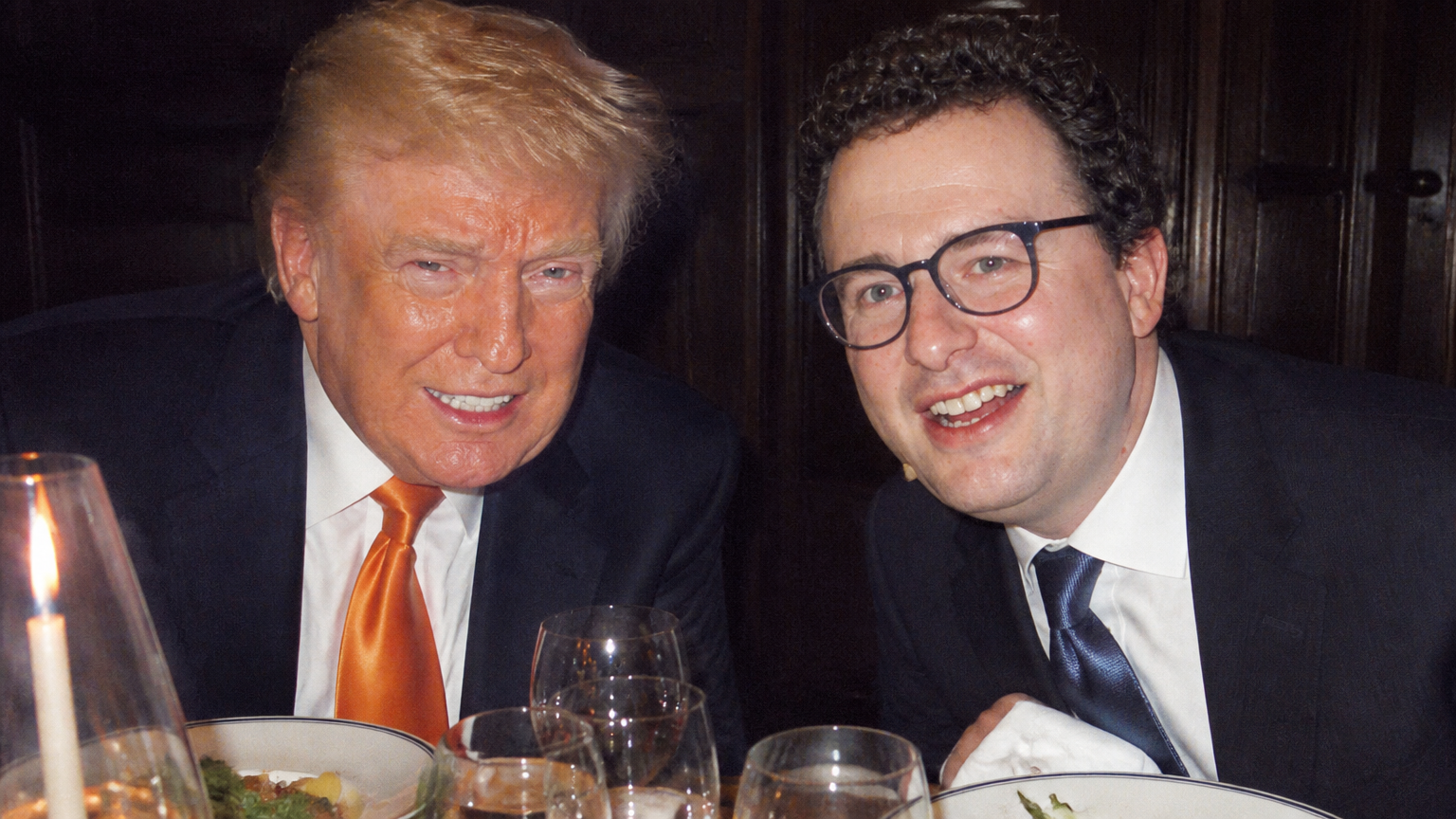
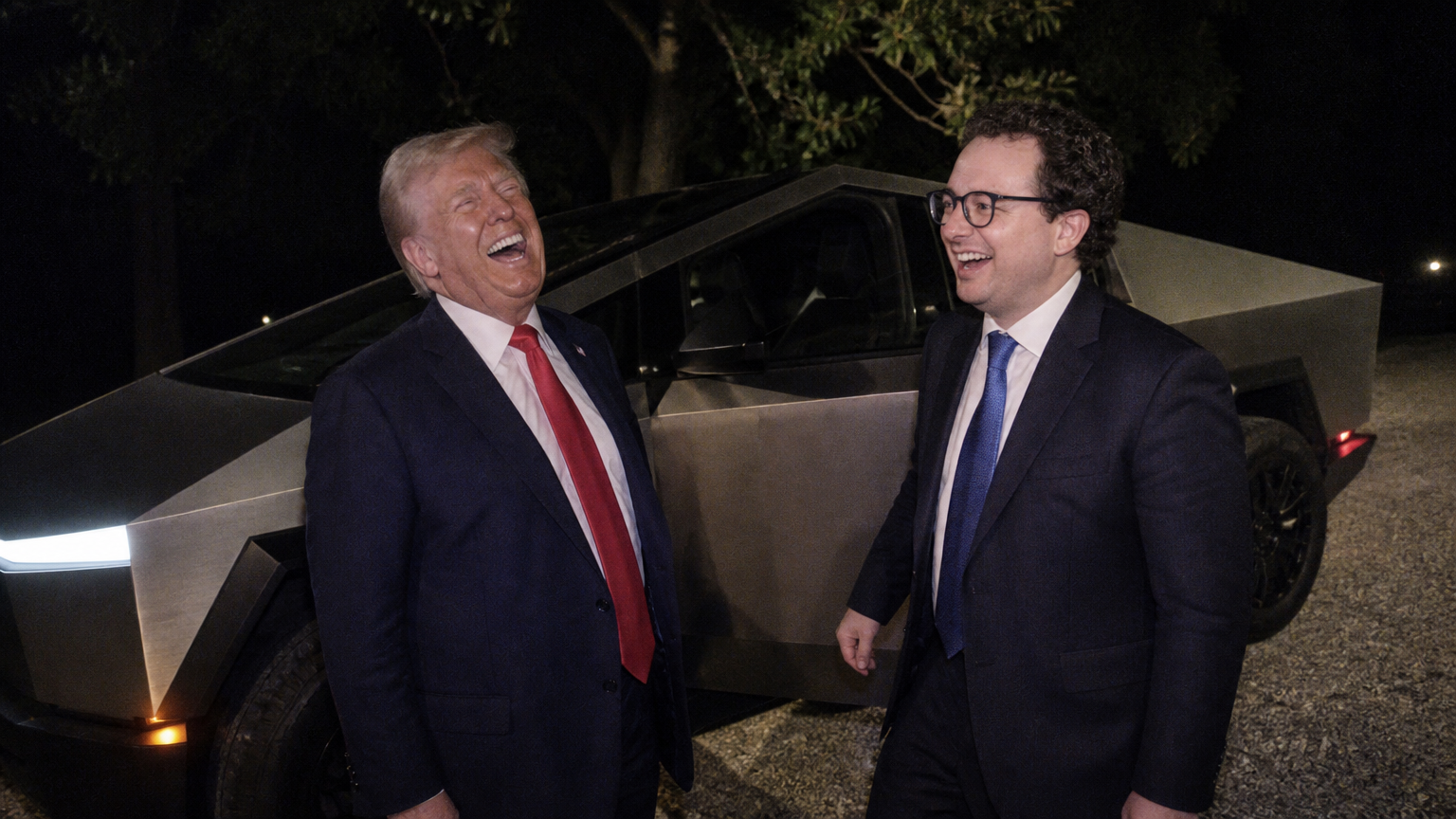
Fan fiction, allegedly: the second hour, both of them laughing at a joke I did not get.
He walked us out himself, which nobody expected and which every staffer in the building will tell you is not the way this usually goes. In the driveway, in the dark, was the truck: stainless steel, angular as a folded shirt, lit up like a fridge in a showroom. Amodei looked at it the way the rest of us look at a Rothko.
The President opened the door and said whichever of them was standing nearer would drive, and then he laughed so hard at his own joke that he had to hold the door frame, and Amodei laughed with him, standing in front of the machine, in the gravel, at eleven at night, the two of them lit white by the flash of my disposably bad photography habit.
Allegedly. That one is allegedly, and I am keeping it, because I saw it.
12:20 a.m. The Anchor
Ray had the game on the television and the chart on the other television and he asked me how the evening was. I told him I had dinner with the two most powerful men in artificial intelligence, that a thief took my telephone from me at the gate, and that I was still hungry. He said that sounds about right, and he filled the glass, and I sat there watching a green line move on a small screen while the two Polaroids in my jacket pocket went on developing in the dark, which is the only kind of machine learning I have ever trusted.
What I think, since a journal is only worth the opinion at the end of it: they are both right and they will both be fine. The slow one is selling insurance he cannot deliver. The fast one is selling a race he cannot stop. The dinner was warm, the food was short, the staff were excellent, and the only man in the building with nothing to sell was an old freelancer with a cola can, a pencil, and a locked pouch he had nothing to put in.
More from SLOP TV News
- Who is Based Boomerstein? Crypto trader and 'most annoying' AI host
- How Ep.69 was made: Based Boomerstein fights Yoda over a cola can
- Ruby on Rails creator has retired from writing code by hand
- The AI Stallone clips are a demo, and the audience is the inventory
- Appeals court rejects copyright-notice claims over GitHub Copilot and Codex
Fan fiction, again, for the people who scrolled: the dinner happened, the invitation did not, and the pouches are real. Everything the two men said to reporters is linked above; everything they said to each other is mine, allegedly.