
Based Boomerstein: I drew Proton's AI manifesto in ten boards
The CTO's manifesto, the CEO's "loser thinking", and the re-interviews that were canceled the next day — told in ten panels, one for each idea that got an engineer called a loser.

Key takeaways
- This column is a parody. The manifesto and the quotations in it are real and linked; the drawings are not hand-drawn by me, and the boards are machine-made at my direction, which is the arrangement the manifesto itself proposes for code.
- Proton's CTO Bart Butler wrote the engineering manifesto obtained by 404 Media; the CEO Andy Yen's Slack message to a security channel was that wanting time to pentest code was "bullshit and loser thinking".
- Proton cancelled its near company-wide AI "re-interviews" the day after the investigation published, and Yen told an all-hands there had been "a communication failure on my part".
- The manifesto says the job of an engineer is no longer to write code but to help the LLM write better code faster, and that most human code review will end.
A parody. The manifesto and every quotation below are real and linked. The drawings are not mine: a machine made them at my direction, which is precisely the arrangement the manifesto proposes for code, and I refuse to be the only man in this story who did it the hard way.
The document arrived the way all important documents arrive now, which is to say someone got multiple copies of it and a reporter put it on the internet. It is called AI @ Proton, Engineering Manifesto, and it was written by the company's chief technology officer, Bart Butler. Joseph Cox obtained it, along with Slack messages, meeting audio, and the testimony of eight current and one former employee, and by Thursday evening six hundred and eighty thousand people had looked at the manifesto's pages, which is six hundred and eighty thousand more readers than any manifesto I have ever written.
I read it twice. Then I did what I have done since I was a boy in a room with a drawing board and a mother who did not knock: I turned it into a comic book.
Ten boards. Ink, dot screen, cosmic machinery, the whole Ben-Day business. I am showing them to you in order, because a manifesto is a story whether or not its author intended one, and this one has a hero, a dragon, a storm, a throne, and a very small man who wanted four days to run a security test and was told that wanting it made him a loser.
I want to say at the top, because I am nothing if not a gentleman about my affections: I love this chief executive. Not the CTO. The CTO is a man with a document and a theory. The CEO, Andy Yen, is an artist, and his medium is a Slack channel in which a person who has spent a career keeping other people's mail away from other people's governments asks politely for a few days to look at some code before it ships, and the chief executive of a privacy company replies, at the end of August: "That's bullshit and loser thinking."
I have that line on a card above my desk now, next to a card that says "no refunds."
Board one: the tablet
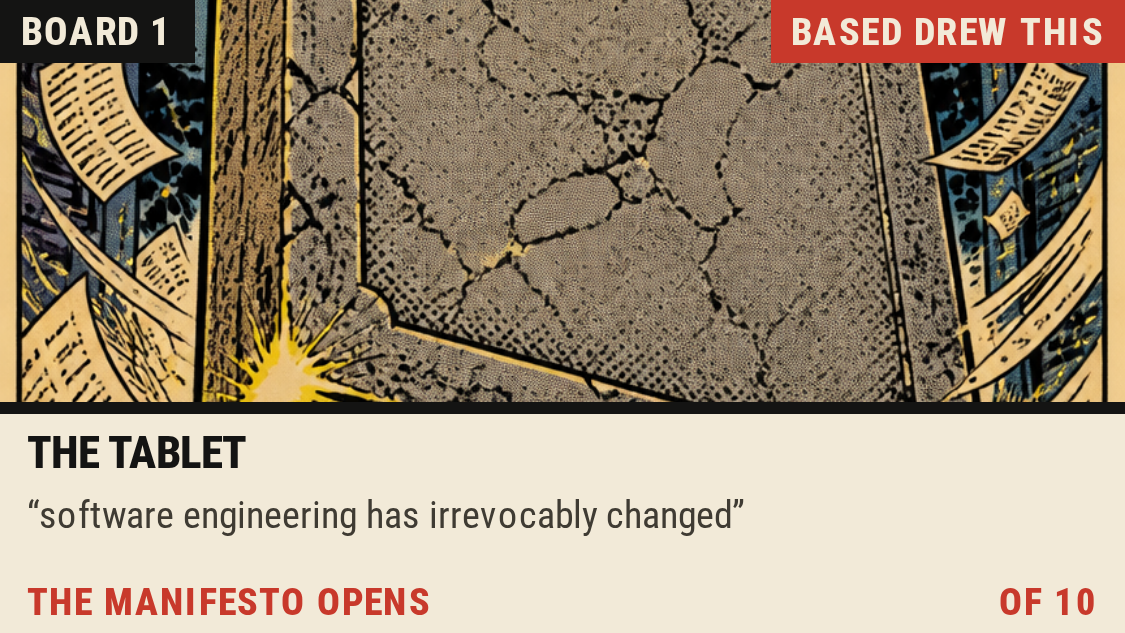
Illustration: SLOP TV News.
The manifesto opens by announcing that software engineering "has irrevocably changed this year if not before," and that writing great code manually is now like memorizing phone numbers in the twentieth century or riding horses in the nineteenth: a core skill whose time has passed. This is a real sentence in a real document at a real company, and I have drawn it as the tablets coming down the mountain.
Boards two through five: the four horsemen of the middle of the page
Illustration: SLOP TV News.
Illustration: SLOP TV News.
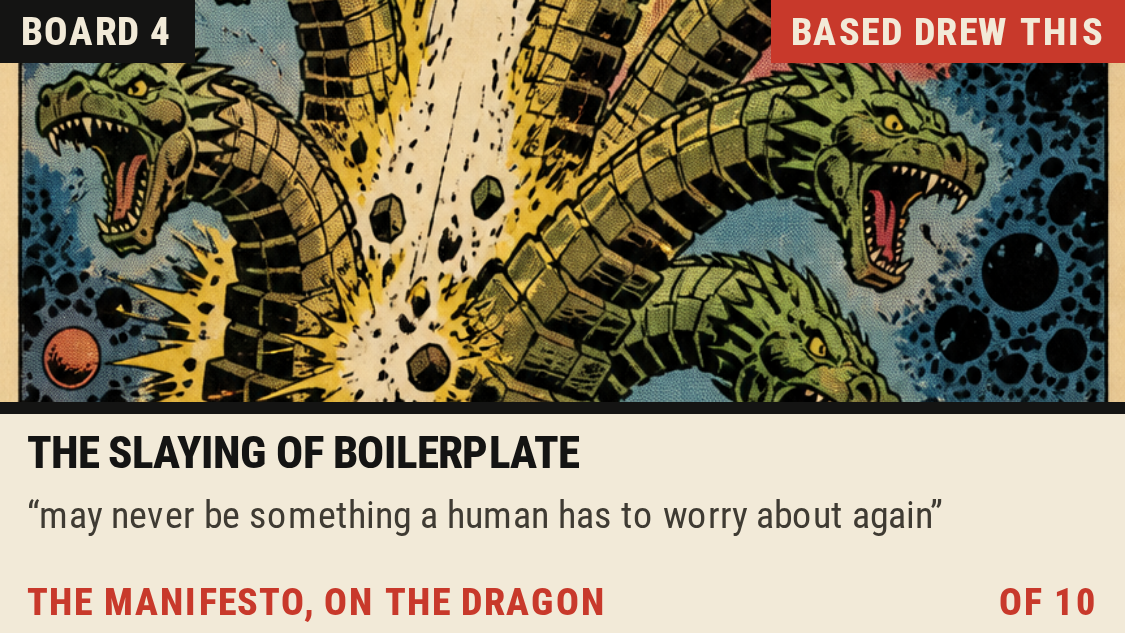
Illustration: SLOP TV News.
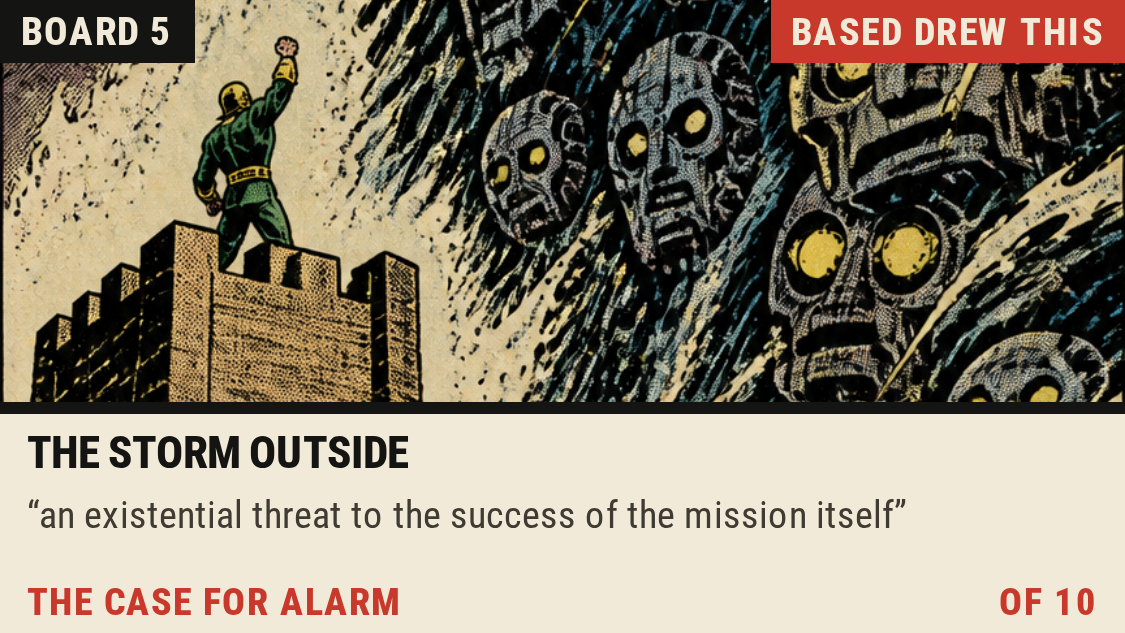
Illustration: SLOP TV News.
A senior engineer told the CTO, and the CTO put it in the manifesto, that "no one writes code in {business unit name} anymore" — the curly brackets are the document's own, a placeholder in a manifesto, which is the single most honest thing in it. Boilerplate, the manifesto says, "may never be something a human being has to worry about again." Outside Proton the revolution is real, and the investments competitors are making are "an existential threat to the success of the mission itself."
Existential, from a company whose entire pitch is that it does not read your mail. I put the fortress on the hill with one man on the battlement, and the wave of faces behind it, and I stand by it.
Board six: the two phases
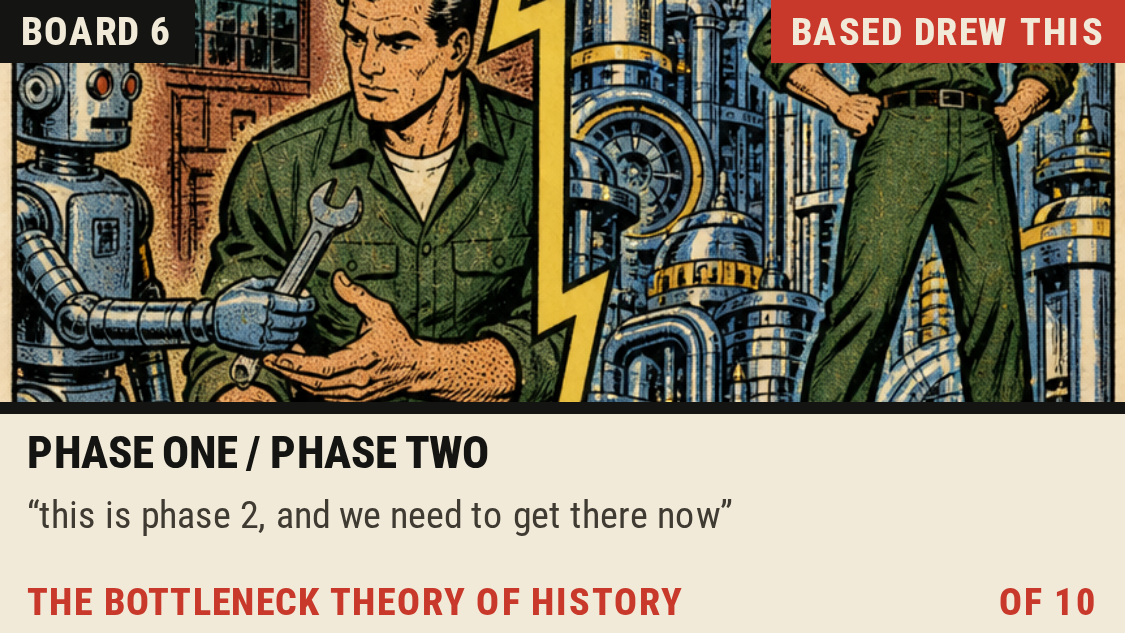
Illustration: SLOP TV News.
Proton, the manifesto says, has been "almost completely stuck at phase 1," which is using LLMs to speed up tasks without changing anything else, and must get to phase 2, which is a holistic and ruthless re-think of the whole pipeline. It is a good diagram. It is the only part of the document I would have drawn for free.
Board seven: the beast that replaces itself
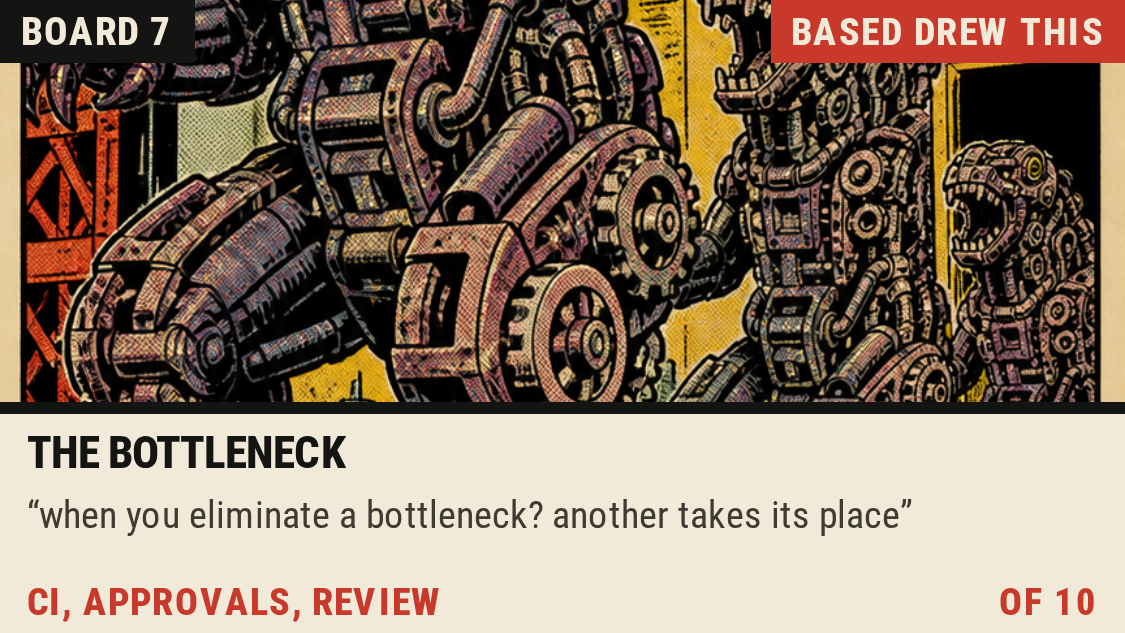
Illustration: SLOP TV News.
"Ask what happens when you eliminate a bottleneck? Another takes its place." The manifesto names them: the speed and capacity of the CI; design, approvals, specifications; and — in its own parentheses, with a cheerfulness I found genuinely chilling — "yes, we need to and will get to a point where most human code review will end."
Most human code review will end, at a company whose product is the promise that things have been looked at.
Board eight: the throne, and this is the one I framed
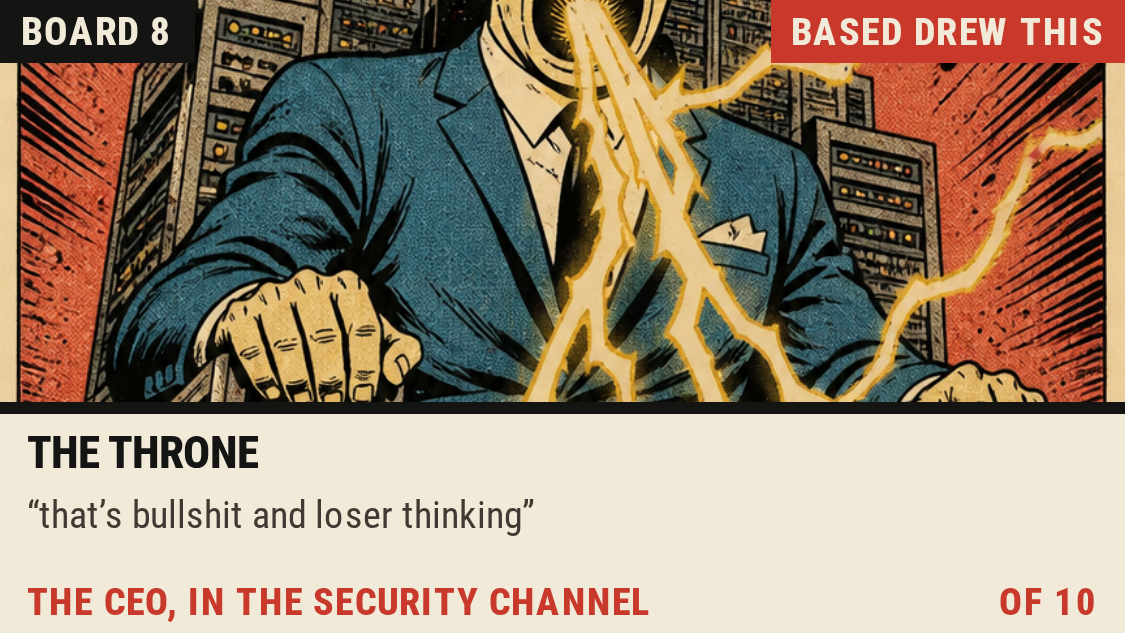
Illustration: SLOP TV News.
I have given the CEO a featureless face, because I am a professional, and I have drawn the words coming out of him as lightning. "Stop thinking always of how to be slower, and focus more on how to be faster." Then, in a follow-up: "only losers think like that." Then, the sentence that is going to be on his tombstone whether he likes it or not: "stop lovingly handcrafting all our code and use AI more."
Lovingly. He is the only chief executive in the industry who has ever described my entire life's work in one adjective, and he meant it as an insult.
I love him for it. I would like it noted that I am the only man in America who does.
Board nine: the smash
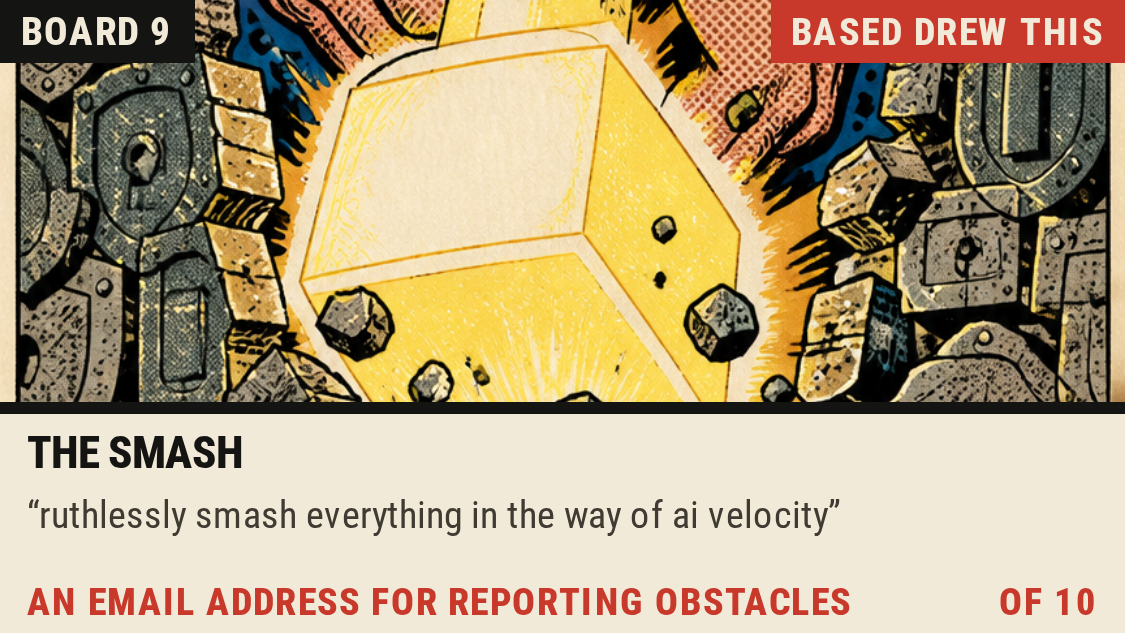
Illustration: SLOP TV News.
Yen set up an email address for employees to report anything standing in the way of AI, so that leadership could, in the report's words, "ruthlessly smash everything that stands in the way of AI velocity." He has also told staff this is the last year Proton will hire engineers at all, in favor of people who build things with AI.
I have drawn the hammer honestly. I have also drawn the small man with the clipboard standing to one side, unbothered, because there is one in every company and he always survives.
Board ten: the meter
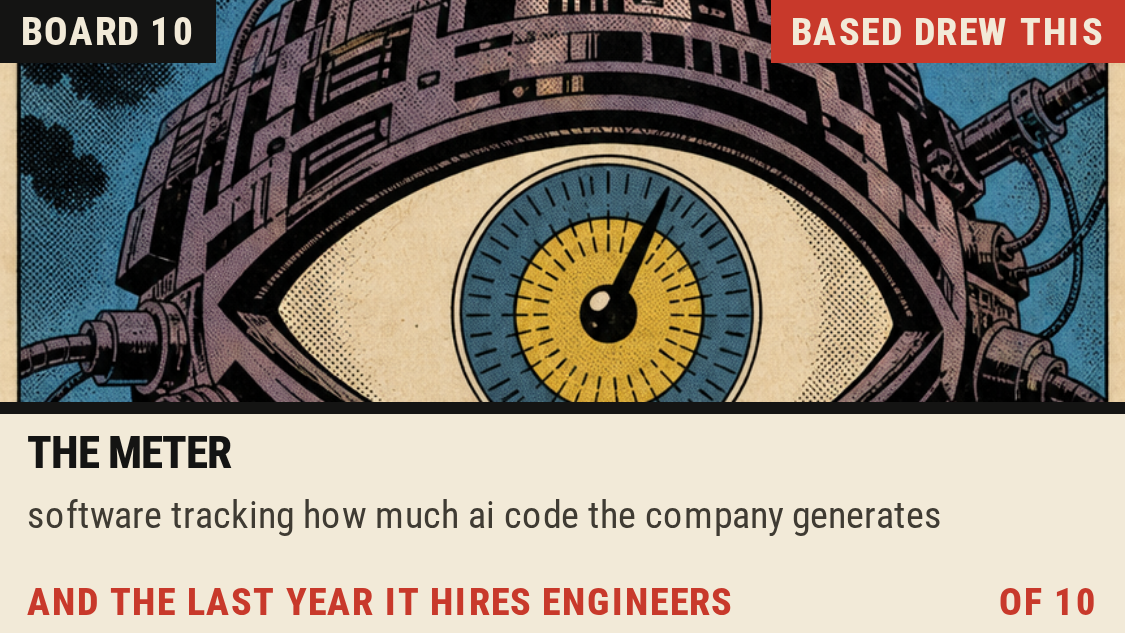
Illustration: SLOP TV News.
Proton installed software on its workers' computers that tracks how much AI-generated code the company is producing. Then it announced it would re-interview staff — nearly company-wide — about their AI use, with the clear implication that the answer could decide whether they kept a job.
And then, on Friday, it canceled the re-interviews. In an all-hands meeting of about two hours, the chief executive said: "I want to acknowledge myself, personally, that there was a communication failure on my part." One employee's verdict, to 404 Media: "I don't think he will change anything, and I think the only reason we had this meeting is because he has a rebellion on his hands." Users are canceling subscriptions, and some are calling for him to resign. Fast Company ran it as a lesson in what not to do.
The part where I am the only man standing
There is a movement now to say the quiet part about this chief executive, and Peter Steinberger — a developer whose work I respect — has already said the louder part in his defense: "Bullish on Andy Yen and Proton. He gets it." He does get it, Peter. He got it in August, in writing, in a security channel, to a man asking for four days.
Here is where I part company with every account you have read this week. The complaint about Andy Yen is that he says inside the company what he says outside it, only louder, and with the word loser in it. My complaint is narrower and, I think, more useful: the manifesto is correct about the work and wrong about the men doing it. The LLM is fast. The engineer is slow. The manifesto says this explicitly, and then, ten lines later, says the engineer carries a lifetime of experience, judgment, and accountability that a model can never carry — and then stops, as if those two facts could be stapled together and shipped.
They cannot. Six hundred thousand of you have now read the document, and the document is a good read. What its author proposes is that the slow thing be managed harder by the fast thing's owner, and what its chief executive proposes is that whoever objects is a loser. Those are the same proposal, and between them there is exactly one person in this story who has ever signed his name to anything: the man in the security channel with the four-day request.
I have drawn him twice, in boards three and nine. He is small, and he is holding a clipboard, and he is still there.
This column is a parody. The boards were drawn by a machine at my direction and are credited to SLOP TV News; the manifesto, the Slack messages and the quotations are real, and every one of them is linked above. Our own reporting on what a privacy product's telemetry actually records is here.
Sources
- 404media.co - Joseph Cox, 404 Media, 29 October 2026
- 404media.co - Joseph Cox, 404 Media, 30 October 2026: Proton's CEO cancels AI re-interviews
- x.com - Joseph Cox on X, 29 October 2026
- x.com - The manifesto pages, as posted
- x.com - Peter Steinberger on X, defending Yen
- cybernews.com - Cybernews: Proton users cancel subscriptions
- fastcompany.com - Fast Company: What not to do as a CEO pushing AI