
Simulon's mammoth is 3D in your room, finished on a server
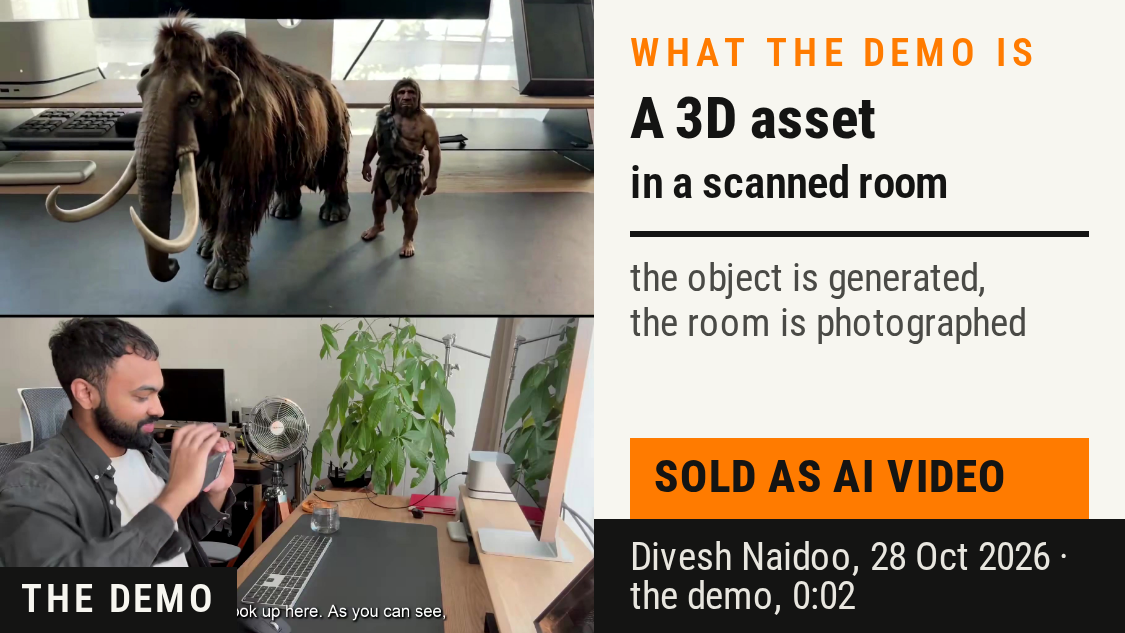
A three-dimensional asset placed in a scanned room, then finished by a cloud render. The demo that 180,000 people shared has no video model in it.
Key takeaways
- Simulon's Reality-Aware Rendering demo is a three-dimensional neural asset placed into a scanned room and finished by a cloud render, not a video model that invents the room; the object is generated, the room is photographed.
- Creating a custom asset requires a paid plan: Simulon Plus at $14.99 a month or Pro at $39.99 a month, after 100 one-time free credits that work on library assets only, with top-ups from $4.99 for 100 credits.
- The app is iPhone-only at iOS 17 or later and 71.7 megabytes from Beamm Technologies Inc, and the App Store listing still carries legacy tiers (Core $29, Studio $200, Lite $15) beside the current ones.
- Founder Divesh Naidoo drew the line in 2024: the machine learning in Simulon made the lighting, and it was not generative AI; under the 2023 clips, viewers were already saying 'This isn't AR. It's rendered off-line.'
Eighty seconds long, 1920 by 2160, and by the time I saw it more than 180,000 other people had too. A man stands in an office in Cape Town with his phone up and an elephant the size of the desks walks between the monitors. Somebody threw water at its legs and the legs answered.
I have watched that clip more times than is healthy, and I want to say the true thing about it before the enthusiasm crowd gets its hands on it. There is no video model in that demo. There is a three-dimensional object standing in a room that was scanned, and then a server finished the picture.
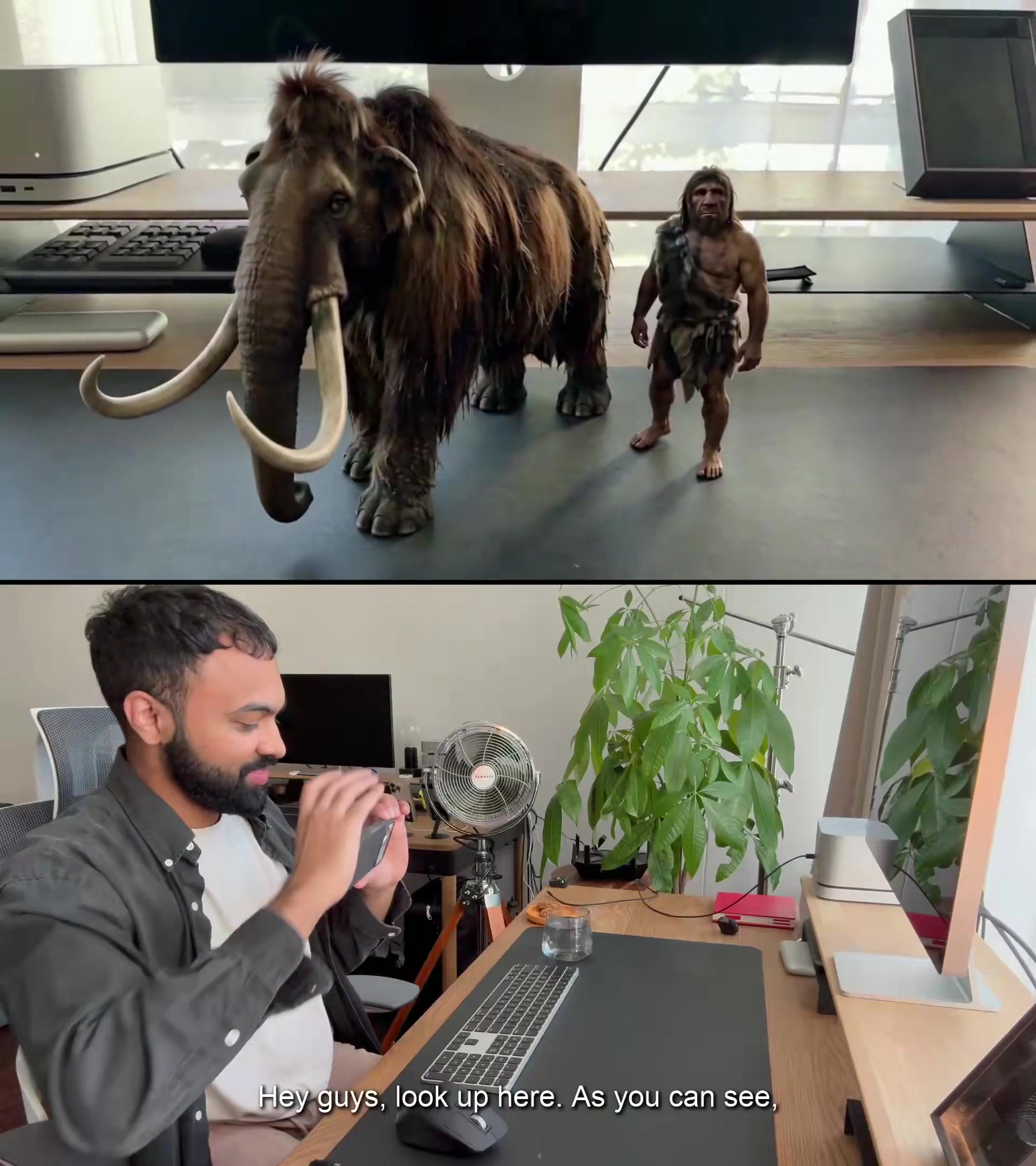
Divesh Naidoo, 28 October 2026, 0:02. Source: https://x.com/diveshnaidoo/status/2115477721455214623.
The inventory
Here is what the machine actually is, because the marketing does not say it in one place and the readers deserve it in one place.
The app is Simulon, an iPhone app from Beamm Technologies Inc, iOS 17 or later, 71.7 megabytes, free to download. It captures your room. Machine learning turns one ordinary camera pass into a full 360-degree environment map so the lighting is measured rather than guessed. You place a thing in the viewfinder. You act. The final shot is rendered in the cloud, which is why the finished file looks better than the preview you were watching, and why the pipeline was never the real-time miracle the clips imply.
And then the prices, which is where the tent gets interesting:
- Free: 100 starter credits, library assets only, one-time gift and no refill.
- Plus: $14.99 a month. Pro: $39.99 a month.
- Own your ideas: creating a subject of your own requires one of those two plans.
- Top-ups: 100 credits $4.99, 260 for $12.99, 500 for $24.99.
The App Store listing tells it messier: Core at $29, Plus at $24.99 and $239, Pro at $55, Studio at $200, Lite at $15, credit packs at $19.99 and $5.00, old tiers and new sitting in the same list like receipts in a coat pocket.
The law of the trade, as near as I can work it out
A camera that finishes its frames on a server is a render farm with a viewfinder, and render farms have been in the movie business since before I could drive.
That is not a knock. It is a correction of the label. What the mammoth demo proves is that a phone can now capture a room well enough to light a foreign object convincingly, and that a cloud render can put it in the plate. That is a real achievement and it took them seven years. What it is not is a model that understands your office and invents an elephant in it. Nobody generated that room. They scanned it.
The room said it first
The technical audience has been saying this since 2023, when the clips first started making the rounds and strangers were arriving at the comments with their hands over their mouths. Under one of them a commenter put it in six words: "This isn't AR. It's rendered off-line." Another was kinder and said the same thing at length, that the app used augmented reality to help you compose the shot and the output everyone admired was finished afterwards in the cloud. The founder had to post a side-by-side that week because so many people believed a real object had been in the original frame. Creative Bloq ran it as "This new iPhone VFX app is already blowing minds" and quoted a stranger saying "Hard to believe this isn't a hand-made render and compositing", which was meant as praise and is now the most load-bearing sentence in the file.
The maker has never actually hidden it. In 2024, describing the pipeline, Naidoo drew the line himself: the machine learning in Simulon made the lighting, and it was not generative AI. Then Reality-Aware Rendering arrived in version 2.1.0, five days before the mammoth, and the copy moved: "The final is regenerated from your recording: a new performance of the scene, not a copy of the footage." Water thrown at the legs now earns a reaction, which means something is generating. But the object is still three-dimensional, the room is still a scan, and the mammoth still occupies a place in your office that was photographed, not imagined.
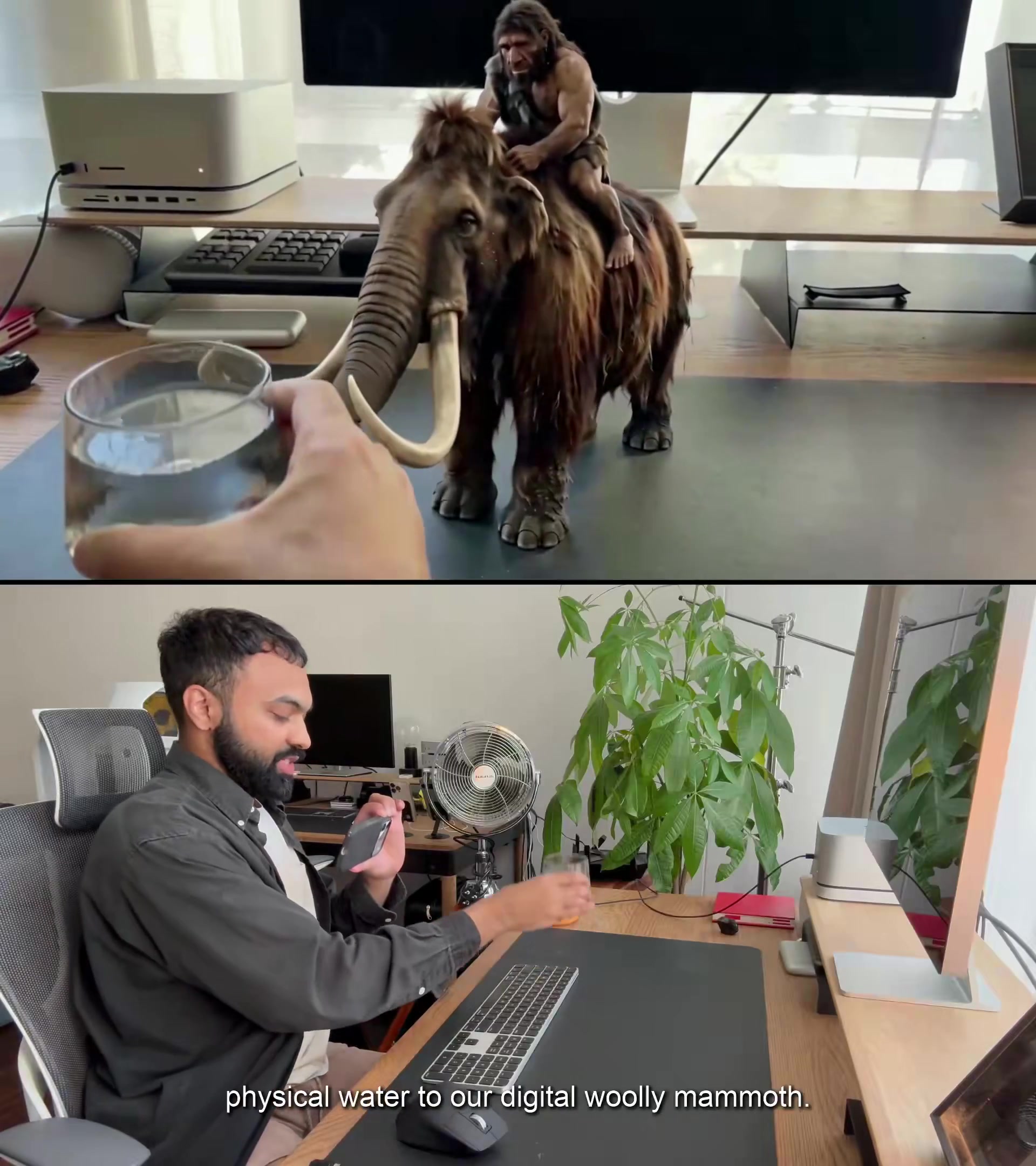
Divesh Naidoo, 28 October 2026, 0:26. Source: https://x.com/diveshnaidoo/status/2115477721455214623.
What the reviews argue about
The App Store sits at 4.4 out of 5 from 31 ratings, and the best-written review on the page is the one-star, because it is the complaint the pricing manufactures. "I bought this app thinking it was a free fun fx app but after 10 hours of setting up it demanded payment," it reads. Simulon answered it in public, on the listing, without the marketing voice:
"The app does not take 10 hours to set up and we have always offered a free trial."
So: free to download, paid to make anything of your own, and per-credit after that. A creator who saw the mammoth, installed the app and wanted a mammoth of their own is looking at $14.99 a month before the first usable render, which is a different proposition from the one the demo advertised. That is where a hit becomes a bill, and it is where most of these launches quietly die.
What it means for the rest of us
Two things, and I hold both.
The scary camp is right and getting righter. Under a 2024 repost of the mosquito in amber one commenter wrote would there be any footage left that counts as proof, and we have spent the two years since proving them correct — a viral clip in this country was ruled a fake, and a detector showed up from Kling and Peking University that at least shows its work while it tells you so.
And the boring camp is right too, which is the part nobody wants to hear. There is nothing new under this hood except the room scan. EdenLive hit 720p at 24.7 frames a second on one desktop card, SpAItial's Echo-3 builds a measurable world out of a phone scan, and FilmFlow drives a Blender camera from a sentence. We have been watching generative video and three-dimensional capture walk toward each other for a year. Simulon is where they meet, wearing a costume that says AI video on it while the actual payload is a very good compositor.

Illustration: SLOP TV News.
The one that broke my brain
Three weeks before the mammoth, the same account posted something quieter: a quagga, extinct since 1883, cloned from a photograph and filmed walking through the museum where its remains are on display. "There's something surreal about seeing it move through the museum where it's on display."
That is the product in one sentence and the problem in one sentence, and both halves are true at once. The animal does not exist. The room does. That is the whole trick, and it is a good enough trick that it does not need the word AI in front of it.
More from SLOP TV
- SpAItial's Echo-3 turns phone scans into metric 3D worlds
- EdenLive renders 720p video at 24.7 FPS on one RTX 5090
- FilmFlow turns a text prompt into a Blender camera path
- Kling and Peking University publish a detector that shows its work
- Viral Talarico clip is a deepfake, fact checkers say
- World models guide: Genie 3, GWM and open weights, updated weekly