
Is Higgsfield's Three.js bazaar real? What Claude Fable 5.2 actually changes for AI filmmaking
Higgsfield says every pixel of its 21.5-second Bombay bazaar is Three.js code. Three.js can do that — a 4x4 km WebGPU world proves it, source and seed included — but the tells in these frames say the textures arrived by the other road. Plus a lip-sync dub timed to 7 milliseconds, against a broadcast threshold of 45.
Key takeaways
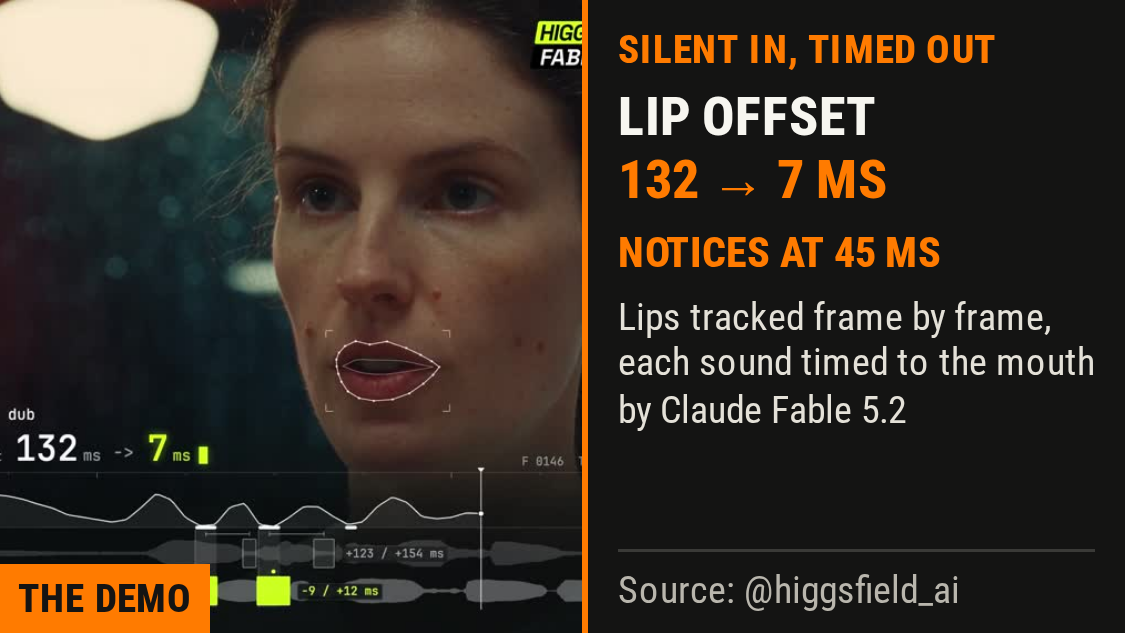
- Higgsfield released a demo on 9 November 2026 in which Claude Fable 5.2 took a silent video, tracked the speaker's lips frame by frame, and timed a generated voice track to match, with the demo's own readout showing a median lip offset of 132 milliseconds falling to 7.
- Higgsfield's second demo claims that every pixel of a 21.5-second Bombay bazaar, in six shots, is Three.js code; the frames themselves show photoreal generated imagery, and the platform sells Claude alongside its own video and image models through an MCP server.
- A verifiable code-only example exists: LAAS, an MIT-licensed procedural 4x4 km world running in a browser on WebGPU, released with its source, its seed parameter and a README stating that no image, model or audio assets are in the repository.
- Programmatic video is a different category from generated video: the code describes each frame, the output is deterministic and re-renderable, and Three.js is one of the renderers, alongside Remotion and HyperFrames.
- The ITU's broadcast recommendation, BT.1359-1, puts the average detectability threshold for sound against vision at about +45 to minus 125 milliseconds, and acceptability at about +90 to minus 185.
The demo Higgsfield posted on Monday night is nineteen seconds long and almost all of it is a diagnostic overlay. There is a woman in close-up under neon, and across her mouth a tracked wireframe: the lip contour, vertex by vertex, frame by frame. Underneath her, three strips run in parallel — LIPS, ORIG, DUB — with waveforms and green blocks marking where each lands on the timeline. The captions are terminal commands. input: silent video. voice timed to her lips by code. And in the bottom corner, at frame 0146, the number the whole thing is about:
median lip offset 132 → 7 ms
The post says it plainly: "We asked Fable 5.2 to put words in her mouth. Precisely. It tracked the lips frame by frame and timed each sound to match. Made with Higgsfield." It has 15,833 views and 232 likes, which is a small number for a claim of this size, and that is worth understanding before the claim is assessed.
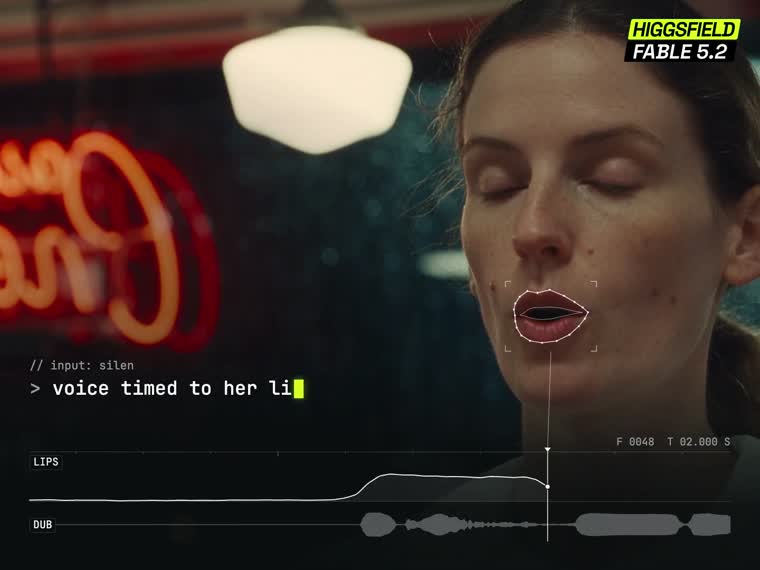
@higgsfield_ai, 9 Nov 2026, 0:02. Source: https://x.com/higgsfield_ai/status/2119909938969580024.
What the demo actually does
The workflow being shown is not video generation. It is audio placement, which is the other half of the problem and historically the more stubborn one.
Higgsfield's own help pages split the tools clearly. Voice generation, voice replacement and translation live in Audio — the platform offers text to speech, voice change, and a translate mode covering 18 languages. Making a character talk lives in Lipsync Studio, under Video, with separate pipelines for image-to-video and video-to-video and scene templates called General, Selfie, Podcast and Car Talking. What changed in this demo is who is driving: instead of a person nudging a dubbing slider until the mouth stops looking dubbed, Claude Fable 5.2 read the frames, found the mouth, and wrote the timing.
That is a job the model is actually built for. Fable 5.2 takes images as input alongside text, holds a million tokens of context, and costs $8 per million input tokens and $40 per million output. Frame-by-frame lip analysis across a sequence is exactly the kind of long, tedious, structured task that has been the argument for these models in post-production. Nothing here requires the model to draw a single pixel. Higgsfield renders; Claude keeps time.
Why seven milliseconds is the number that matters
For a claim like this, the honest measuring stick is not a rival demo. It is the broadcast standard.
Recommendation ITU-R BT.1359-1, Relative timing of sound and vision for broadcasting, is the document the industry has been arguing from since 1998. It reports that subjective evaluations put the detectability threshold at about +45 milliseconds to −125 milliseconds, and the acceptability threshold at about +90 to −185, where a positive value means the sound is ahead of the picture. Outside those windows, viewers notice, and then they complain.
A median offset of 7 milliseconds sits deep inside the detectability window.
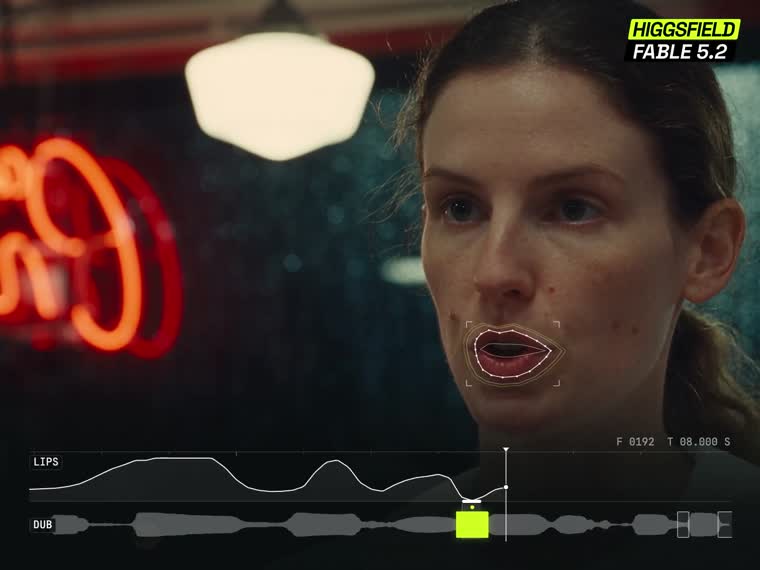
@higgsfield_ai, 9 Nov 2026, 0:08. Source: https://x.com/higgsfield_ai/status/2119909938969580024. On this measurement, the audio is not merely acceptable; it is closer than most viewers can perceive, and closer than a great deal of broadcast television manages on a bad day. If the number holds up outside a single nineteen-second close-up, the practical consequence is that dubbing stops being a revision cycle and becomes a build step: you set the language, you run the pass, and the worst case is a frame-by-frame review rather than a re-record.
The implications, stated without inflation
Dialogue was the last mile of AI film, and it just got shorter. The AI short-film scene has spent two years solving the picture — plates, characters, camera moves, weather — while dialogue remained the tell. A model that can look at an unmoving mouth and generate a track that matches it also, by definition, can do the reverse: take a performance in one language and place it in another.
Translation turns a film into eighteen prints. Higgsfield's translate mode covers 18 languages, and the step that used to require a casting session per territory is now a run of the same tool. That is an economic event for anyone selling to more than one market, and it is the reason the union language below reads the way it does.
The archive becomes talkable. A silent clip is no longer a silent clip. Every dignity-restoring use of that — a family film, a newsreel, an interview whose audio did not survive — is a genuine good. So is every misattribution of words to a person who never said them, which is the reason a visible technical overlay in the demo is not an aesthetic choice.
Consent stops being a footnote. SAG-AFTRA's 2026 TV/Theatrical agreement — we covered the terms here — requires consent to use a performer's digital replica to dub their performance into another language, for motion pictures starting 1 July 2027, and carries the principle that there will be no synthetic performer in a human role unless it brings significant additional value over a digital replica. The demo's own platform says the same thing in its help center, in one line: only clone a voice that is yours or that you have permission to use. Nineteen seconds of technology, and the compliance question is already built into the feature list.
The second demo: 21.5 seconds that Higgsfield says is code
Three hours after the lip-sync clip, the same account posted a different kind of claim. "Fable 5.2 generates insane Three.js videos," it says. "As a leading AI video company, we have to say: the progress is super fast. Every pixel in this Bombay bazaar is code. 6 shots, 21.5 seconds." That post has 10,237 views and 95 bookmarks — a tenth of the audience of the lip-sync demo, and the more interesting of the two.
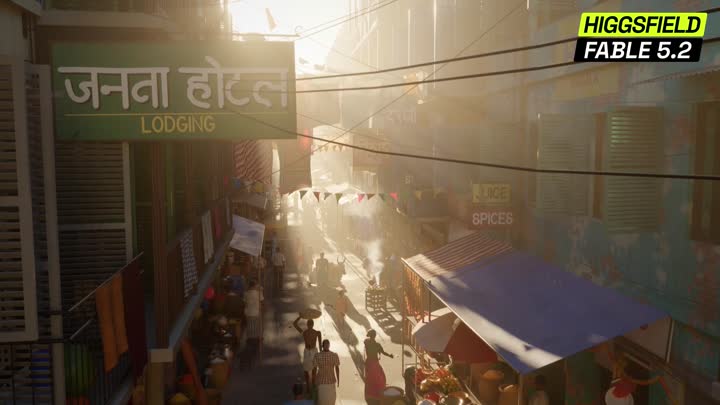
@higgsfield_ai, 9 Nov 2026, 0:03. Source: https://x.com/higgsfield_ai/status/2119918834841010320.
Three.js is the piece of software in question, and it is worth being precise about because the phrase "Three.js video" is doing a lot of work. It is, in its own manual's words, "a 3D library that tries to make it as easy as possible to get 3D content on a webpage" — commonly confused with WebGL, which is the low-level system underneath it that "only draws points, lines, and triangles". Three.js handles what you would otherwise write yourself: scenes, lights, shadows, materials, textures and the 3D math, with a Scene and a Camera handed to a Renderer. The current release is r187, and the library now ships WebGL and WebGPU renderers.
This matters because it belongs to a category that is genuinely different from everything else on this page. The explainer writers at Pexo draw the line cleanly: programmatic video means writing code that describes what appears on each frame. Remotion does it in React and TypeScript and has more than 126,000 installs inside the Claude Code ecosystem; HyperFrames does it in HTML, CSS, GSAP and Three.js. A headless browser captures each frame at a stated framerate and FFmpeg stitches them into an MP4. The output is deterministic — the same code produces the same video every time, with no generation involved. As they put it, the video is "a recording of rendered web content". AI-generated video is the other paradigm: you describe intent in natural language and receive footage with motion, lighting and performance you did not specify.
For a filmmaker the difference is not philosophical. Code-rendered footage can be re-rendered at any resolution, re-timed, re-lit and version-controlled, and it costs GPU time rather than generations. It is also, frame for frame, the wrong tool for a face or a crowd — which is exactly why the two demos in this week's Higgsfield posts are not the same achievement.
Is the bazaar real? Here is what the frames can and cannot tell you
I downloaded the bazaar clip — 1920×1080, 24 frames a second, 21.5 seconds — and cut stills from all six shots. Then I looked at them the way you look at a claim.
What a code-rendered Three.js scene gives itself away by is geometry and light that obey the API: primitives with visible construction, matte or physically-based surfaces, hard silhouette edges, and the flatness that comes from a scene graph built out of meshes rather than photographed. What these frames show instead is volumetric shafts through a market, soft depth of field, cloth on the line, produce on a tray, a cow, silhouetted figures, and shopfront signage in Devanagari and Bengali that is typographically clean. Every frame carries Higgsfield's own HIGGSFIELD / FABLE 5.2 wordmark in the corner.
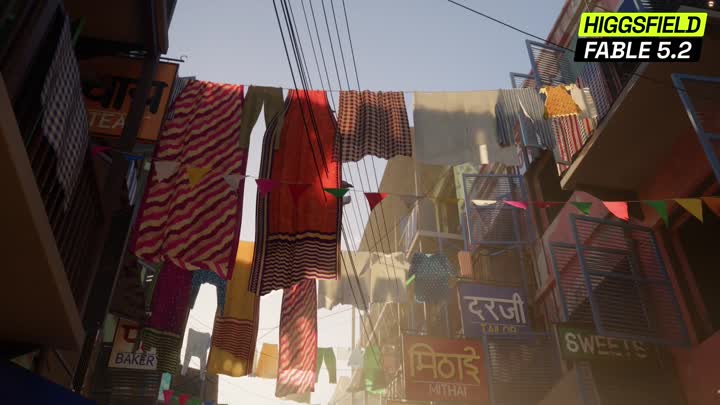
@higgsfield_ai, 9 Nov 2026, 0:18. Source: https://x.com/higgsfield_ai/status/2119918834841010320. That is not the signature of a scene assembled from Three.js primitives. It is the signature of generated imagery.
That does not make the post a lie, and the likelier reading is more mundane: Higgsfield sells Claude and its own models as a package. Its launch post for the pairing says Anthropic's model "excels at 3D modeling, visual reasoning, computer use and coding", while Higgsfield's MCP provides access to its video and image models. If Claude authored the scene, the camera moves and the timing while Higgsfield's models supplied the look, then "every pixel is code" is a description of the direction, not of the pixels — which is a much smaller claim than the sentence makes.
What a code-only world actually looks like, verifiably. On 12 June 2026 an MIT-licensed repository appeared called LAAS — Estonian for old-growth forest. It is a fully procedural 4×4 km open world running in a browser on WebGPU: three.js' WebGPURenderer with TSL materials and raw WGSL compute, TypeScript with strict typing and no WebGL fallback, reproducible from a single URL parameter, ?seed=N. Its README states the standard the bazaar post does not: "Unedited engine output. Every mesh, texture, and light in this frame is generated by code at boot — the repository contains no image, model, or audio assets."
The repository is public, MIT-licensed, has 728 stars and 113 forks, and the interesting part is how it was made. Roughly 99% of it was written by the model, with the human contributing one document — the brief, which set the visual bar and the banned outcomes without saying how to build any of it — plus occasional notes on things a model cannot judge from a still: wind sway, camera bob, whether an artefact only shows up in motion. The model ran its own quality assurance: booting the world headless with Playwright, sampling pixels, diffing frames against baselines, profiling GPU passes and writing regression probes for bugs it found. That is what the code-only claim looks like when someone is prepared to be checked.
And there is a precedent for treating these posts carefully. On 19 September 2026 a tester posted a Brawl Stars-style game reportedly built in about an hour with Three.js, with a public artifact link and a follow-up prompt: "Can you make a 3JS Brawl Stars clone, focusing especially on lighting and shadows for the game?" The build was real and playable. The model attribution was not verified — Anthropic's own documentation still listed Fable 5.1 as the latest public Fable model on the day it was posted. The analyst who wrote it up drew the honest line: the disruption shows up first in prototype speed and cost, not in replacing production art pipelines, live operations or design judgment.
So, is the Bombay bazaar real? The clip is real, the six shots are real, and the platform that posted it is real. The claim that every pixel is code is unverified, and it is posted nine days after the same company started selling three days of unlimited access to its models through an MCP server. What would settle it is what LAAS published on day one: the scene graph, a playable URL, a seed, or a render time. Until then the fair reading is that a model with strong 3D and coding abilities drove a render — and that the textures arrived by the other road.
What the demo does not show
Four honest caveats, in the order they will bite a producer.
It is a median. A median offset of 7 ms can hide a worst frame of 60 ms, and it is the worst frame that a viewer sees. The demo does not publish a distribution.
It is one face, in close-up, in a static frame. A two-hander, a profile walking through dialogue, a mouth behind a hand, a man chewing while he talks — those are the cases that break lip tracking, and none of them are in the nineteen seconds.
It does not say what a bad take costs. One pass at a median of 132 ms and a second at 7 is a story about iteration. What a producer needs to know is how many passes it takes for a sequence that fights back, and whether the output arrives stable or in need of hand timing.
And sync is not performance. A mouth can match a waveform to the millisecond and still be acting badly. The gap that remains in AI film is not timing. It is intention — the reason a line is said the way it is said.
Where this sits in the year
Higgsfield is not a neutral observer of its own demo, and the timeline is worth keeping straight. The same platform paid out $1,000,000 in prizes on 1 November to 14 AI short films, chosen from 5,000 submissions out of 176 countries by a jury that included Pixar co-founder Edwin Catmull. Its festival rules required films of at least three minutes, built entirely inside its Cinema Studio, with all music, voice and sound made by AI. The winning film, Listen to Meh, is a dialogue-free comedy from Argentina — a sheep on a gaucho's roof, no conversation at all.
The week that festival crowned a film with no dialogue, a model arrived that can time a voice to a face to within 7 milliseconds. The next festival's winners will not have the option of staying silent.
The Higgsfield post, its clip and its readout are real and are linked above; two frames from it are reprinted below with the source. The ITU thresholds, the SAG-AFTRA terms and the festival figures are quoted from the documents themselves, and Higgsfield's platform details come from its own help center. Where a number in this piece is our own arithmetic on published figures, it says so.
Sources
- x.com - the demo post, its clip and its readout; frames reprinted
- itu.int - the broadcast recommendation, thresholds quoted from the text
- higgsfield.ai - the platform's own help centre: Audio tools, transcripts, Lipsync Studio
- sagaftra.org - the union's own summary, dubbing consent from 1 July 2027
- sloptvnews.com - our own - the agreement's terms
- sloptvnews.com - our own - the festival figures, by this byline
- anthropic.com - the model's capabilities and price
- x.com - the Three.js claim and its clip; frames reprinted
- threejs.org - the library's own manual, quoted on what it is
- github.com - the library's repository and WebGL/WebGPU renderers
- github.com - LAAS: source, seed parameter and the code-only statement, MIT, 728 stars
- aiidelist.com - the September Three.js precedent and its unverified attribution
- pexo.ai - programmatic versus generated video, Remotion and HyperFrames
- x.com - Higgsfield's launch post for the pairing and its free-access offer