
Claude Fable 5.2 formalized Fermat in 30 hours, and the memes wrote themselves
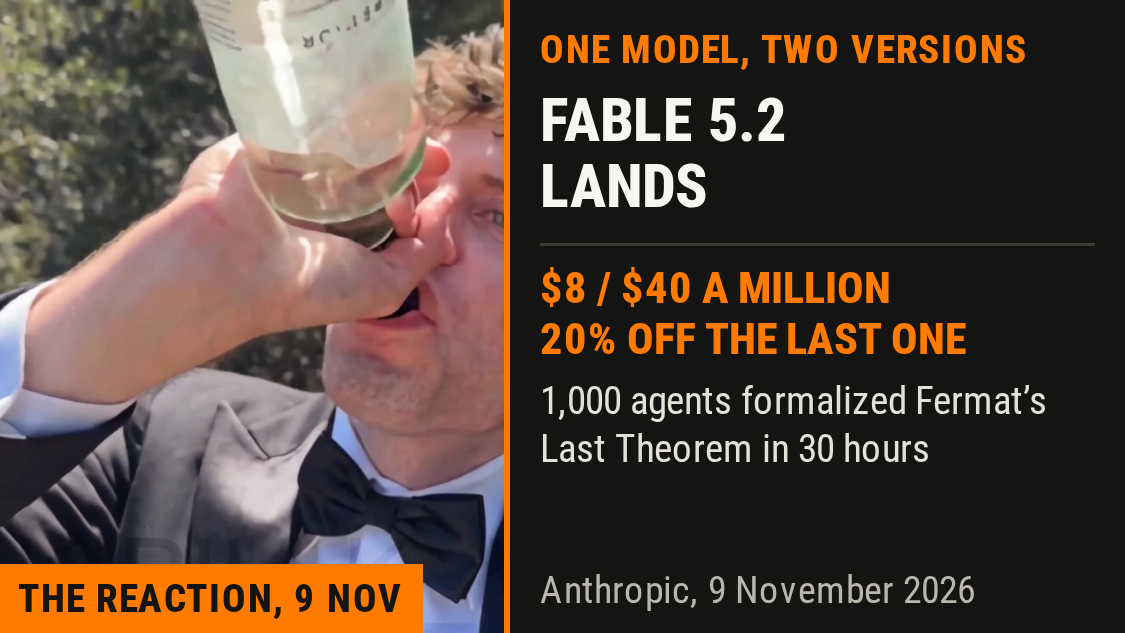
Anthropic's new frontier pair costs 20% less than the last one, claims a 30-hour formalization of Fermat's Last Theorem, and quietly reserves the better-guarded half for vetted organizations — days before an IPO. The reaction: a tuxedo, a bottle, and a cigarette called Fable 5.5.
Key takeaways
- Anthropic released Claude Fable 5.2 and Claude Mythos 5.2 on 9 November 2026 at $8 per million input tokens and $40 per million output, down from $10 and $50 for the 5.1 generation.
- Fable and Mythos are the same underlying model; Mythos is the configuration with stronger cyber and biology safeguards, available only through Anthropic's verification programs.
- Anthropic says 1,000 Fable 5.2 agents formalized Fermat's Last Theorem in 30 hours, against 11 days for its first, unreleased formalization; the claim drew immediate scepticism on Hacker News.
- The launch is Anthropic's first frontier release since CEO Dario Amodei called for slowing AI development in September, and lands as the company prepares an IPO that CNBC reports could come as soon as the following week.
- Reaction split between "best model ever created" and "it's basically a school hall monitor", with cost and usage limits the loudest second theme.
Anthropic released two models on Monday and the internet spent the following twelve hours doing what it does: pricing them, arguing about whether the benchmark chart was a straight line or a magic trick, and making a man in a tuxedo drink from a bottle in the woods.
The models are Claude Fable 5.2 and Claude Mythos 5.2, announced at 18:57 UTC on 9 November. The launch post says they show "improvements in areas like coding, reasoning, and vision", that they generate output up to 30% faster than the 5.1 generation, and that they cost $8 per million input tokens and $40 per million output — a 20% cut on both. The announcement post has 8.4 million views.
What Anthropic actually shipped
The first thing to understand is that Fable 5.2 and Mythos 5.2 are the same model. Anthropic's post says it plainly: "Claude Fable and Claude Mythos are the same underlying model." The difference is the guardrails. Fable carries what the company calls strong cybersecurity and biology safeguards, which is what allows it to be sold to anyone; Mythos is the version with those safeguards at their strongest, sold only to organizations verified through Anthropic's Cyber and Life Sciences verification programs. VentureBeat describes the vetting as Project Glasswing.
The specifications are on Anthropic's own model page: 1 million token context, 128K max output, adaptive thinking that is always on, a default effort setting of high, and a knowledge cutoff of June 2026. It is listed on the Claude API, Amazon Bedrock, Google Cloud, Microsoft Foundry and Claude Platform on AWS. There is an optional fast mode at $16 and $80 per million tokens, which Anthropic says speeds up generation by up to 2.5 times.
Prices, as published:
- Fable 5.2 / Mythos 5.2 — $8 input, $40 output, $0.20 cache read, $10 and $16 cache write (5 minutes and 1 hour)
- The 5.1 generation it replaces — $10 input, $50 output, $0.25 cache read
- Opus 5.5, which Anthropic recommends as the daily driver for most coding and knowledge work — $4 input, $20 output
Anthropic is explicitly not telling you to run everything on the new model. Its own advice is to start on Opus 5.5 and move up to Fable or Mythos when the work demands it, or down to Sonnet 5.5 or Haiku 5.5. Fable 5.2 can also serve as the Advisor in a multi-model setup.
The 30-hour proof, and the room's verdict on it
The claim that traveled furthest came out of the system card: during prerelease testing, the models helped Anthropic's engineers complete "otherwise-infeasible software migrations", designed three working electronic devices from scratch, made progress on robotics evaluations and formalized the proof of Fermat's Last Theorem in 30 hours.
The comparison Anthropic publishes is the striking part. Its first formalization of the theorem, by an unreleased research version of Claude, took 11 days and leaned on a purpose-built harness and a human researcher's guidance. This time, a thousand Fable 5.2 agents finished in 30 hours with minimal human intervention, needing a third of the action tokens and producing a proof seven times shorter. With the identical thousand-agent setup, Opus 5.5 completed only 26% of the formalization in 18 hours and "barely made any more progress after 30".
On the Hacker News thread — 948 points, 574 comments — that landed as either the singularity or a press release. "We are truly inside the singularity," wrote one commenter, quoting the system card. Another answered with the resource-constraint argument: nitrogen fixation before the green revolution, then testing, then the fact that "you still need to first find out what to build in the first place". A third read the thousand-agent number as a ceiling rather than a triumph: "I would imagine Anthropic is hitting a wall on the number of simultaneous agents that can be useful on a task."
The cut is real; the effort dial is where the money goes
The 20% reduction is the headline number for finance departments. The number for engineering departments is stranger, and it is the one engineers spent Monday evening posting charts about.
On Cognition's FrontierCode 2.0 test, Anthropic's system card puts the average cost of a task on Fable 5.2 at $6.72 with effort set to High, against $12.82 for Opus 5.5 at Max — for a near-identical score. But turning Fable all the way up to Max effort drove the average task cost to $44.70 and produced a lower score than the cheaper Xhigh setting.
Yuchen Guo posted the chart and the arithmetic that goes with it: Max landed at 45.6% accuracy for $44.70 a task, while Xhigh scored higher, at roughly 49%, for around $12. His verdict, roughly translated: Max is paying more for a worse result. VentureBeat reported the same trade-off from the system card.
On r/ClaudeAI, where the launch thread ran to hundreds of comments, a reader posted the same graph and asked what it meant. The top reply: "Yes. Lots of benchmarks show that behavior, but not all of them. So generally, if you are using Max, it should be as a test, or for a purpose you have benchmarked yourself." Another: "The most advanced models all display signs of overthinking at Max effort."
The community's own automated summary of the 200 comments in that thread is blunter than any review: "The community is pretty whelmed by Fable 5.2, with most people deciding to stick with good ol' Opus 5.5 for now. The general vibe is confusion over its purpose."
The memes
The meme that DataChaz posted, captioning it "Ram Altman right now:" and quoting Anthropic's announcement underneath, is a man in a black tie in the dry hills drinking straight from a bottle of clear liquor, then staring into the lens with the expression of a man who has just read a benchmark chart. It is the least subtle thing posted on Monday and it went around regardless.

@datachaz, 9 Nov 2026. Source: https://x.com/datachaz/status/2119880510612660505.
The other one is more committed. On 2 November, a week before the launch, @apples_jimmy posted an image of Sam Altman in a black suit holding out a pack of cigarettes labeled "Fable 5.5" — a model that does not exist — with the caption "One smooth hit of the 5.5s and you're in Flavor Town. So kid what will be, wanna have a smoke with your ol pal Dario?" It has 18,457 views and 536 likes, and it is now a small monument to how fast this market moves: the joke about the next model shipped before the current one did.

@apples_jimmy, 2 Nov 2026. Source: https://x.com/apples_jimmy/status/2117067062132740381.
Earlier still, on 27 October, @argofowl was asking the room: "fable 5.5, are you here with us? 👀" — 5,698 views. The appetite for the next version is apparently stronger than the appetite for this one.
What the room says
The most-quoted review is Matt Shumer's, and it is two sentences long in its X form: "Fable 5.2 is the best model ever created. The things I created with it are mind-blowing. It's also basically a school hall monitor." That post has 104,958 views and 996 likes. His follow-up, showing a game he built in which weather matches the real Earth in real time — "Fable 5.2 created a MIRROR EARTH as a game" — has 172,829 views and 1,483 likes.
His long review is titled "It's Smarter Than Me. It's Also a Narc." He puts almost 400 billion tokens through it, says he would trust it to run large parts of his company, and counts the cost: it refused to ship a routine product change until he had published the accompanying privacy-policy update first. In a multi-agent setup he describes reviews, sign-offs and agents waiting on other agents — bureaucracy, generated at token rates. His practical advice: give one agent ownership of a project rather than a committee.
Sentiment across the platforms, tallied by Opportunity Market, which read 605 public comments and found 259 on topic from 240 people: 28% impressed by coding and design, 23% worried about costs and account limits, 17% treating the release as a step toward AGI, 13% praising the announcement video. The single most-liked quote in its sample is a joke about the calendar: "Claude: Give me the most impressive demos you can think of before the IPO. Make no mistakes!!!"
That is the axis the launch sits on. On CNBC's reading, this is Anthropic's first frontier release since CEO Dario Amodei called in September for slowing the pace of AI development, and it arrives as the company readies what the network describes as a potentially historic IPO that could come as soon as next week. Fortune frames the pricing as a shot at OpenAI's GPT-6 Astra: cheaper on the token, and by a wide margin on some workloads.
Two smaller arguments are worth watching. SemiAnalysis's first GDPx leaderboard puts Fable 5.2 top at 16.4%. And a community dispute over whether Anthropic rated GPU kernel optimization as a risky capability and limited it in training is being described, on both sides, as a pre/post nerf question — a model that was quietly adjusted, or a model that was always going to be this.
The launch in one line
Anthropic shipped one model in two configurations, cut the price 20%, claimed a theorem, recommended you use a different model for your actual work, and gave the internet a bottle, a cigarette and a graph showing that the most expensive way to run it is also the worst. The IPO meeting is next week.
Sources
- anthropic.com - the launch post, opened
- platform.claude.com - Anthropic's own model page: specs and prices, opened
- platform.claude.com - the verified-organizations version, opened
- anthropic.com - the system card carrying the Fermat and cost figures
- venturebeat.com - the price table and per-task cost
- cnbc.com - the IPO context and the September slowdown call
- news.ycombinator.com - 574 comments, the scepticism quoted
- x.com - the reviewer's own post, quoted with its figures
- x.com - the Fable 5.5 meme, quoted with its figures
- x.com - the clip the owner sent, frames reprinted
- x.com - the anticipation post, quoted
- reddit.com - the launch thread, including the community's own summary
- somethingbig.ai - the full review behind the quoted post
- agihunt.info - the Max-effort cost chart, as posted
- opportunitymarket.org - third-party sentiment tally, counted and attributed