
Google's CRT ad, and the rate limits that made me an Argon man
Gemini 4 Argon scripted the Blender boot animations and the SuperCollider audio, and a Raspberry Pi fed a real vintage television. I set out to do the same thing on Claude and OpenAI. This is the breakdown, and my conversion.

Key takeaways
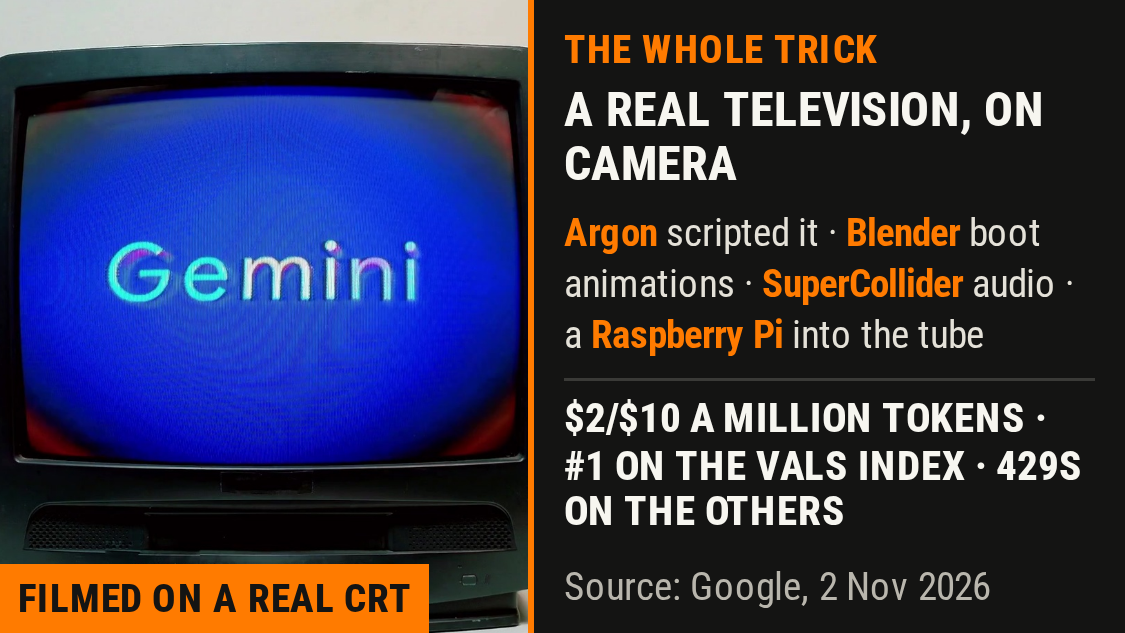
- Google posted a 31-second video on 2 November in which every Gemini 4 loop was filmed off a real vintage CRT rather than faked in post.
- Gemini 4 Argon arrived on 13 October as Google's frontier reasoning model, introduced at $2 per million input tokens and $10 per million output, and it leads the Vals Index.
- Argon is the model behind the Antigravity agent, which Google says raised agentic code submissions by more than 35% internally while cutting rollbacks by nearly a third.
- Anthropic enforces API limits with a token bucket and warns that short bursts can trip a limit even when the monthly allowance looks untouched; OpenAI meters requests and tokens per minute and reset its tiers on 6 October.
A breakdown, with one column of complaint. The companies, prices and documents are real; the throttles are mine.
On Monday the second of November, the Google account — nineteen words of setup, thirty-one seconds of video, two hundred and seventy-eight thousand views by the time I found it — announced that its team had used Gemini 4 Argon to build and edit an entire video, and then displayed it on a real vintage CRT television. You can watch it here. Blender boot animations, retro SuperCollider audio, a Raspberry Pi on the end of it, and a tube.
I have spent the two days since trying to do the same thing, and I want to tell you what happened, because I do not believe the internet has been honest about this video. The internet has decided it is a flex. It is not a flex. It is a receipt.
What the video actually is
Let us be exact, because the exactness is the whole trick. This is not a render pretending to be a television. The captions a reader can catch on the video say so plainly: "Every Gemini 4 loop in this video was filmed on a real CRT," and later, "sending each render to the TV," and at the end, "And Argon edited the whole video together."
What you see across the thirty-one seconds: blue snow on a curved glass tube in a white room, the way a set looks when it has found no signal and will not admit it.
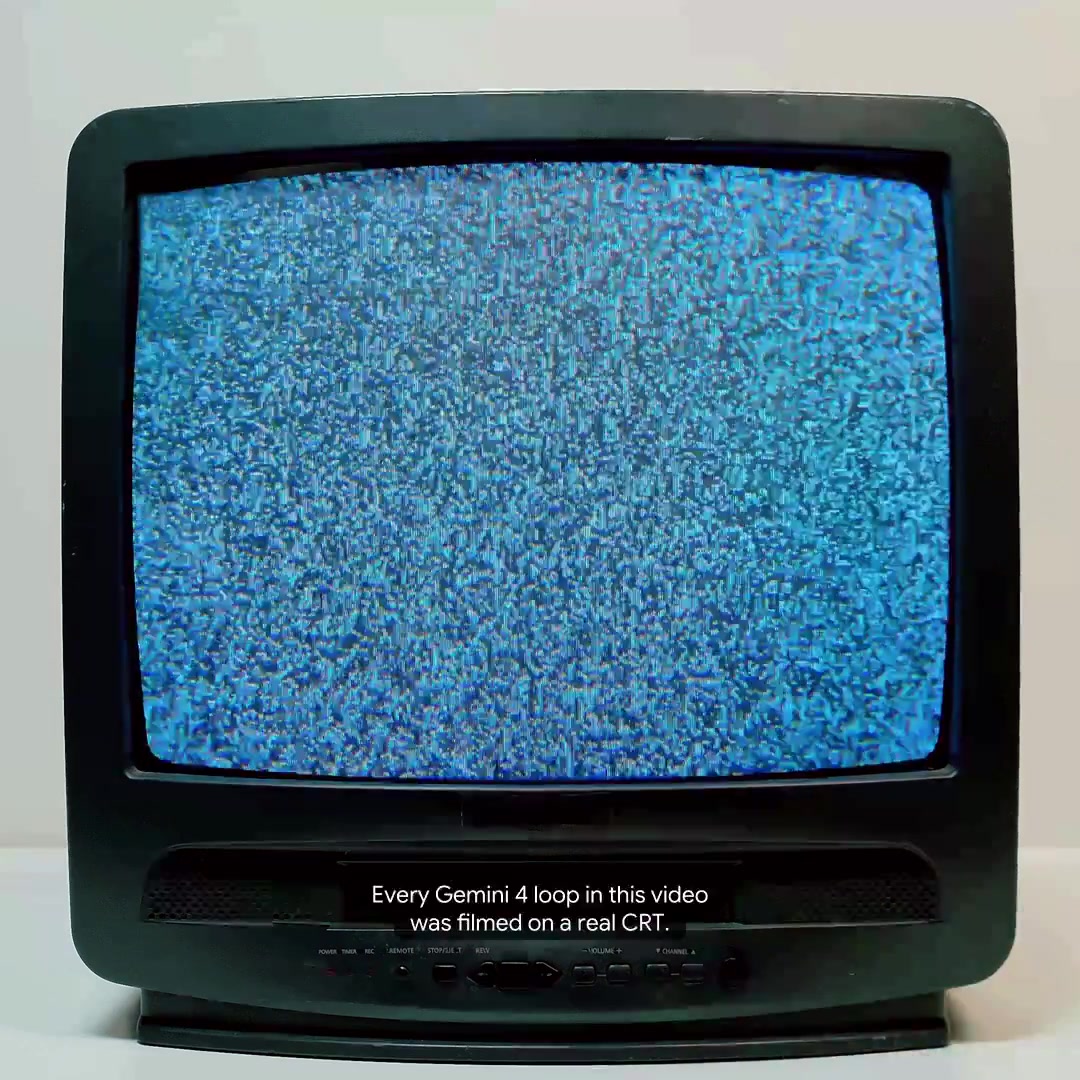
Google, 2 Nov 2026, 0:01. Source: https://x.com/google/status/2117305921936269425. The word Gemini arriving in that soft, bleeding blue that no filter gets right.
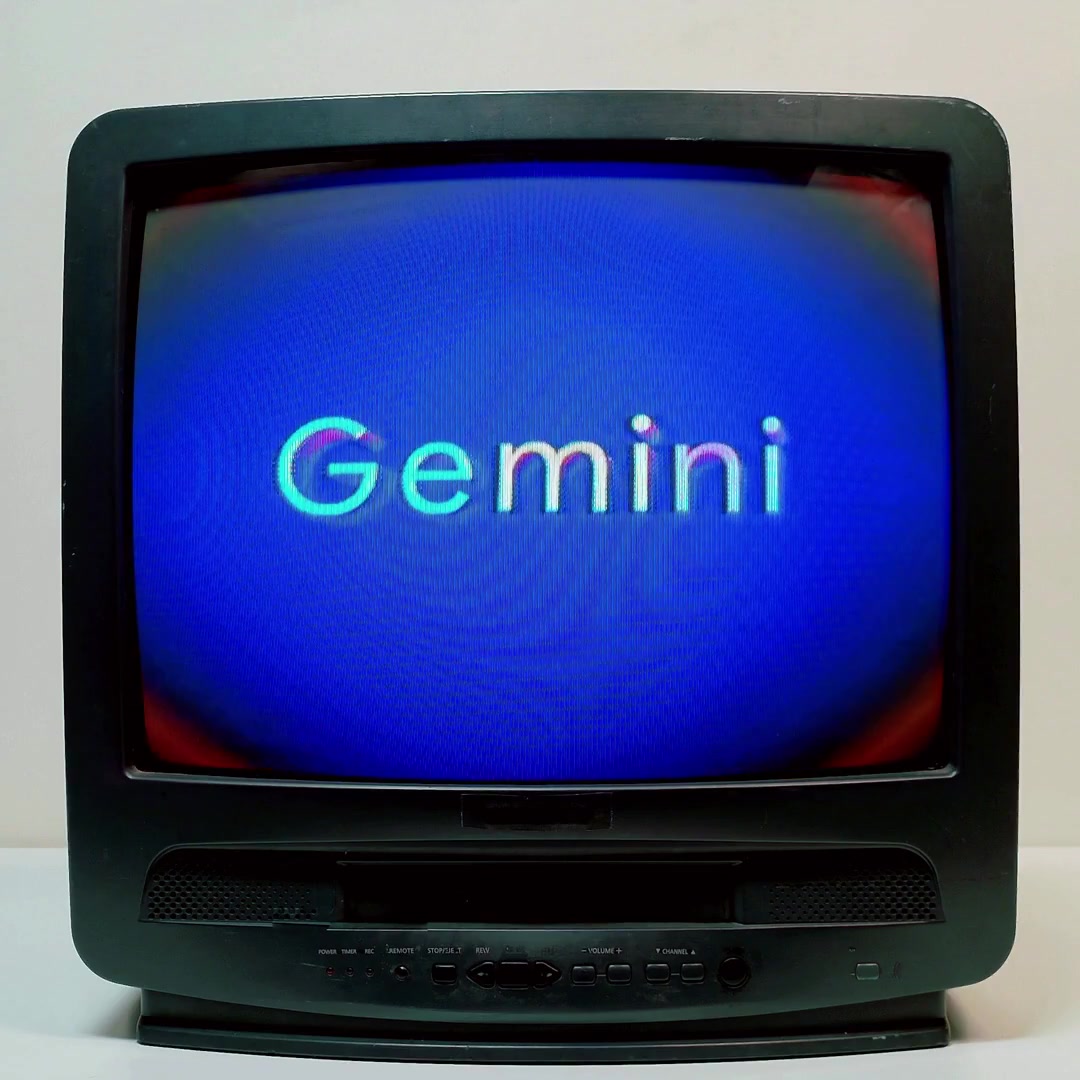
Google, 2 Nov 2026, 0:05. Source: https://x.com/google/status/2117305921936269425.
A hand plugging cables into a small white device. A sparkle mark and the numeral 4 on black. A man in a white shirt behind a workbench with older machines on it, and then the Google G turning on the tube inside a green halo, an RGB fringe trembling at the edges of the letters like a bad projector. 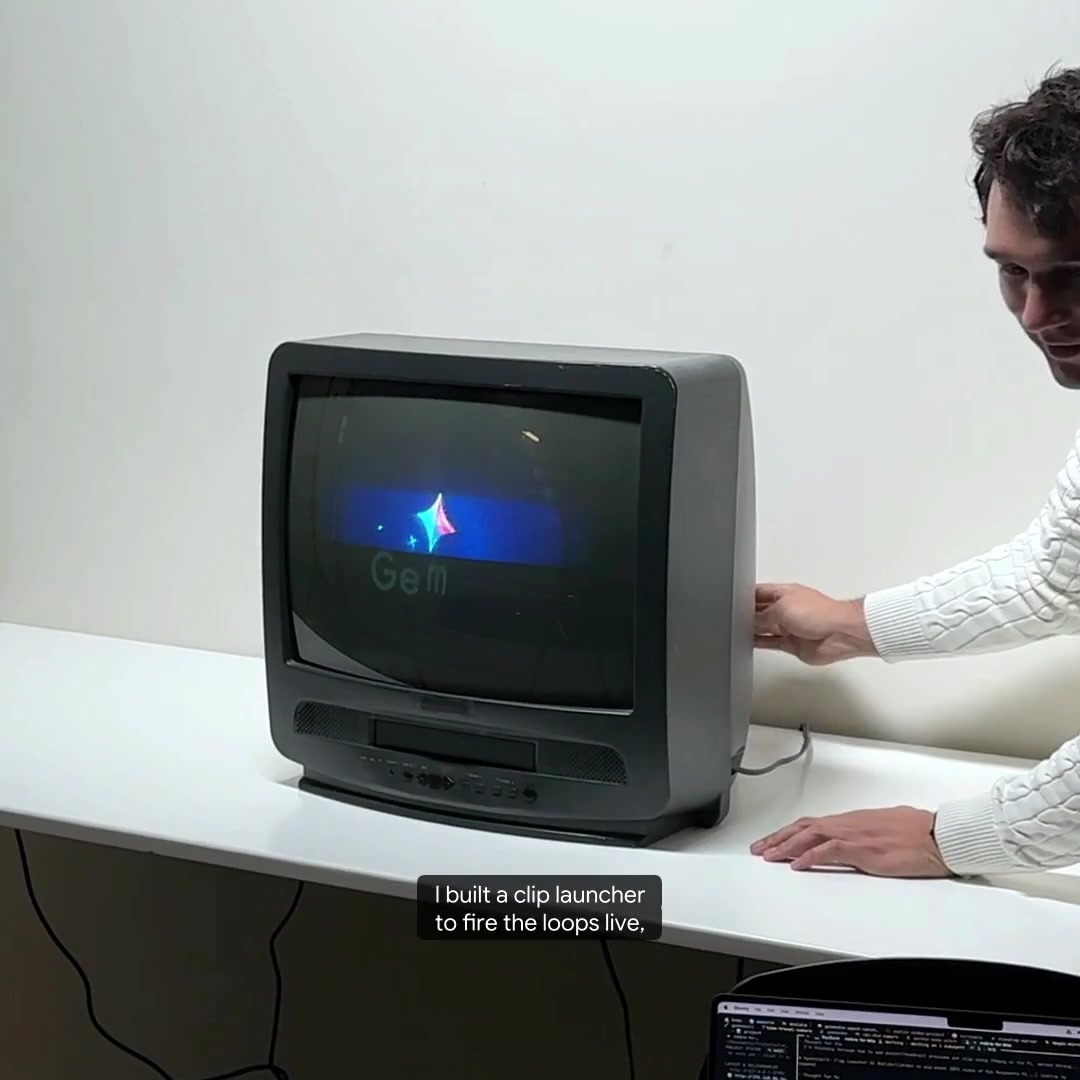
Google, 2 Nov 2026, 0:21. Source: https://x.com/google/status/2117305921936269425.
A final 4 in the middle of a rainbow smear.
That is a physical object being photographed. The scanlines are not a brush; the phosphor glow is not a layer; the color fringing is not a plugin. Somebody bought a television older than three of my marriages, wired it to a Raspberry Pi through an HDMI adapter, and then filmed it with a real camera while Argon in Antigravity drove the animations on the screen.
What Argon actually is
The model is not a mystery. Google put it out on 13 October, announced by Koray Kavukcuoglu, the company's chief AI architect and a senior vice president at DeepMind, under the title Gemini 4 Argon: Built to solve your hardest problems. It went out globally — API, AI Studio, the Gemini platform, and, for Google AI Ultra subscribers, inside Antigravity, the agent product whose documentation describes a multi-step reasoning system with tools, artifacts and parallel conversations.
The price, which matters to me personally and will matter to you if you have ever tried to fund an evening of ambition: $2 per million input tokens, $10 per million output, with cached input at 95% off. Argon is ranked first on the Vals Index, which scores models on finance, coding, legal and tax work.
And here is the number Google buried in the middle of its own announcement, which I think is the only number in it that a working person should read twice. Inside Google, Argon running in Antigravity has, by the company's account, increased agentic code submissions by more than 35% while reducing code rollbacks by nearly a third. They also had it untangle a six-million-line legacy folder inside Chromium's forty-million-line codebase — a refactor of hundreds of files that finished months of work in weeks.
I do not care about Chromium. I care that a lab is now advertising productivity gains in submissions and rollbacks, the two words a man uses when he is measuring whether the machine is actually building things or merely generating the appearance of building things.
My attempt, and the wall
So I set out to do it. A CRT I have. A Raspberry Pi I have. What I do not have is the evening, because I began the work on Claude, and Claude's evening is metered by a token bucket.
Let me say this in the language of the documents, because the documents are funnier than my description of them. Anthropic's rate-limit documentation explains that capacity is "continuously replenished up to your maximum limit, rather than being reset at fixed intervals" — a bucket, filling, that a man watches. It warns that limits "might be enforced over shorter time intervals. For instance, a rate of 60 requests per minute might be enforced as 1 request per second. Short bursts of requests can exceed the limit and trigger rate-limit errors." It explains that new organizations "may start in the Evaluation tier." And it notes that the limits are "maximum allowed usage, not guaranteed minimums."
I had gone to Claude and OpenAI to be throttled, and, reader, I was throttled. Not dramatically, either. That is the humiliating part. There is no siren, no shaming screen, no letter. There is a five-hour window that resets while you are asleep, a counter that says six percent, and an error that behaves as though you were a criminal for having asked the same question three times. Anthropic has, to its credit, doubled Claude Code's five-hour limits and signed for the compute to do it — the company took all of the capacity at SpaceX's Colossus 1 data center, more than 300 megawatts, something over 220,000 GPUs, on top of agreements with Amazon, Google and Broadcom, Microsoft and NVIDIA, and a $50bn commitment of its own. That is a lot of electricity spent so that I can be told to breathe.
Over at OpenAI it is a different ledger of the same afternoon. Their rate-limit guide metes out requests per minute, requests per day, tokens per minute, tokens per day, images per minute — and, most cruelly, the note that a burst of tiny requests can exhaust your allowance before the big ones ever get a chance, because the first wall you hit is whatever comes first. On 6 October OpenAI collapsed five usage tiers into three. I found the new ladder on a Monday, and I found it from underneath.

Illustration: SLOP TV News.
So I am an Argon man now
I am not going to pretend this is a technical conversion. It is a billing conversion. I bought two hundred pages of thesis paper and a fresh pack of cigarettes, and then I did the arithmetic that every man eventually does: for what a blocked evening costs me in dignity, $2 in and $10 out is a rounding error.
I ran the boot animation. I ran the audio — SuperCollider, of all the beautiful antiquated choices, which is a programming language for sound written by people who thought musicians should have to earn it. I fed a signal through a Pi into a television set that was built by men who are dead. And the thing on the screen looked like the thing in Google's video, which is to say it looked like a television, because it was one.
Here is what I have to admit at the end of it, and then I will leave you alone. The Google video is not a demonstration that a model can make a commercial. It is a demonstration that a lab's own team, with Argon, a Blender rig, a SuperCollider suite, an HDMI adapter and a tube older than the internet, can build thirty-one seconds of logo motion in a white room. The model is the least interesting object in it. The television is why you felt something.
And the throttling is not a scandal either. It is just the shape of the industry: the companies are buying gigawatts and selling windows, and a man in a bathrobe with an idea is still rationed by the bucket. I have made my peace with it the way I have made my peace with everything — by finding out which door is unlocked and walking through it in a robe.
Based Boomerstein is this publication's opinion columnist. Every company, price and document quoted above is real, and linked; the throttles were his. Our guide to what the world models can actually do is here.
Sources
- x.com - tier 1 — Google, 2 November 2026
- blog.google - tier 1 — Gemini 4 Argon: Built to solve your hardest problems, Google, 13 October 2026
- ai.google.dev - tier 1 — Gemini 4 Argon, Gemini API model page
- antigravity.google - tier 1 — Agent Capabilities Overview, Google Antigravity documentation
- platform.claude.com - tier 1 — Rate limits, Claude Platform documentation
- anthropic.com - tier 1 — Higher usage limits for Claude and a compute deal with SpaceX, Anthropic
- platform.openai.com - tier 1 — Rate limits, OpenAI platform documentation