
Invideo says manual editing is dying. The first pass is.
Vendor threads promise the timeline is over, while the tools doing the actual work are aimed at the boring first pass rather than the cut.
Key takeaways
- Invideo posted a long-form post on September 22, 2026 claiming traditional manual editing is dying, illustrated with eleven seconds of effect presets applied in a browser.
- The Premiere Pro MCP server documents that Premiere Pro 26.3 can silently ignore structural edits such as ripple delete and razor split, so the tool verifies the sequence and returns an error instead of a false success.
- Auto-Editor, a public-domain command-line tool with about 5,300 GitHub stars, describes its own job as the boring first pass: cutting the silence before the real editing starts.
- OpenTimelineIO, an interchange format from the Academy Software Foundation, lets a timeline move between applications as data, which is what makes an agent-written string-out portable.
Invideo posted a long-form post on September 22 announcing that traditional manual editing is dying, and illustrated it with eleven seconds of effect presets applied inside a browser. The first pass is dying. The cut is not.
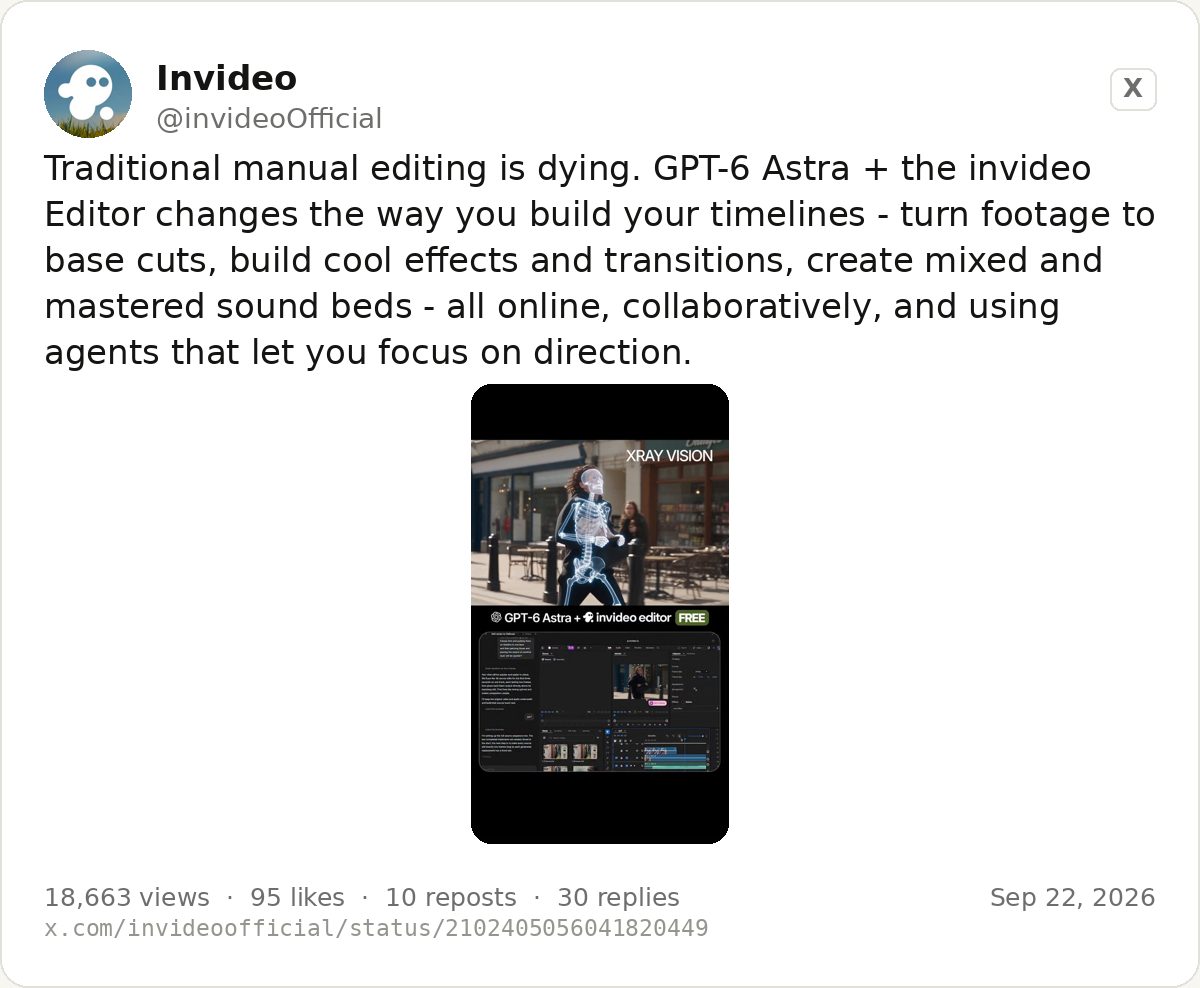
@invideoOfficial, September 22, 2026. Card rendered from the post; read it on X at https://x.com/invideoofficial/status/2102405056041820449.
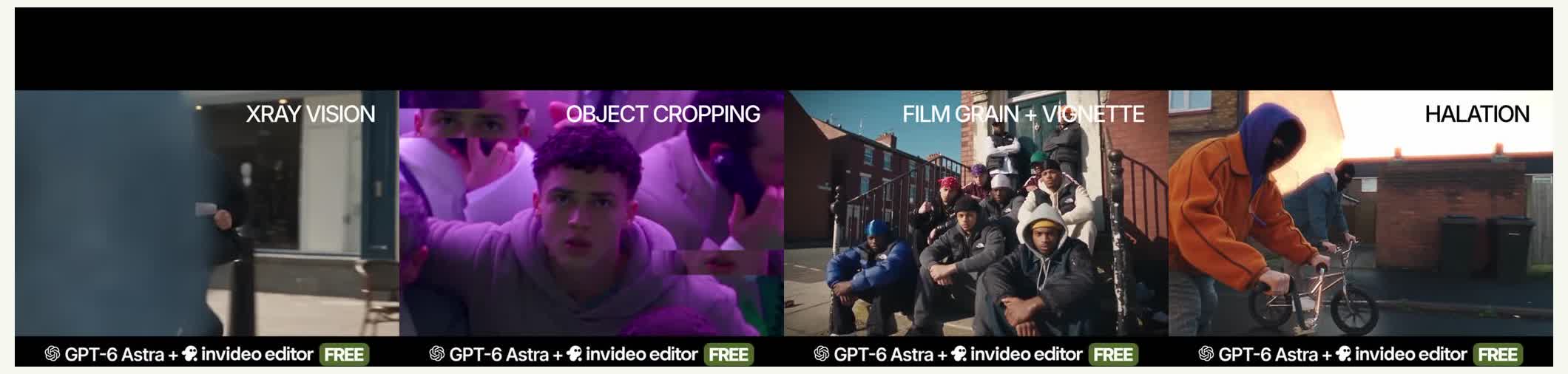
Four of the looks invideo's demo applies to a clip in the browser, each stamped GPT-6 Astra + invideo editor. Still: invideo on X.
Give the claim its due, because the tooling behind it is real and multiplying. There are MCP servers that let a chat assistant drive DaVinci Resolve and Premiere Pro, a public-domain command-line tool that has been cutting silence since 2020, and an interchange format from the Academy Software Foundation that lets a timeline move between applications as data. What is new is the agent-driven, MCP-shaped layer connecting them, not the underlying tools themselves.
The problem is what the claim does to the people who read it. If manual editing is dying, an editor's work is a rounding error, and buyers can price it that way. The most useful evidence against that comes from the companies selling the alternative.
The Case for the Timeline
The strongest argument for the old way is written by the new tools. CutAgent, which sells an AI editing system, names the characteristic failure in its own explainer: semantic drift, where "the system makes a plausible edit that answers a different brief", and its summary is blunt: "The operation can succeed while the editorial result fails." A faster opening becomes a shorter, less clear one. "Clean up the interview" erases the pauses that carried the thought. Its definition is careful for a reason: vibe editing is "not a standard, a named DaVinci Resolve feature, or permission to stop understanding the timeline."
The mechanical layer is worse than the pitch. The Premiere Pro MCP server, an MIT-licensed bridge with hundreds of tools, documents that on Premiere Pro 26.3 "some installations silently ignore QE structural edits (ripple_delete, razor/split) and existing effect-parameter writes". The author's fix was to verify the sequence state after every write and return an error rather than a false success, an admission that the tool could not tell a completed edit from an ignored one.
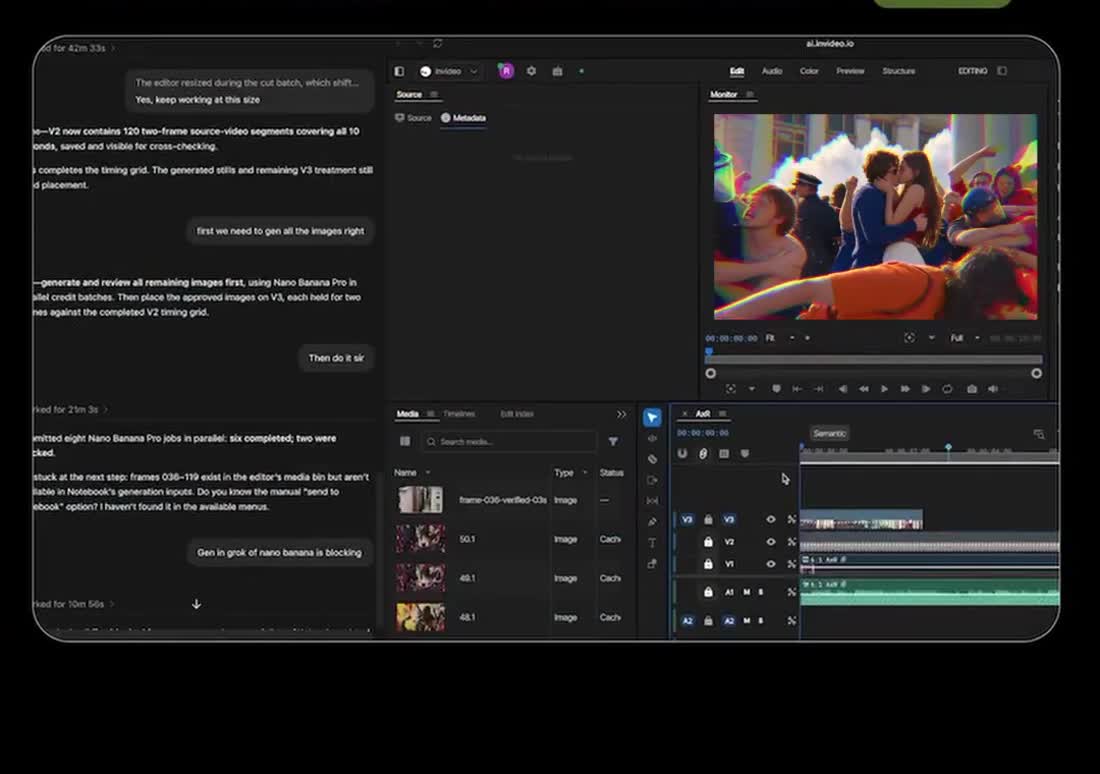
The editor the post points at: asset panel, preview, timeline. Still: invideo on X.
Then there is the measurement problem. The loudest negative result comes from Cutback, whose test of plain chatbots on editing work reported "93% target miss, 11 of 11 cuts mid-sentence, hallucinated arithmetic". Cutback sells an agentic editor called Selects, so that test is also a sales document and should be read as one. It still points at the gap nobody has closed: a language model does not ingest video, it works from text about video, and the edit has to survive the trip back to a timeline. None of the sources cited here offer an independent measurement of these tools in either direction.
That is the case for the timeline, and it is stronger than any vendor thread admits. It is also aimed at the wrong half of the job.
Why the First Pass Is the Real Shift
The part of editing being automated is the part nobody entered the craft for. Auto-Editor, a public-domain command-line tool with about 5,300 stars and a first commit in 2020, states it on its own front page: "Before doing the real editing, you first cut out the 'dead space' which is typically silence. This is known as a 'first pass'. Cutting these is a boring task, especially if the video is very long." An hour of interview becomes a day of syncing, transcribing and trimming before anyone makes a creative decision.
What changed is not that a model learned taste. It is that three pieces of plumbing arrived at once, and they are the three things worth knowing about this shift.
The first is silence and motion detection as a one-line command, which is Auto-Editor's entire job. Its own issue tracker shows the honest failure mode: users report it cutting word endings, and the answer in the thread is to lower the audio threshold and add margin. That is a tuning problem, not a judgement problem.
The second is transcript-driven assembly. Cutting by editing text is the version that survives contact with real work, because it maps one edit to one visible object, and because it is the only stage where the model reads a document instead of guessing at pixels.
The third, and least discussed, is the interchange layer. OpenTimelineIO, from the Academy Software Foundation, describes itself as an "Open Source API and interchange format for editorial timeline information", with a plugin system whose adapters read and write other applications' formats into one data model. It is the piece that makes an agent's string-out portable: a timeline as a file, rather than as a sequence of clicks inside one vendor's application.
Around those three sits the MCP server class, most of it unofficial. One Apache-2.0 Resolve server drives Resolve Studio live through the scripting API, or, on the free edition, writes FCPXML, LUTs and markers that import in one step. Its feature list reads like an editor's job description: beat-aware music cuts, dialogue tightening, broadcast-loudness mixes, reference colour matching baked to a LUT, and a push-to-talk voice bridge. These servers multiply because the demand is to drive an NLE, not to replace one.
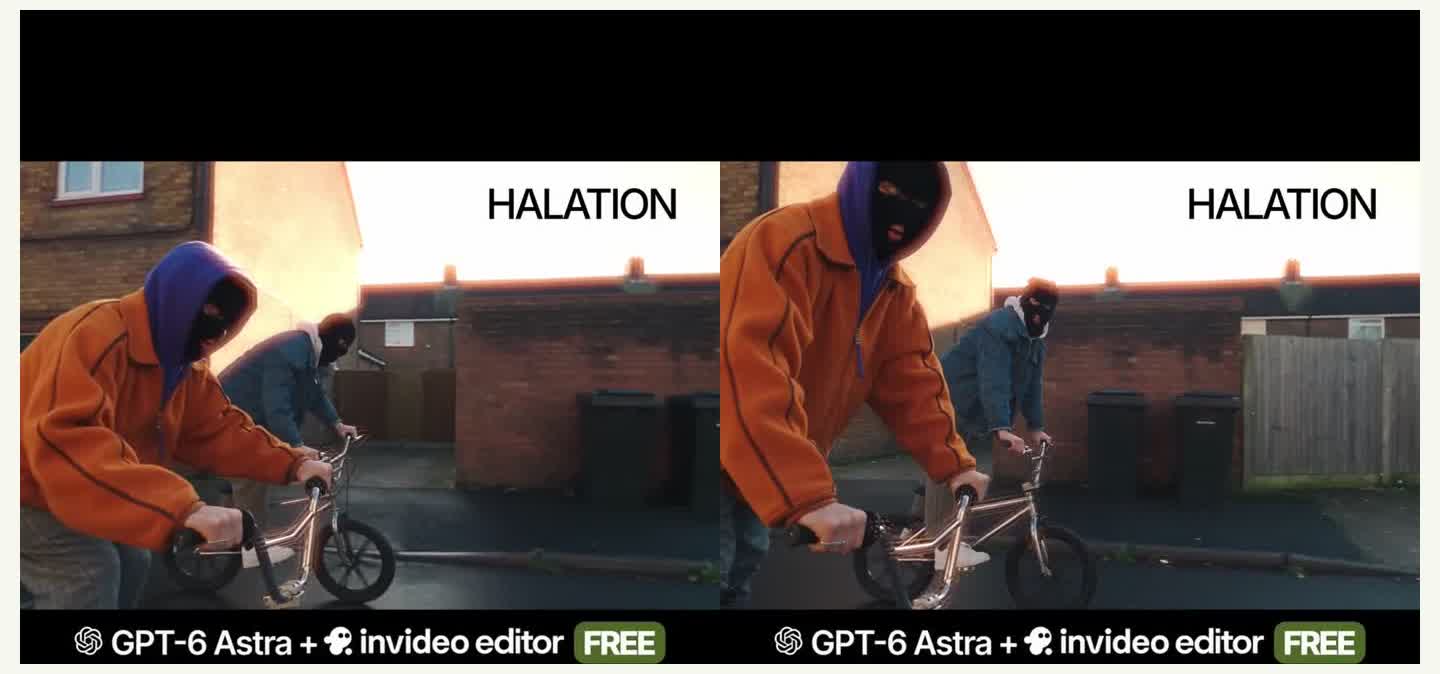
Two frames of the same demo clip, both run through invideo's halation preset. Still: invideo on X.
The split matters. An independent creator gets the assembly for free: silence removed, a transcript to cut against, a timeline exported into whichever editor they already own. That is the difference between publishing this week and not. An editing team gets the same drudgery removed and inherits a new review burden, because every agent-written edit now needs checking, and checking is the part the tools cannot do.
The honest verdict on effectiveness is that the gains are real and narrow. The credible savings sit at the front of the process where the work was mechanical, and the failures that remain are semantic: an edit that is plausible, complete, and about the wrong thing. The tools are good enough to build the first version. They are not good enough to decide whether the first version is any good.
Manual editing is not dying. It is being shortened at the front, and what remains is the part that was always the job. Invideo's post is at https://x.com/invideoofficial/status/2102405056041820449.
Sources
- x.com - the post, its second post linking the editor, and its claim that traditional manual editing is dying
- ai.invideo.io - the editor the post links to
- github.com - Auto-Editor: its own description of the first pass, its licence and its star count
- github.com - the word-cutting failure mode and the thread's threshold-and-margin fix
- github.com - the interchange format for editorial timeline information and its adapter plugin system
- github.com - the admission that Premiere Pro 26.3 can silently ignore structural edits, and the verify-or-error fix
- github.com - a Resolve MCP server's two-tier design and its editorial feature list
- cutagent.ai - semantic drift and the definition of vibe editing; the author sells an AI editing system
- cutback.video - the 93% target miss test; the author sells a competing agentic editor