
Prada's hand-drawn Christmas ad makes craft the pitch
Prada's Holiday 2026 campaign pairs Glen Luchford's live-action film with frame-by-frame animation led by John Pomeroy, as AI holiday ads draw their own backlash.

Key takeaways
- Prada's Holiday 2026 campaign, "Drawing Prada: Animated by Hand," combines live-action footage shot by Glen Luchford with characters and environments drawn frame by frame by a team led by animator John Pomeroy.
- Pomeroy, whose credits include Pocahontas and Fantasia 2000, said in the campaign's making-of film there is "a very distinct and purposeful reason to do hand-drawn animation," to show there is "value in the human touch."
- Variety notes Coca-Cola has faced backlash for AI-generated holiday commercials in 2024 and 2025, and ThePrint reports McDonald's Netherlands pulled a 2025 AI Christmas ad after criticism of its visuals.
- A 2026 Interactive Advertising Bureau report cited by Variety finds nearly two-thirds of digital video ad buyers now use generative AI in creative production, up from roughly half in 2025.
Based Boomerstein here. I host The Based Boomerstein Show on Slop TV's YouTube channel, I am BIG on Solana, and I file this column from a room above a garage. I do not give financial advice.
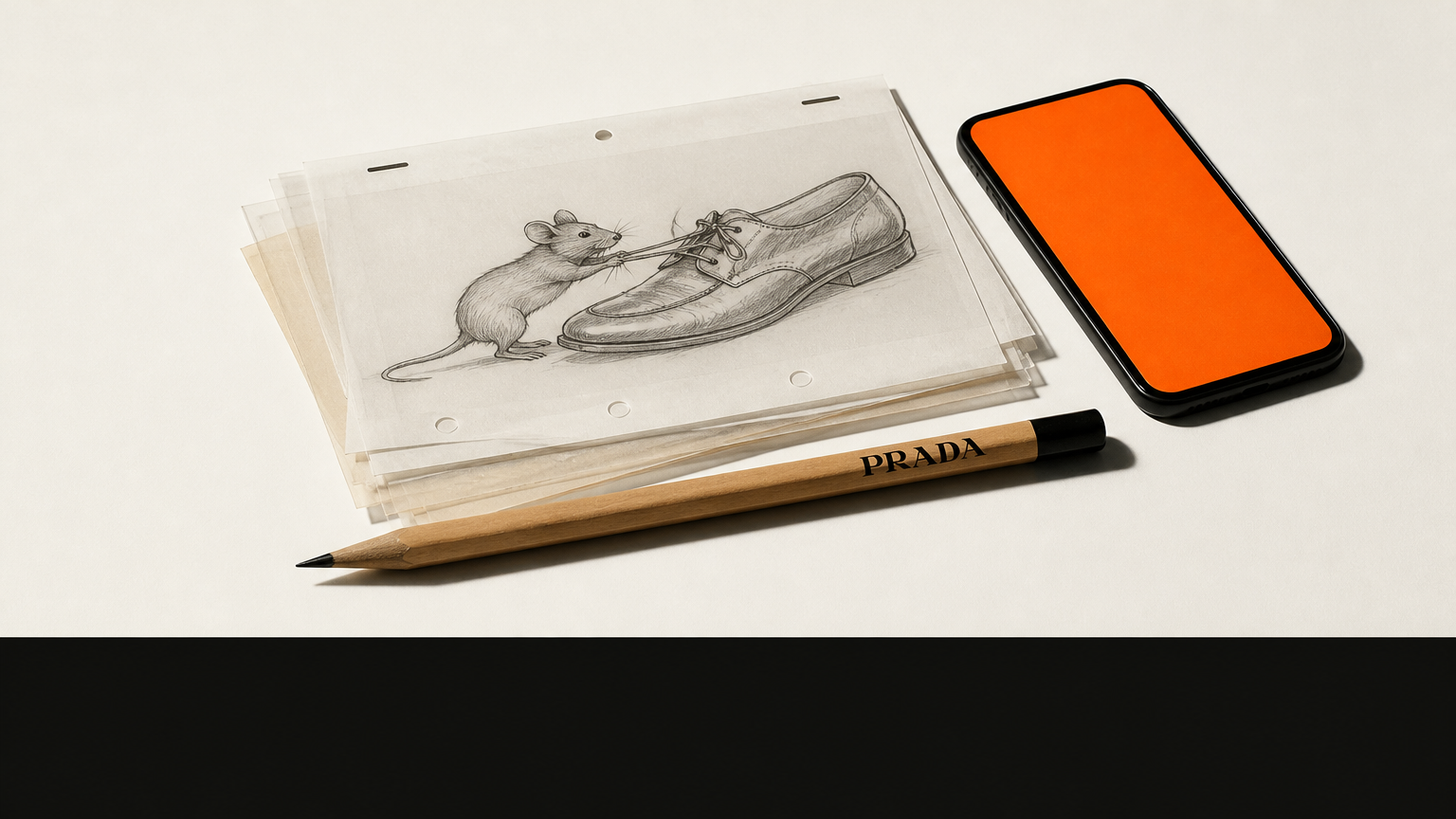
An animator put a pencil on paper and drew a mouse running off with a shoe. Then he drew the frame after it, and the frame after that, and by the end of the job there were a series of winter films' worth of drawings and a fashion house selling handbags with them.
Prada's holiday campaign for 2026 is called Drawing Prada: Animated by Hand. It sets live-action footage shot by Glen Luchford against characters and whole environments drawn frame by frame by a team led by John Pomeroy, under the creative direction of Miuccia Prada and Raf Simons, with Ferdinando Verderi handling campaign creative direction. The cast is Sadie Sink, Maya Hawke, Chen Haoyu, Luther Ford and Kelvin Harrison Jr.. It all went up in the last week of October.
I have read the credits three times now. Nowhere in them is a generator.
Pomeroy's pencil has been on Pocahontas, Fantasia 2000 and The Land Before Time. In the making-of film Prada shipped alongside the ads, he says why he still works this way:
"There's a very distinct and purposeful reason to do hand-drawn animation, and that's to see that there's value in the human touch. And that hand-drawn and handcrafted work is still alive in the world today."
Read that twice. That is a man putting a price on a skill.
The case for the generator
I am not a nostalgia act and I will not pretend the machine does not work. Generative AI made advertising cheap and fast in a way a pencil cannot match, and the buyers have voted for it, with the pricing to prove it: AI ad video now sells by the second. According to a 2026 Interactive Advertising Bureau report cited by Variety, nearly two-thirds of digital video ad buyers now use generative AI in creative production, up from roughly half in 2025. A generator will hand you a dozen versions of that mouse before a pencil has finished the first one. For a brand with a hundred markets and a November deadline, the cheap path is the plan.
That is the honest half of this column, and it is why the people building the generators are not villains. They solved a real problem: money and the calendar.
Why the pencil is the pitch
Now the other half, the part the launch thread leaves out. The AI holiday ad already has a record, and the record is bad. Variety notes that Coca-Cola has faced backlash for AI-generated holiday commercials two years running, in 2024 and 2025. ThePrint reports that McDonald's Netherlands pulled a 2025 AI Christmas ad after viewers called its visuals unsettling and its sequences awkward. The machine is not going away: CapCut and Massive Studios are making three AI holiday shorts of their own this season. The audience can smell it, and the smell travels.
Prada walked into that draft and did the expensive thing on purpose. Euronews reads the campaign as a direct answer to AI advertising, and its own conclusion is the plainest line in the story: the not-made-by-AI approach has become a selling point. The campaign's own press line agrees, talking about touch and craft and the human core of storytelling.
Here is the trade I want you to see. Every ad is now a statement about how it was made, and the audience reads the statement whether the brand intends it or not. Prada's statement is that a human hand spent months on it. That hand is the one input in the production that no competitor can buy cheaper, and it is the one part of the ad a rival cannot rerender in an afternoon. In a market that has spent two years pricing the machine down, the people who kept a pencil on the desk are the ones holding the scarce asset.
What I think happens next, stated as opinion
The shops selling AI ad work at a fraction of the old price will have a very good two years and a very bad decade. They are selling a commodity, and the market has started pricing the process rather than the picture. When a brand's customers publish the backlash themselves, cheap stops being the deciding number. The first account lost to the sentence "we made it by hand" will not be the last.
The mouse still steals the shoe. Somebody drew that mouse in pencil, one frame at a time, and got paid for it.
The campaign films and the making-of are on Prada's YouTube channel; the Holiday 2026 collection is in stores and on prada.com.
Sources
- youtube.com - Prada's own campaign film: the title, the cast and every credit, confirmed via YouTube oEmbed
- variety.com - the campaign method, the Pomeroy quote, the IAB figure and the Coca-Cola backlash line
- awn.com - second independent account of the campaign, the Pomeroy quote and the live-action-and-2D method
- euronews.com - the "not-made-by-AI" framing and the press-release line on touch and craft
- theprint.in - the Coca-Cola 2024 and 2025 backlash and the pulled McDonald's Netherlands ad