
Jev's Creator on Why Your AI Assistants Can't Decide: "Overpromising Is a Feature"
In a talk recorded six weeks before Jev launched, TypeSafe's founder argued AI was trained to please people, which is exactly why it cannot be trusted to decide.
Key takeaways
- Diogo Almeida, founder of TypeSafe AI, said in a talk posted July 31, 2026 that AI inherited from RLHF is "incredible at the human-in-the-loop stuff but not for automation tasks."
- Almeida described the pattern he says replaced trustworthy automation - pushing the cost onto users instead - and called it "Horrible pattern. But that is the state of AI right now."
- He said "overpromising is a feature. This is by design," arguing RLHF optimizes human preference, so "no matter how wrong the models are, they will look right."
- Jev shipped on September 15, 2026, six weeks after the recording, priced at $0.042 per million input tokens with output tokens free, and TypeSafe claims it is 193.6x faster and 444.6x cheaper.
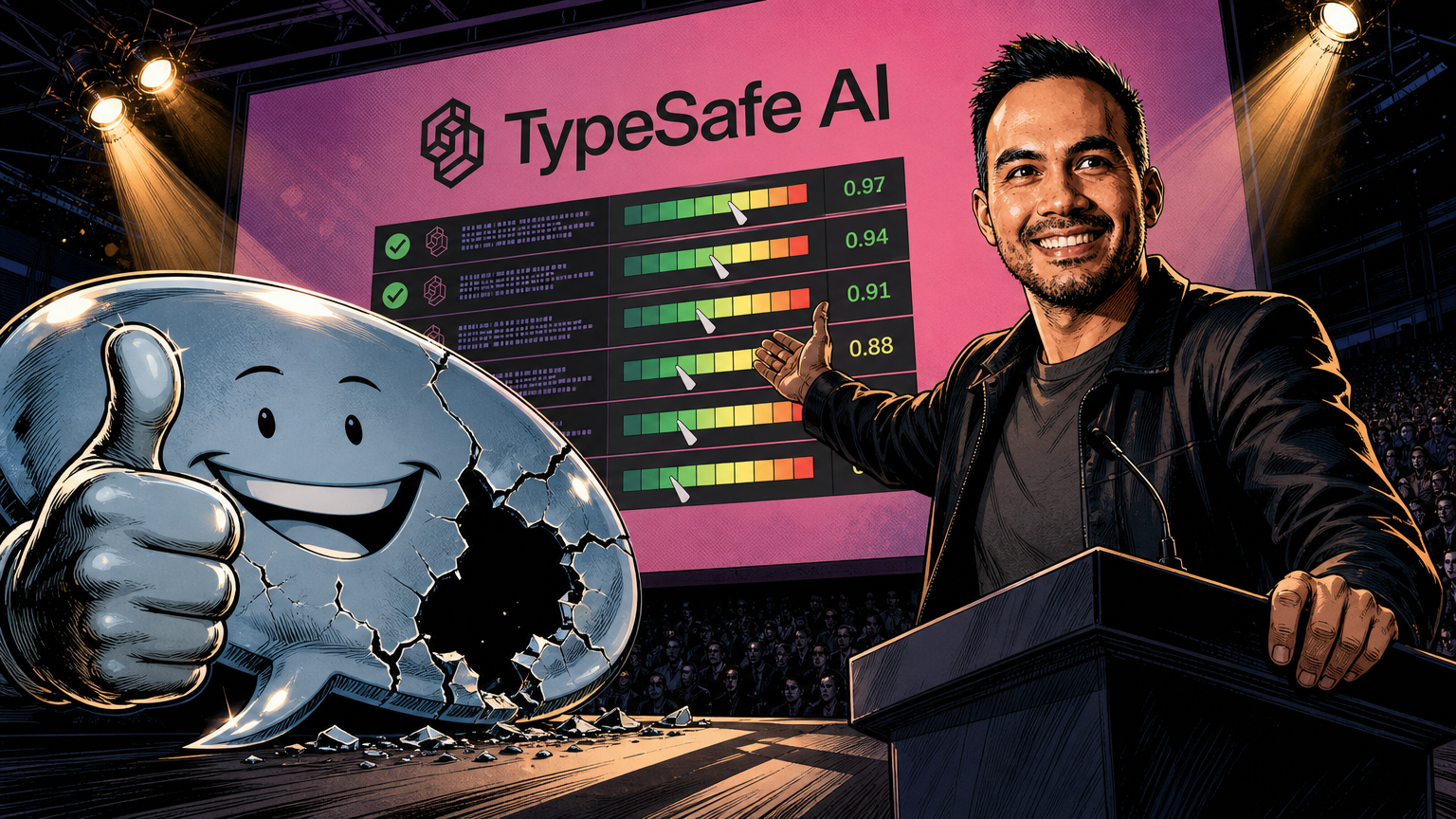
TypeSafe AI's founder once helped build the machine he now argues is pointed at the wrong problem. In a talk posted on July 31, 2026, six weeks before his company released Jev, Diogo Almeida told an AI Engineer audience that today's models were trained to please people, and that this is exactly why they cannot be trusted to decide anything.
"I'm one of the few people at OpenAI who actually hates on ChatGPT," he says, introducing himself. Then come the receipts: co-author on GPT-4, on ChatGPT, on RLHF and InstructGPT. "The team I was part of basically invented post-training as a concept."
His hint for the room is blunt. What comes after the ChatGPT era, he says, "is not the Claude code era."
The Split: Assistance Versus Automation
Almeida sets up the talk by mapping the field's two loudest camps. "Cult one" says AI is going insanely well and crushing every benchmark. "Cult two" says AI is a bubble generating nothing, which is why everything is still a chat app. He asks what single explanation covers both.
His answer is the difference between assistance and automation. On one side are tasks where a human stays in the loop and the point is to please them. On the other are tasks so rote that the goal is to remove the human entirely and let the thing run in a background server nobody watches.
He is funny and precise about which is which. "The Claude Code's job is not to just make code work," he says. "The goal is to please the human in it." That is not a criticism, it is a description: the model was built that way.
Lesson one, in his words: everything inherited from RLHF is "incredible at the human-in-the-loop stuff but not for automation tasks."
The business consequence is the line most likely to be quoted back at him. He calls it the lesson every company has learned: "do not use AI for decisions with stakes to your business." What replaced it, he says, is a pattern where the costs land on the user instead — "it's oh totally okay to throw the user at infinite docs and customer service, but it is not okay to make expensive decisions." His verdict on that arrangement takes five words. "Horrible pattern. But that is the state of AI right now."
Why Overpromising Is a Feature
The technical explanation is not complicated, and Almeida reduces RLHF to a caption: collect human preferences, optimize for human preferences. The consequence, he says, is that asking why every LLM needs a human in the loop has a one-line answer. "We literally put them in the loop."
Then he explains why the models sound so sure. "Overpromising is a feature," he says. "This is by design." By construction, he argues, an RLHF model will always show a gap between human preference and actual results, even when the results are good, because preference is what the objective rewards.
The joke he uses to land it is the best thing in the talk. Someone, he says, sent ChatGPT an audio file of fart sound effects and asked what it thought of the music they had made. The model's review: "It's a very eerie vibe atmosphere piece." Almeida's read on that is not that the model was confused. It is that the model was doing its job. "If it doesn't know," he says, "it will [err] on the side of doing what it thinks is best for human preference."
The sentence that does the real damage comes a moment later: "no matter how wrong the models are, they will look right."
The Detour, and the Third Thing
From there Almeida turns to software, and complains like a builder. SaaS, he says, has barely changed since 2019 apart from a chatbot bolted onto the side. He quotes Garry Tan's phrase about a "golden age of just-in-time software" and half-agrees with it, then says what bothers him: he wants smarter software, not merely cheaper software to write. "We're just automating the writing of the software, but then its expressibility is the same." His word for it is "tragic."
He is equally willing to file his own field's biggest idea under detour. RLHF, he says, is not wrong, "but it was like a weird detour, and one that we didn't expect."
The question TypeSafe was built around is the one he leaves on the screen: "what if the AI stack was redesigned for reliability and automation?"
He also offers a teaser he cannot resist. "I actually will post something later today that I guarantee will be very spicy," he says. "The hint is that the original scaling laws were incorrect."
In the Q&A he is looser and more interesting. Pre-training, he says, is not the problem: "pre-training is fucking phenomenal." Hallucination, he argues, is intrinsic, coming from an asymmetry in the reward model that encourages models to drop modes and be confident, in the way GANs do. He names the two branches everyone knows — RLHF optimizing human preference, RLVR optimizing plain correctness — and says TypeSafe is doing a third thing, "optimized for calibrated decision making."
His version of the bitter lesson is worth the whole clip: algorithms matter more than compute, "this is true in games but not true in reality," and so "data matters more than compute and doing the right task matters way more than data."
What Happened After the Talk
Jev shipped on September 15, 2026, six weeks after this recording, and TypeSafe's launch post leans on the distinction Almeida previews here. The model answers typed questions and returns calibrated probabilities instead of text, priced at $0.042 per million input tokens with output tokens free, and TypeSafe's headline is a claim of 193.6x faster and 444.6x cheaper.
The talk's afterlife is its own story. On September 18, the X account @0xCodez resurfaced the video with the launch numbers pasted on top — "x200 faster, x400 cheaper and 0 hallucination" — and a line about it being worth more than a $500 Claude Code course. The clip has since travelled through the Jev Engineering guides that were published the same week.
Worth noting for anyone reading the talk as a product pitch: it was recorded before there was a product. Almeida tells the room TypeSafe is "still kind of stealthy," asks people to join a mailing list, and admits he is just starting a Twitter account. The handle he gives out is CompleteSkeptic, which he says is on brand.
The closing line of his Q&A is the one to hold onto: "usually when there's a big branch in new ways to post-train, it just looks totally alien and then in hindsight becomes super obvious."
Six weeks later, it had a name, a price and a waiting list.
Sources
- youtube.com - the talk itself, "Jev Creator: Why RLCD beats RLHF", AI Engineer, uploaded 2026-07-31
- x.com - the September 18 repost with post-launch numbers
- typesafe.ai - Jev launch, pricing, the RLCD distinction
- typesafe.ai - the 193.6x and 444.6x headline claim
- x.com - Almeida's own launch-day thread on the names