
Newsom signs SB 1050: AI ad performers must be labeled
The law takes effect January 1, 2027 and puts AI actors inside California's false advertising statute.
Key takeaways
- Governor Gavin Newsom signed SB 1050 on September 16, 2026, requiring a clear and conspicuous disclosure on video or audio advertisements that prominently feature an AI-generated synthetic performer.
- The law applies to synthetic performers who do not depict an identifiable real person, and effective January 1, 2027 it makes a missing disclosure a violation of California's false advertising law.
- Approved wording includes "this performance features a synthetic performer" and "no human performer is depicted," and a violation means the ad must be pulled once a court orders it.
- New York has required synthetic performer disclosure since June 9, 2026, with civil penalties of $1,000 for a first violation and $5,000 for each later one.
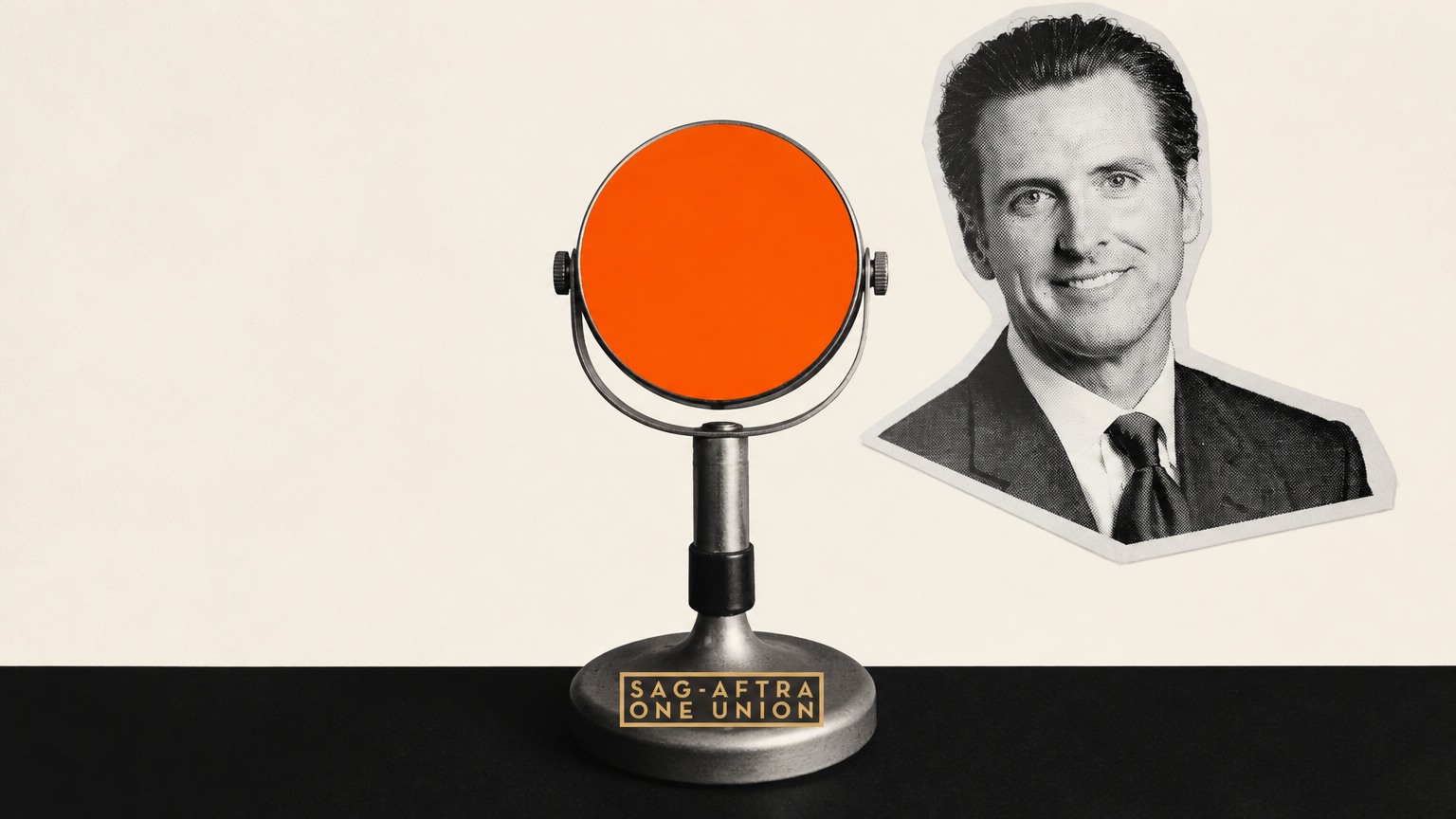
California advertisers have until January 1, 2027 to label any AI-generated performer who sells something to a Californian, after Governor Gavin Newsom signed Senate Bill 1050 at SAG-AFTRA's Los Angeles headquarters on September 16, 2026.
The bill, authored by Senator Angelique Ashby (D-Sacramento) and sponsored by SAG-AFTRA, adds a section to California's Business and Professions Code making it unlawful to publish an advertisement in California that prominently includes a synthetic performer without a clear and conspicuous disclosure that the performer is synthetic. A violation is treated as a violation of the state's false advertising law, Section 17500, and is enforceable through the Unfair Competition Law, Section 17200.
According to the bill text, a "synthetic performer" is a digital figure, voice or representation created in whole or in part with generative artificial intelligence that creates the realistic impression of a human performance "who is not recognizable as any identifiable natural person." The distinction matters. Unauthorized replicas of real, identifiable people are governed by California's separate right-of-publicity statute, Civil Code Section 3344, and by digital replica rules that predate this bill. SB 1050 covers the opposite case: a performer who looks human and is not anyone.
The disclosure has to be difficult to miss, easily understandable and presented so a reasonable consumer would notice, read and comprehend it, judged against the medium and format. Approved wording includes "this performance features a synthetic performer" or "no human performer is depicted." The Assembly's Privacy and Consumer Protection Committee analysis describes the required on-screen text as 55 characters placed in close proximity to the synthetic performer.
It triggers only on a prominent role. The signing announcement frames the requirement around an AI performer who sells a product or service on camera. Background or incidental AI figures do not carry the obligation. The law also exempts advertisements for expressive works such as films, television, streaming content, documentaries and video games, provided the synthetic performer's use in the promotional material matches its use in the underlying work.
Enforcement reaches the distribution layer. Once a court finds an advertisement unlawful and issues an order, streaming services, broadcasters, publishers and ad networks that receive the order and enough information to identify the commercial must stop distributing it in California as soon as is commercially reasonable and technically feasible, and must stop accepting payment to run it. Pre-screening is not required.
California is not first. New York's synthetic performer disclosure law took effect June 9, 2026, carrying civil penalties of $1,000 for a first violation and $5,000 for each subsequent one. California's version attaches no new penalty schedule of its own, which is why its exposure runs through existing false advertising and unfair competition remedies, including private rights of action.
The requirement also sits alongside the union contract that already governs studio productions. The Assembly committee analysis notes that producers must notify and bargain with SAG-AFTRA before deploying a synthetic performer, and that the union may arbitrate if no agreement is reached. SB 1050 reaches a different set of productions: the ones with no union contract at all.
For AI video creators, the practical change is a compliance step rather than a permission. A synthetic spokesperson built in Veo, Kling or any other generator is still legal in California advertising. It has to be labeled from January 1, 2027, and the label is a factual commercial disclosure, not a statement about the model or the training data behind it.
The bill carried the Senate 38-0. A coalition of opponents led by TechNet, with the California Broadcasters Association among them, argued for a materiality standard that would require a showing the advertisement actually misled a reasonable consumer before it counted as a violation.
The requirement applies to advertisements disseminated in California from January 1, 2027. The bill text is at leginfo.legislature.ca.gov.
Sources
- gov.ca.gov - Newsom's signing announcement, the two-stage requirement and the SAG-AFTRA venue
- leginfo.legislature.ca.gov - the bill text: definitions, required wording, exclusions
- apcp.assembly.ca.gov - committee analysis: sponsor, Senate vote, the 55-character text disclosure and the materiality argument
- mondaq.com - enforcement route through Section 17500 and the Unfair Competition Law
- gadgetreview.com - New York's earlier law, its effective date and penalty schedule