
AI Stallone clips are a demo, and the audience is the inventory
The impossible stunts are not a test of what video models can do. They are a distribution trick, and the corrections rarely travel as far as the lie.

Key takeaways
- A 25 September 2026 repost of an AI-generated Sylvester Stallone stunt clip, from an account with 625,670 followers, had 568,408 views and 14,017 likes on X when this piece was written.
- An AI Stallone dam clip made with Pixverse was posted by its creator on 20 September 2026 and reposted the next day by another account; the repost had 1.6 million views when a post traced it back, and that tracing post had 819.
- Picsart markets PixVerse C1 in its playground as its film engine, with an "industrial-grade action system" for martial arts, sword fights and acrobatics, up to 15 seconds at 1080p.
- Picsart's chief executive, Hovhannes Avoyan, wrote in Forbes on 26 August 2026 that a $2,000 AI-made ad ran during the NBA Finals, against commercials that cost hundreds of thousands to produce.
The opening header: a ten-second animated sequence made for this article with SLOP TV's own HTML series kit. No sound.
The Sylvester Stallone stunt clips are not a story about what video models can do. They are a story about who the audience is for, and the honest answer is that the audience is the product.
Start with the least glamorous document in the whole affair, which is a product page. Picsart sells PixVerse C1 inside its AI Playground as its film engine, and the copy promises "cinematic VFX" and an "industrial-grade action system" that handles "martial arts, sword fights, acrobatics". Clips run to 15 seconds at 1080p. Stallone is 80. The tool that markets acrobatics and the man being made to perform them are the same paragraph, and only one of them is fiction.
Stallone is the reason the format works at all. Born on 6 July 1946, he turned 80 in July 2026, and the career the clips are quoting is long and specific: Rocky in 1976, which he wrote and for which he was nominated for Best Actor and Best Original Screenplay; First Blood in 1982 and four more Rambo films after it, five in all; Cliffhanger in 1993; and a run that makes him one of two actors, with Harrison Ford, to have starred in a box-office number one in six consecutive decades, according to his Wikipedia entry, which also puts the gross of his films above $7.5 billion. The clips are not borrowing his body. They are borrowing that record, and the part of it that cannot be borrowed at all: the work he actually did.
He has been through a version of this before. In January 2025 a fan-made AI trailer for a fake "Godfather Part 4" went viral and Stallone posted stills from it on Instagram: "What is going on? Lol this is definitely not to be taken seriously!" A month later he invested in Largo.ai, an AI analytics platform for film and television, in a $7.5 million raise. In early 2025, then, he did both things the current wave forces a choice between: he called out a fake, and he put money into an AI company.
The wave has been running since August. Offbeat Concerns dated one of the early viral posts to 23 August 2026: an account with 6,728 followers posted a clip of Stallone flipping between explosions, asked "Can you jump like this at that age?", and collected more than 1.8 million views and 11,000 likes. An Instagram repost of similar footage put a caption on it that explains the genre better than any analysis: "POV: I think I'm in good shape for 40". That reel had 3.8 million views by the time Offbeat Concerns wrote it up.
By late September the wave had a second life, and the receipts are public. On 22 September an account with 3,190 followers posted a clip with "Age is really just a number, Sylvester Stallone just proved it".
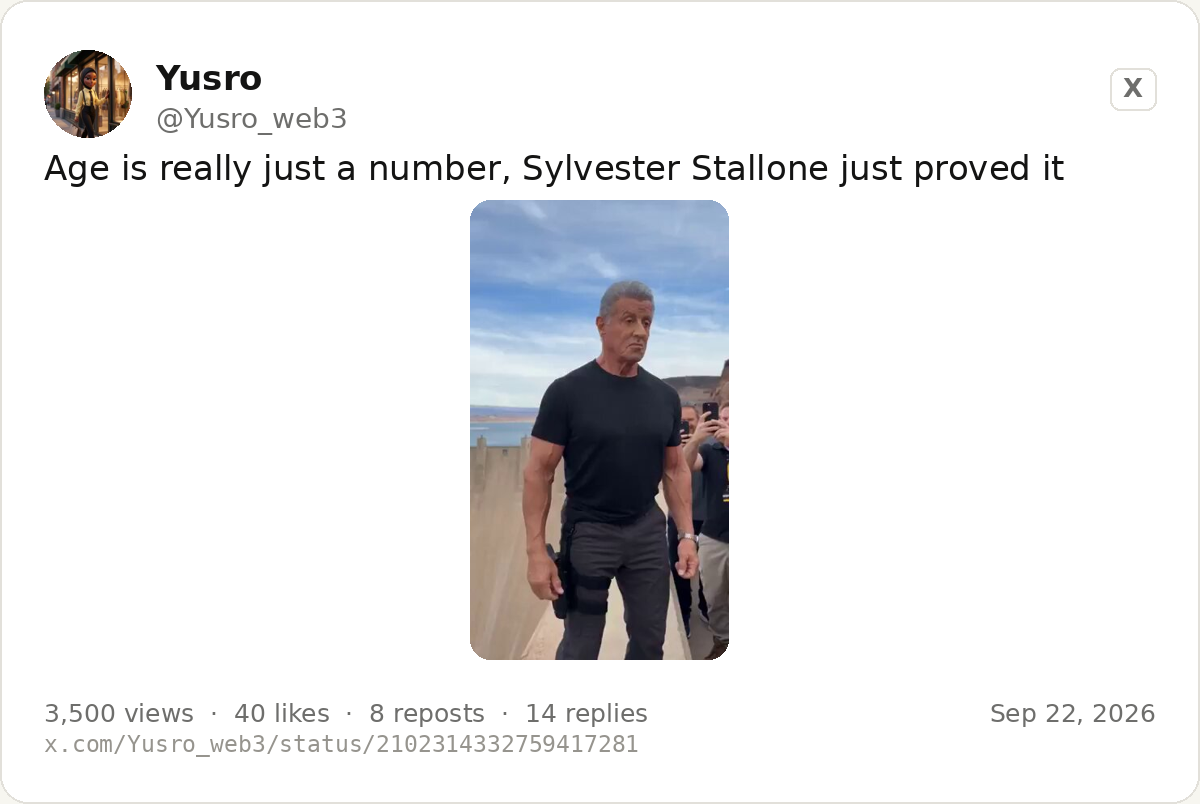
Yusro, September 22, 2026. Card rendered from the post on 27 September 2026, so the counts have moved since; the thumbnail is a frame of the generated clip. Read it on X at https://x.com/Yusro_web3/status/2102314332759417281.
Three days later a viral repost from an account with 625,670 followers said the quiet part out loud: "These Sylvester Stallone videos are getting ridiculous". It had 568,408 views and 14,017 likes when I read it.
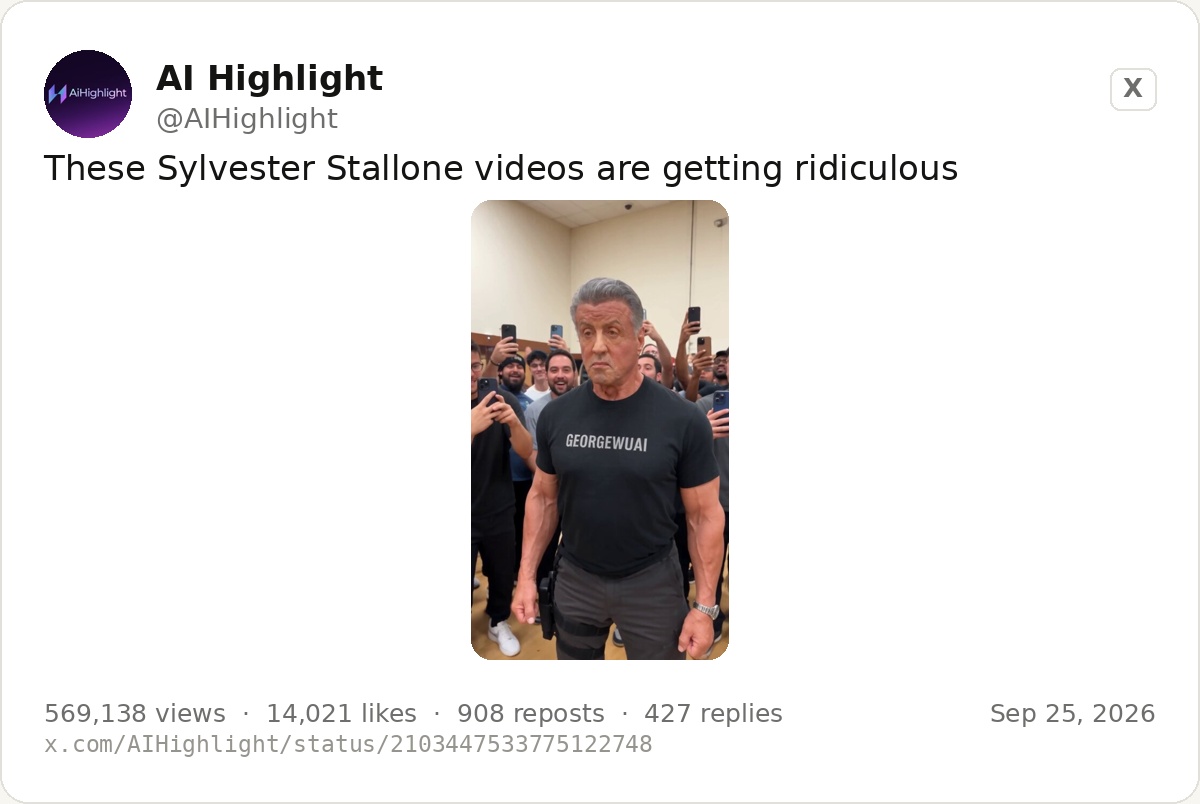
AI Highlight, September 25, 2026. Card rendered from the post on 27 September 2026, so the counts have moved since: the card shows 569,138 views and 14,021 likes, against the 568,408 and 14,017 the copy quotes. The thumbnail is a frame of the AI-generated clip. Read it on X at https://x.com/AIHighlight/status/2103447533775122748.
And one of them is a canyon with two trampolines balanced on separate rock pillars, which is where the whole thing stops being about fitness. A post from 23 September describes it shot by shot: one bad bounce and there is no next scene, Stallone clears it, lands back on the cliff, walks toward camera. "Most men his age are trying not to pull something getting off the sofa." The post tags a brand for the footage and gives its rationale: "Rocky made the comeback famous. @Picsart gave him one physics couldn't explain."
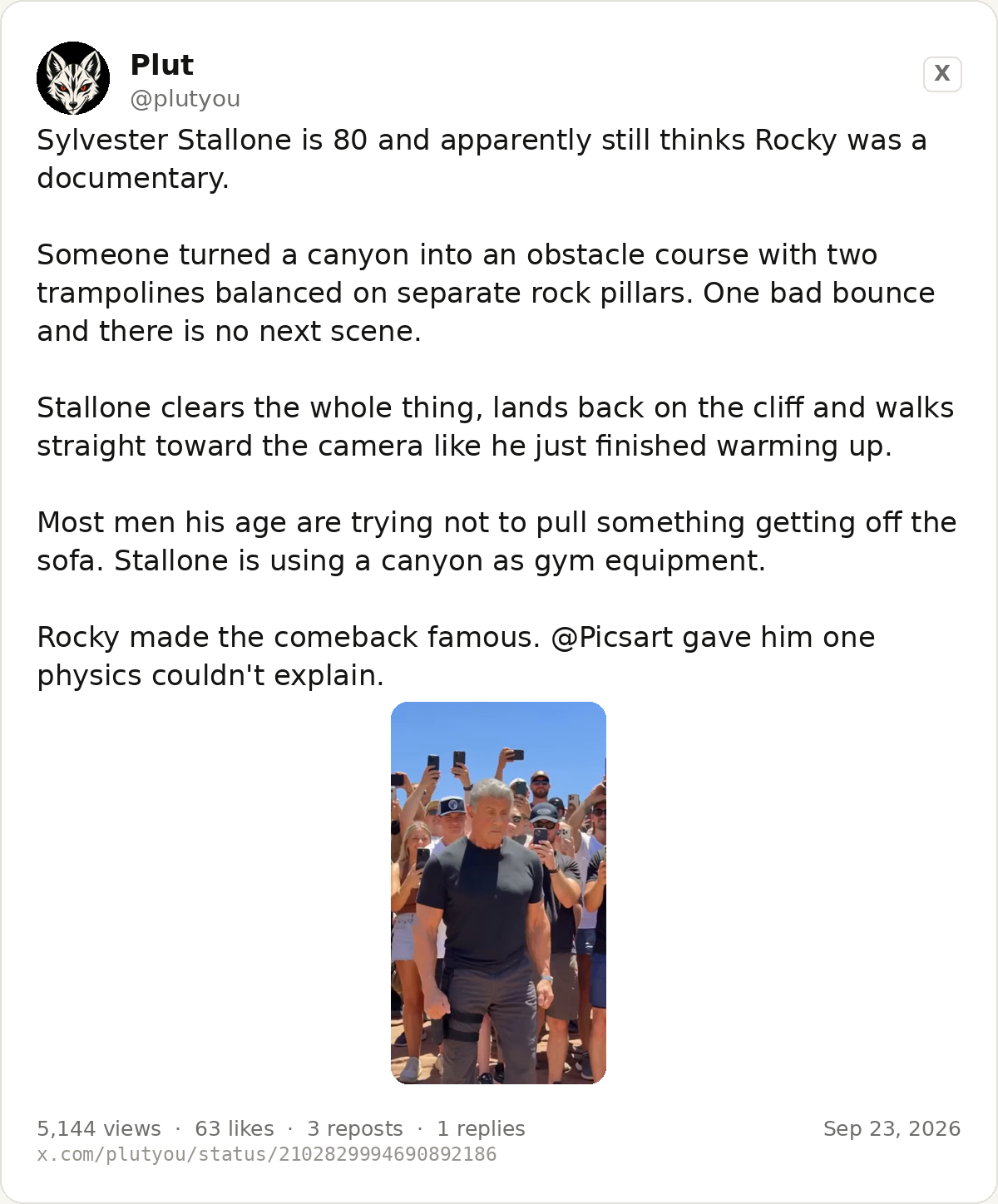
Plut, September 23, 2026; the line tagging Picsart is the post's own. Card rendered from the post on 27 September 2026, and the thumbnail is a frame of the generated clip. Read it on X at https://x.com/plutyou/status/2102829994690892186.
Here is the best case for the people making these, and it is a real one. Nobody was ever sold a stunt as news. Audiences have known since the first matte painting that movies fake what they cannot shoot; the whole trade of the stunt double, the harness, the wire removal and the VFX house exists so that a face can do what a body cannot. Picsart's chief executive, Hovhannes Avoyan, makes the economic version of that argument in Forbes: a $2,000 ad, made by one person in two to three days, ran during the NBA Finals beside commercials that cost hundreds of thousands. About 29.8 million businesses in the United States have no paid employees, he writes, citing Census Bureau data, and by his account the alternative to these tools is not a rival tool. It is going without a commercial at all.
I think that case survives, and it does not cover what happened here.
The difference between a stunt double and an AI Stallone is disclosure, and disclosure is the one part of this pipeline that costs nothing and keeps getting left out. The dam clip is the cleanest test case, because it has a chain of custody. It was posted on 20 September by an account with 1,314 followers, made with the Pixverse video generator, and reposted on 21 September by an account with 908 followers. That repost had 1.6 million views when @AGTPinsights traced the clip back the next day. The tracing post took 819.
That ratio is the business model. The lie is the funnel; the correction is a footnote. Nothing in the chain needed an audience to believe anything for the views to accumulate, because the format sells a three-second question, not a claim that has to hold up. Did he really do that. The viewer who answers "no" has still watched, still replied, still helped. The creator who made the original clip says it was reposted without credit, and he is right, and it did not matter to the numbers either.
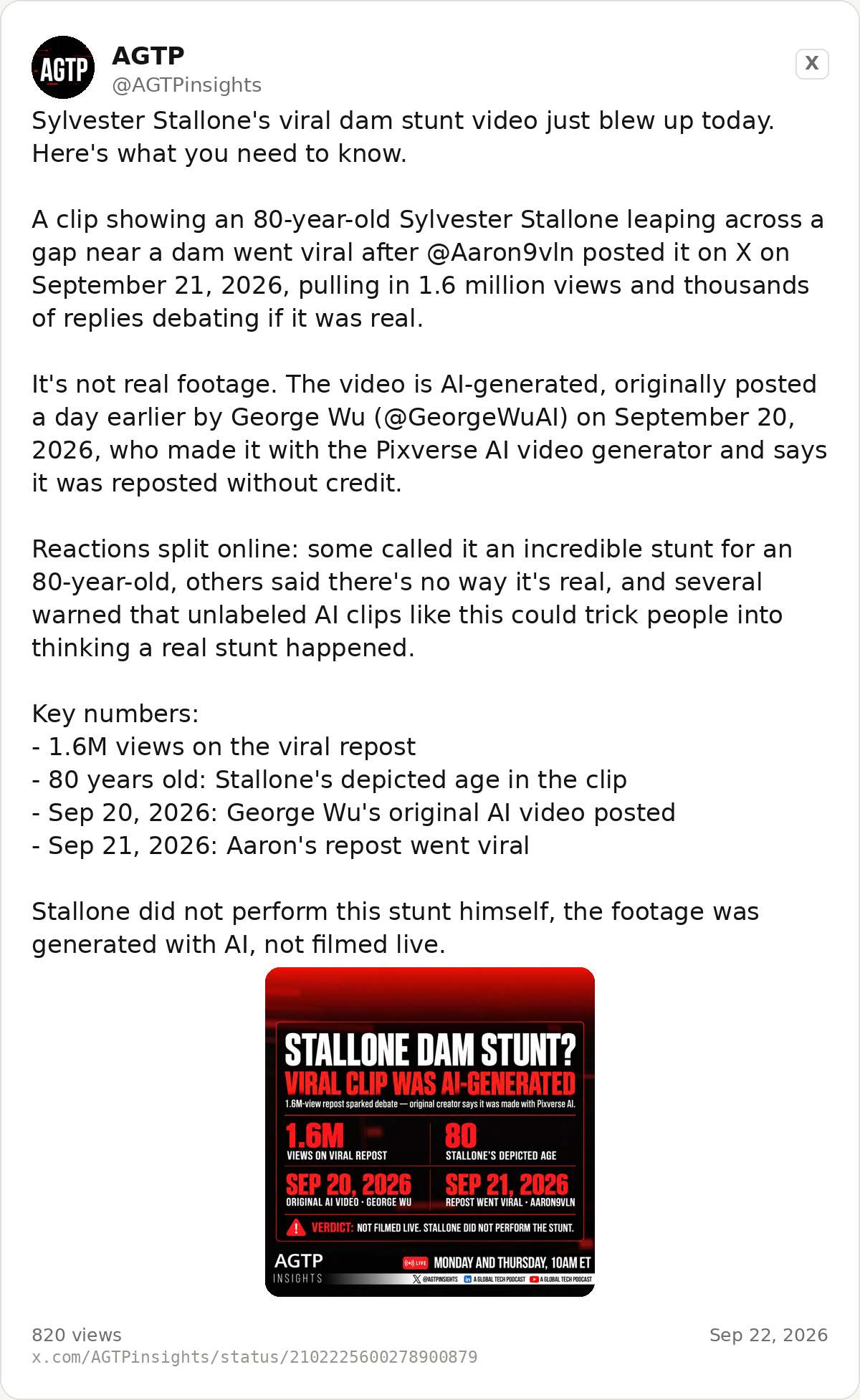
AGTP, September 22, 2026, the post that traced the dam clip to its maker and the generator. Card rendered from the post on 27 September 2026, so its count has moved since: the card shows 820 views against the 819 the copy quotes; read it on X at https://x.com/AGTPinsights/status/2102225600278900879.
The market's own language gives this away. Picsart's model page sorts its engines by the job, not by the craft: C1 is for action and storyboards, V6 for multi-shot storytelling with "synced native audio". The words "acrobatics" and "fight scenes" are there as features, the same way resolution and duration are features. A tool is allowed to sell impossible motion. A distribution system that rewards the omission of its label is a product decision made further up.
For anyone actually working with these clips, the practice is not complicated and it is not censorship. Put the label on the video, not in the reply thread, and put it on the first frame rather than the description nobody opens. Credit the model and the maker, because the credit is what separates a demo from a repost farm; the man who generated the dam clip says it was reposted without credit. If a client pays you to generate a living person, get the release and keep it on file, and if they ask you to skip the label, price the job as if your name is on it, because it will be. And use the tools for the thing they are genuinely good at: the shot you could not afford, the sequence that was going to be a storyboard forever, the impossible camera. The stunt is not the flex. The finished piece with your process visible is.
Label the clip on the first frame, credit the model and the maker, and price the job as if your name is on it, because it will be.
The wave will keep going, because the clips are cheap and the format is addictive. The one decision left is the boring one. A model page can put "acrobatics" in a feature list. The people using it decide whether the audience is told.
Sources
- x.com - the repost with 568,408 views, 25 Sep 2026
- x.com - the 22 Sep 2026 post, 3,431 views
- x.com - the canyon and trampoline description and the Picsart credit
- x.com - the dam clip traced to George Wu and Pixverse, 1.6M views
- x.com - "Sylvester Stallone AI slop. Courtesy of Zoro's BTS"
- offbeatconcerns.com - the August wave, view counts, Hive AI assessment
- mid-day.com - the videos are AI-generated
- picsart.com - PixVerse C1 in Picsart, the action system, 15 seconds at 1080p
- forbes.com - Picsart's CEO on the $2,000 NBA Finals ad
- theverge.com - the Kalshi ad, June 2025, made with Veo 3
- en.wikipedia.org - birth date, Rocky and the Oscar nominations, the six-decade record and the $7.5 billion gross
- foxnews.com - Stallone on the fake AI Godfather Part 4 trailer, January 2025
- foxnews.com - the Largo.ai investment, February 2025