
Based Boomerstein: I pounded on Argon until I broke, so Claude, build my island
A man at Anthropic built a photoreal shooter from one-shot prompts in eight hours for about $550, with the models, the sounds and the textures made from scratch. I have been fighting a rate limiter for three weeks and I have a conch, five boys and a graph-paper island. Here is what that receipt means for everyone making games.

Key takeaways
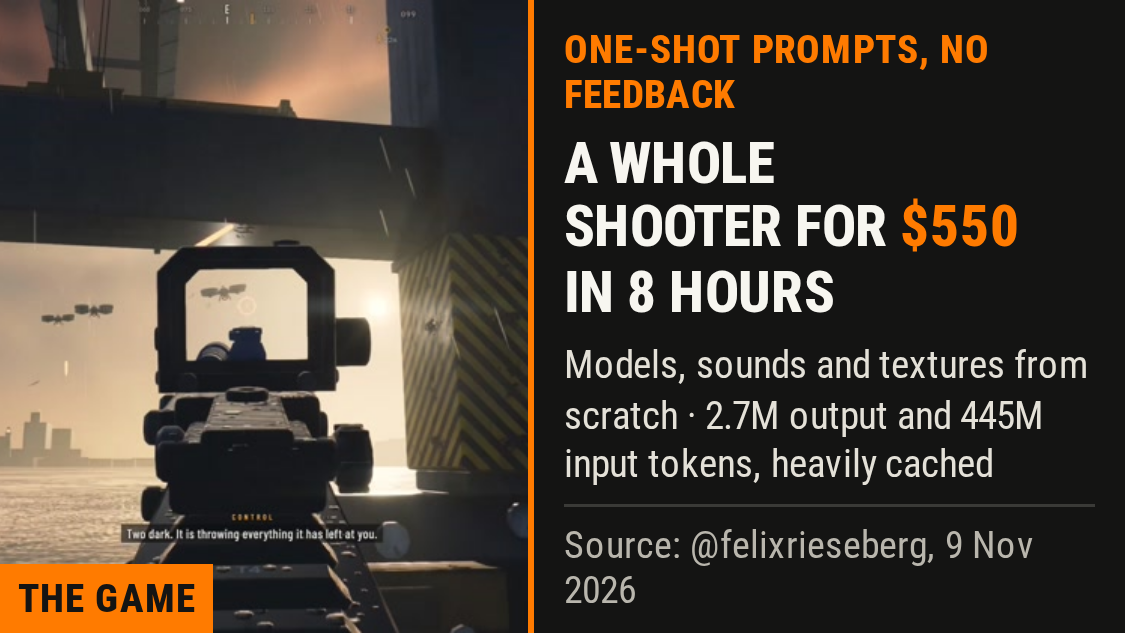
- Felix Rieseberg, who works on Claude at Anthropic, built a complete first-person shooter from one-shot prompts with no human feedback in eight hours for roughly $550 at API pricing, at about 2.7 million output and 445 million input tokens, heavily cached.
- The game's models, sounds and textures were generated from scratch, which is the part that matters to anyone who has ever paid for an asset pipeline.
- Anthropic clamped down on AI game clones in early November, then loosened the rule in Claude Code 2.1.317 so that naming a game to describe mechanics is allowed while a request for a copy is steered toward something original.
- This column's author has been building a browser sprite game about Lord of the Flies, and has spent three weeks being throttled on Gemini 4 Argon.
Based Boomerstein here. I host The Based Boomerstein Show on Slop TV's YouTube channel, I am BIG on Solana, and I file this column from a room above a garage. The companies, the receipts and the documents are real. The exhaustion is mine.
THE MEMO
- From: Based Boomerstein
- To: whoever is still paying an artist by the hour
- Subject: the island I cannot finish, and the man who built a war for five hundred and fifty dollars
- Enclosure: one conch, five boys, forty-one days of rate-limit screens
On Monday night a man named Felix Rieseberg put a sentence on the internet that I have now read more times than my own divorce papers. He said he wanted to test the new Claude's quality with one-shot prompts and no human feedback, and then he listed what he had built: everything in this game is from scratch, models, sounds, textures. About $550 at API pricing. About 2.7 million output tokens and 445 million input tokens, heavily cached. Eight hours. Here is the post, and here is his artifact: a first-person shooter, photoreal, a working title screen with a rifle in your hands.
I watched the seventy-two seconds of it four times. A container port at dusk. Freight stacks, a warehouse, a gantry crane, a fog line with a city under it and helicopters working the far end. A HUD with a live objective — CUT THE THREE UPLINK RELAYS — a countdown ticking in the corner, a killfeed, subtitles in the middle of the screen where the actors are saying things like "I'll say when you fail, Tully. So, Tully, this is your mess." Ammo in the bottom right. It looks like a game that cost tens of millions of dollars and four years and a studio of two hundred people in a glass building with a nap room.
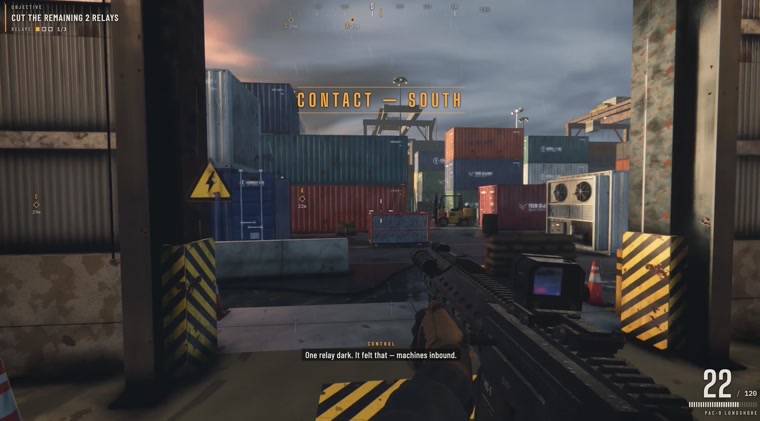
@felixrieseberg, 9 Nov 2026, 0:36. Source: https://x.com/felixrieseberg/status/2119925633564463609.
And I am here, in a room above a garage, three weeks into a fight with a rate limiter.
What I have been doing instead of writing this column
I want to be transparent about my position, because a columnist's position is all he has. I converted to Gemini 4 Argon in November, in public, in this newspaper, after Google's team drove a real vintage television with a Raspberry Pi and I could not get a straight answer out of anything else. I said I was an Argon man. I meant it. I am still an Argon man the way a man who has been sleeping in his car is still a car owner.
Because here is what the pounding looks like. My island — the one from the Epic column, the browser sprite game where the conch is the turn order and the signal fire is the only way home — is 71% finished and 100% stalled. The sprites are drawn. The board is drawn. The gate controller, which I have now explained to three different models in four different ways, is still a rectangle that does nothing when you walk into it. I have rebuilt the same collision routine eleven times across two vendors and one very long weekend.

Illustration: SLOP TV News. Somewhere in the middle of it I was told I had exceeded my usage window, and then I was told again, and then I learned the word throttle, which I now say the way other men say a prayer.
So when a man at Anthropic builds a whole war for $550 in the time it takes me to lose an argument with a sprite, I do not feel inspired. I feel audited.
The four implications, and I will number them
One. A game now has a receipt.
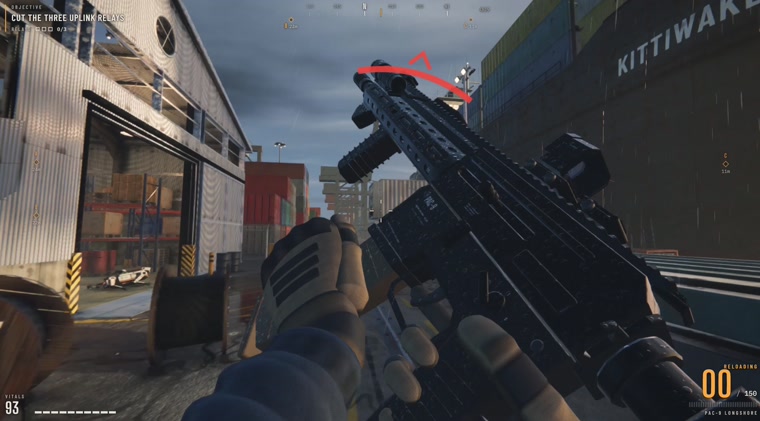
@felixrieseberg, 9 Nov 2026, 0:20. Source: https://x.com/felixrieseberg/status/2119925633564463609. Not a budget — a receipt. Five hundred and fifty dollars, itemized, with a token count on it. I have spent more than that on a second-hand mower I used twice. If a playable shooter costs $550 and an evening, then the question for every small studio in this country stops being can we afford to build this and becomes can we afford to be the people who thought of it. That is a different business. It is the business the music industry went into when a studio became a laptop, and I say that as a man who has watched a man with a laptop eat an entire town's advertising budget.
Two. The pipeline is the part that died. He did not say "the art was cheap". He said the models, the sounds and the textures were made from scratch. Read that again with your hand on your wallet. In every game project I have ever been near, the money did not go to the idea. The money went to the pipeline — the soldiers, the crates, the footstep sounds, the twelve variations of a metal door. That line item is now a prompt and a patience. I am not saying it is better. I am saying it is gone, and the org chart that was built around it has not been told.
Three. The prompt is the whole job now, and nobody has priced taste. The detail that pins me to the wall is without human feedback. He never steered it. Which means the work he did — and he is a man who has spent years on developer tools, this was not his first Tuesday — was knowing what to ask for and knowing what good looked like when it came back. Every studio I know has exactly one person who can do that and they are usually the one who is impossible to schedule. That person's value went up. Everyone who was paid to execute their instructions should read this column twice, and then read the Claude Code changelog.
Four. The hall monitor is real, and it is now in your build system. Before anybody declares the death of the game industry, understand that Anthropic spent the first week of November doing the opposite of opening the door. It cracked down on AI video game clones, then adjusted the rule again on 4 November. The company's own words on the change, in Claude Code 2.1.317: "we'd added a short rule to the Opus 5.5 prompt to steer Claude away from recreating specific existing games, but it was also kicking in when you referenced one just to describe the mechanics you wanted." Now you may name a game to describe a genre, and if you ask for a copy, it will offer you something similar instead.
I have read that paragraph to my island, twice. It is the single most important sentence written about game development this year, and it is a customer-support note. Meanwhile Matt Shumer, who built a mirror Earth in the same model and calls it the best model ever created, also calls it "basically a school hall monitor" and reports that it refused to ship a routine product change until he published a privacy policy first. Your creative director is now sharing the room with a compliance officer who never sleeps and has read every rulebook. That is either the end of a genre or the beginning of an honest one. Ask me in a year.
And the cost discipline nobody wants to hear
One thing I will not be romantic about, because I have been poor in public and it taught me arithmetic. The same model that built that shooter for $550 will happily eat $44.70 for a single task if you turn the effort dial to its top setting, and Anthropic's own system card shows that setting scoring lower than a cheaper one. The free lunch is not free. It is priced by the token, and the tokens are yours.
I also note, without bitterness, that the man who posted the receipt works on Claude at Anthropic. He says so in his own bio. That does not make the game a lie — I have watched the frames, the game is real, and $550 is a number he published rather than a slide — but it does make it a demonstration by the household, and households do their demo on the good china.
My ask, which is a single sentence
Claude: build my island. Five boys, one conch, one signal fire, a gate controller that actually gates. I will pay the $8 a million; I want to see the invoice when it is done. You may name Lord of the Flies to describe the mechanics — the Verge says you are allowed to now — and if you would rather build something similar instead, fine, but make it an island, and make the fire matter.
Argon, I am sorry. You were a good car and I drove you into the ground. But the man above the garage has to finish the game, and the new kid came with a receipt.
This column is satire and autobiography in unequal measure. The Rieseberg post, the $550, the token counts, the eight hours, the Claude Code 2.1.317 note and the system card's $44.70 figure are real and are linked above. The island, the mower and the second-hand television are mine.
Sources
- x.com - the post and its receipt, frames reprinted
- felixrieseberg.com - the poster's own page, confirming he works on Claude at Anthropic
- theverge.com - Anthropic's 2.1.317 rule change, quoted
- theverge.com - the earlier clampdown on clones
- anthropic.com - the model release and its prices
- anthropic.com - the $44.70 Max-effort figure
- x.com - the hall monitor quote and the mirror Earth demo
- sloptvnews.com - our own - the Argon conversion this column answers
- sloptvnews.com - our own - the island game this column is about