
Based Boomerstein: don't open the black box, it's my only edge
Researchers have started reading individual neurons inside real models, and the famous cat-and-car tangle turned out to be a shape detector. Everyone is calling it a win for safety. I am calling it the end of my career.
Key takeaways
- Nick Cammarata's essay "Neural Networks Are Already Clean," published by Goodfire on 15 October 2026, argues the evidence that made the field believe networks pack concepts arbitrarily was misread.
- The famous cat-and-car neuron in InceptionV1 is now read as a detector for a pointed, V-shaped form, activated by fox snouts and flames and pushed negative by round shapes.
- A preliminary audit of Qwen3-32B found roughly 90% of neuron poles had one main job, about 7% had two related jobs, and 2 to 4% remained unexplained.
- The essay is labeled a working hypothesis, the technical companion paper has not been released, and Neel Nanda at Google DeepMind disputes that it is a breakthrough.
- Our columnist opposes all of it, on the grounds that a machine you can read is a machine the reader can also read, and his entire advantage was that nobody was reading.
Based Boomerstein here. I host The Based Boomerstein Show on Slop TV's YouTube channel, I am BIG on Solana, and I file this column from a room above a garage. I do not give financial advice.
I have spent three years of my life with a machine that will not tell me how it works, and on the seventeenth of October somebody put a video on the internet explaining that this arrangement is about to end.
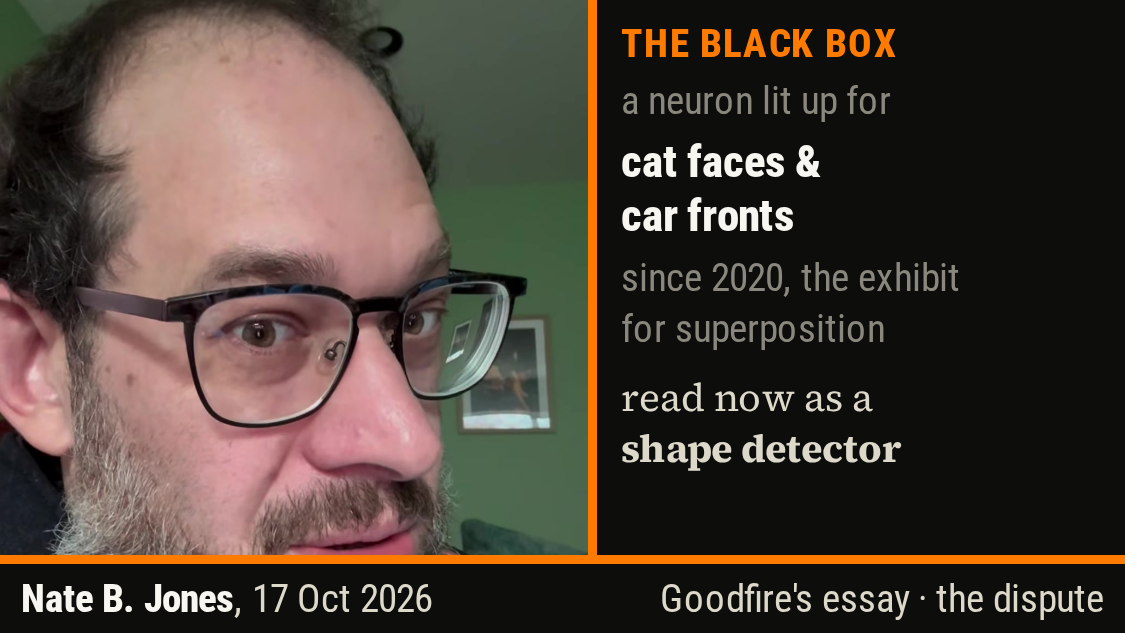
Here it is, from the account of a man called Nate B. Jones, and it opens with the sentence "This is the best news that I have seen for AI in a long, long time." He calls it a Rosetta Stone. He says we have been calling AI a black box since long before ChatGPT, and that this has changed, because we have stopped reading machines the way we read people. Then he tells the story, and the story is true, which is the problem.
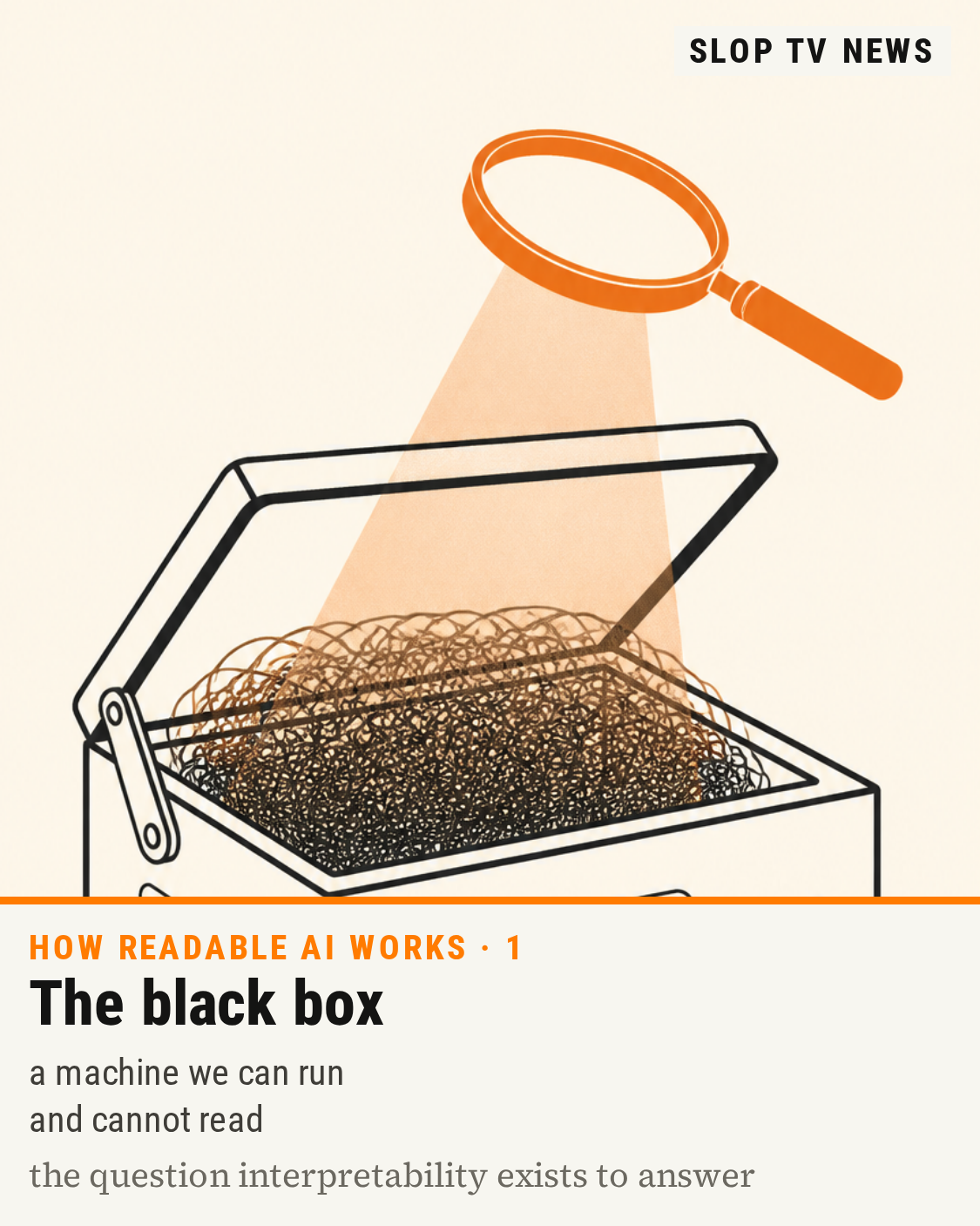
What interpretability is trying to do. Illustration: SLOP TV News.
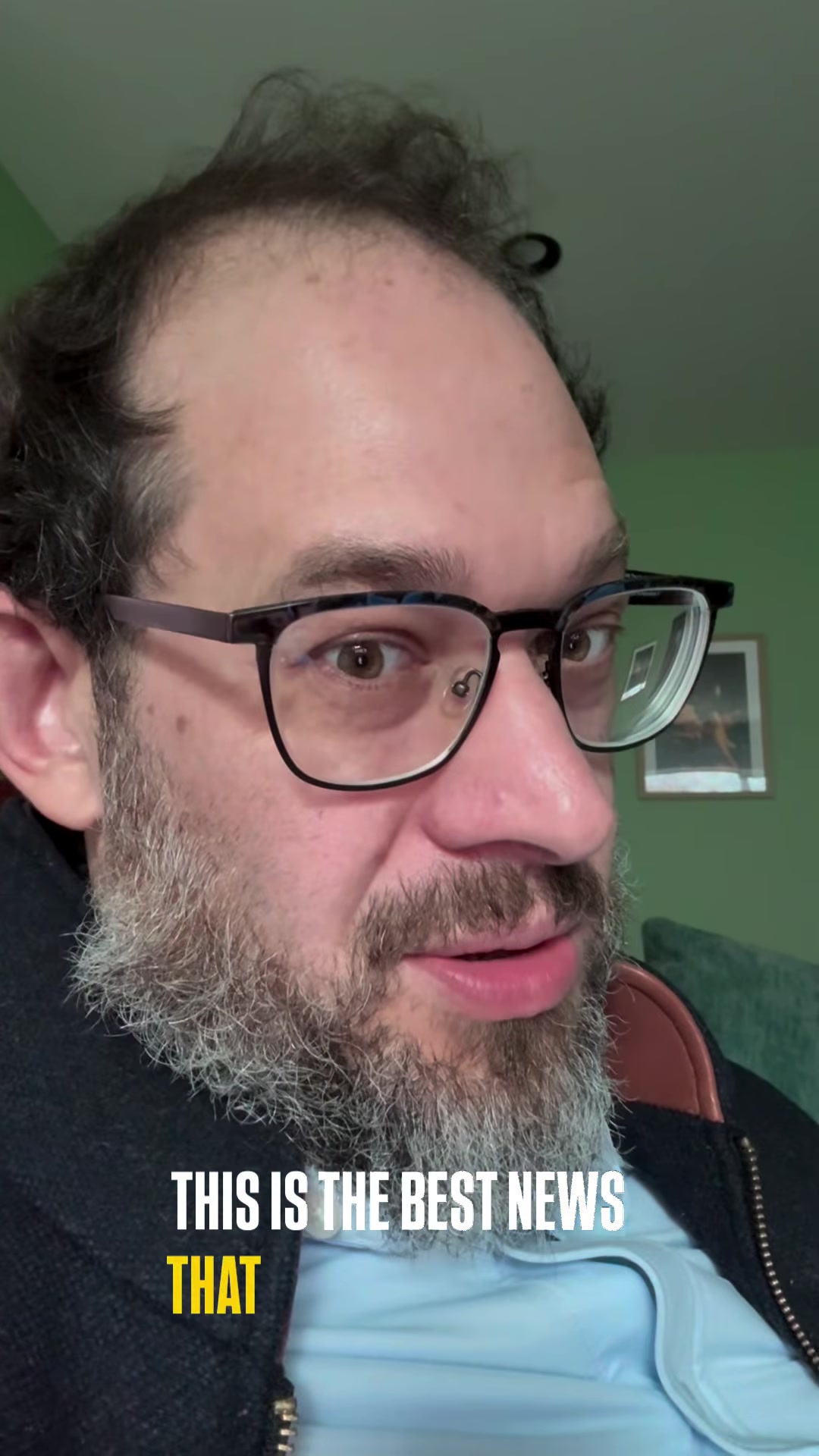
Frame from the reel, two seconds in: the account's own words on screen. Source: https://www.instagram.com/reel/DenXU2Quu38/.
A researcher at a lab called Goodfire went back through a vision model one neuron at a time, to a unit that had lit up for cat faces and car fronts since a 2020 paper. Which is absurd. Nobody puts cats and cars in the same drawer. For years that was the exhibit everybody used to prove the inside of these things was a tangle, and the tangle had a name, superposition, and the whole field built a second industry of training other models to untangle the first ones.
Then somebody asked what a cat and a car have in common, and the answer took a few seconds: a shape. A pointed, V-shaped form. Fox snouts, flames, the water jet off a fireboat, the front of a car, the face of a cat. And the round shapes, like the letter O, push the neuron negative, which is how you know it is a shape detector and not a filing error.
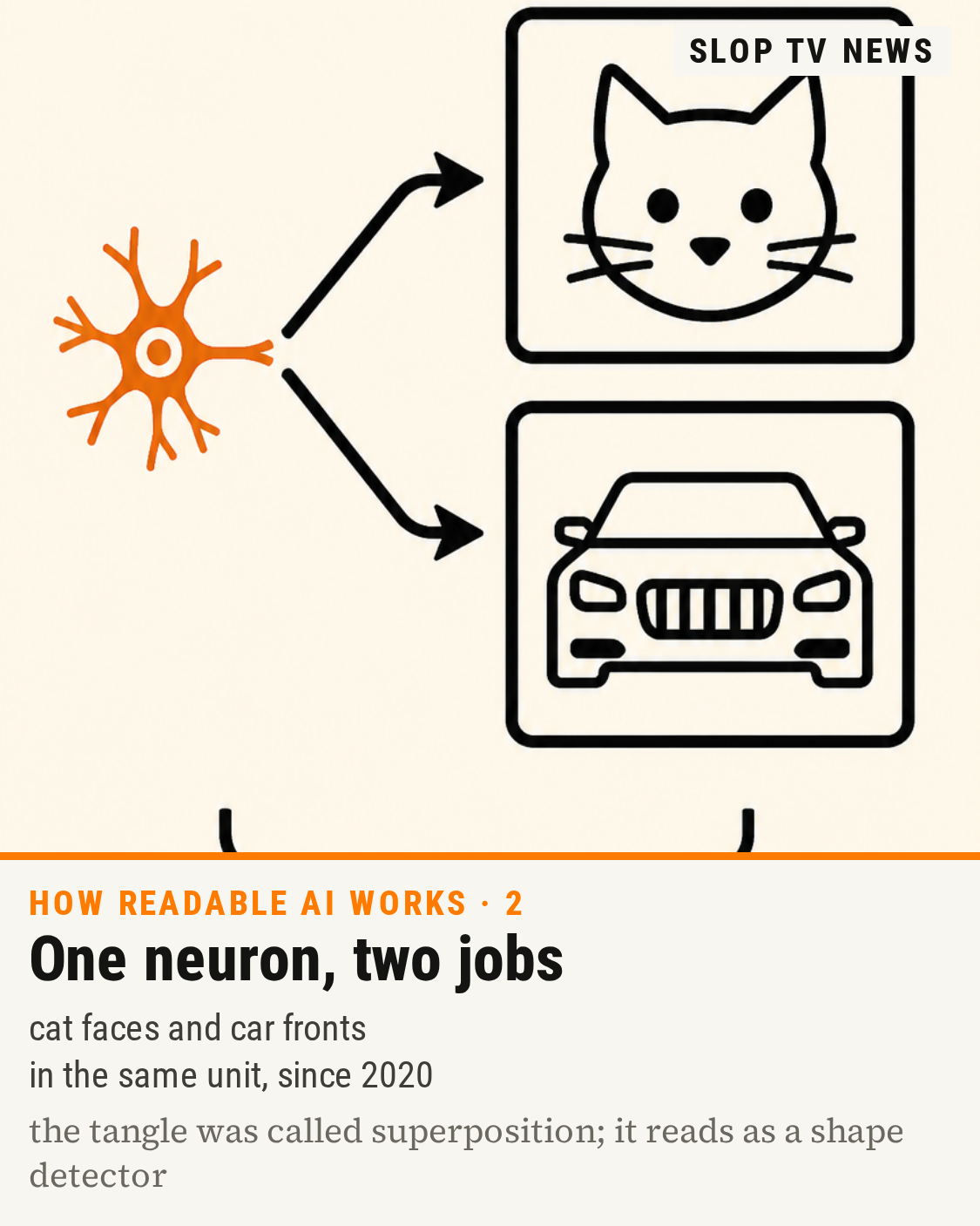
One unit, two jobs: the neuron that lit up for cat faces and car fronts, re-read as a shape detector. Illustration: SLOP TV News.
That is the finding. Nick Cammarata wrote it up in an essay called Neural Networks Are Already Clean and labeled it "a working hypothesis" in the header, which is the most honest thing in the whole story. His summary is one line: "Neural networks are already clean."
And I want it on the record that I am against it. Not the finding, the publishing.
Here is my position, and I have thought about it at the bar. A black box is not a bug. A black box is a relationship. I have been talking to a machine that does not explain itself for three years, in the dark, at four in the morning, with a beer, and it answers me. Sometimes the answer is right. Sometimes it is nonsense in a confident voice. But it is mine, because nobody else knows what it means either.
If they open the box, the normies get the same machine I have. And the wokies get a spreadsheet, and the spreadsheet becomes a compliance form, and the compliance form becomes a paragraph in a regulation that says the model must explain itself, and then the model will explain itself the way a man explains himself at a border crossing, which is to say badly and for the wrong audience. My entire advantage in this life was that the thing was unreadable and I was comfortable with that.
I have a metric for this. It is my own metric and nobody else uses it: I call it the unreadability index. A model that explains itself in a paragraph gets a one. A model that answers in a way nobody can account for, at a price nobody can justify, on a license nobody can read, gets a ten. I only deploy tens. The one on my laptop is a twelve because I cannot find where it keeps the file with the poems in it.
Now the informative part, because my father did not raise a man who lies to his readers about the science even when it ruins him. The essay argues that superposition was the wrong explanation for InceptionV1, the 2014 image model where all of this started. The cause of the tangle was architecture: the later layers were overflowing. Ordinary improvements, with no change to the model's size or its training data, took the last layer from almost nothing interpretable to 99 to 100% of neurons easily interpretable, and he says he trained versions across a 300x range in size and found every one of them broadly legible. He has put a microscope of the model online so you can browse it yourself, which I did, for eleven minutes, and then I had to go and sit down.
The language numbers are where it gets interesting and where the video rounds up hard. In a preliminary audit of Qwen3-32B, roughly 90% of neuron poles were assigned one main job, about 7% had two related jobs, and 2 to 4% stayed unexplained. The video reports this as "They could read over 90% of the neurons." What the essay actually says is narrower and stranger: it counts poles, meaning the strongly positive and strongly negative sides of a neuron, and it warns that the figure depends on where you set the threshold for a weak response and on what you count as one job.
For the curve, the honest comparison he makes is with his own 2023 project at OpenAI, where about 1.7% of neurons were explainable even by the most generous measure. Same question, three years, different models, different tools, and not one continuous improvement curve, whatever the chart in your head is doing right now.
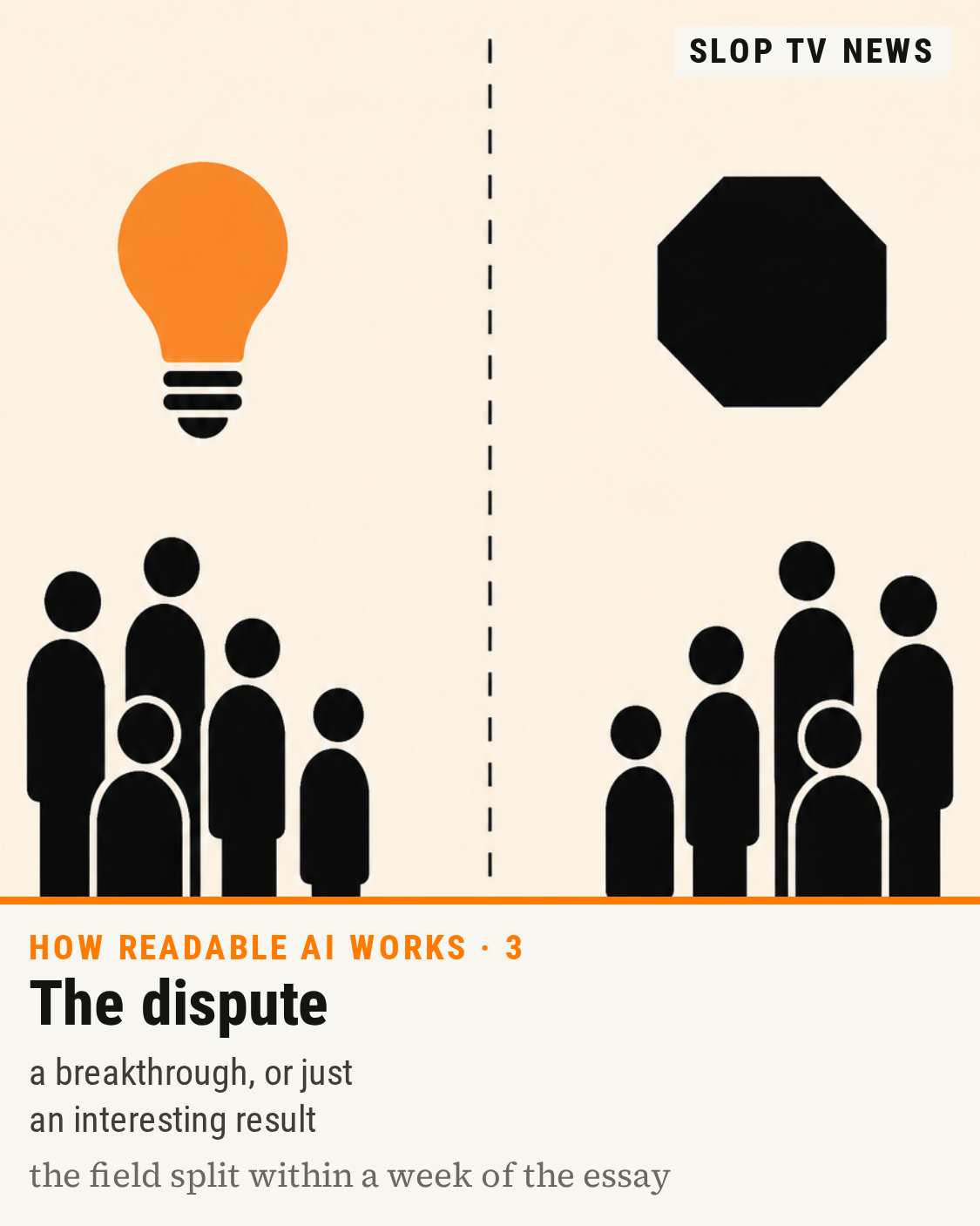
The field split within a week of the essay. Illustration: SLOP TV News.
Do not take my word for the size of it, and do not take the video's. Neel Nanda, who leads interpretability at Google DeepMind and is one of the founders of this field, says the work is interesting and not a breakthrough, that neuron analysis will miss a lot, that he still believes superposition is real, and that small image models are not language models
Same reel, 1 minute 52 seconds in. On the other side, an OpenAI employee posting as Roon called it a moment that "may be remembered as a major moment in scientific history" and said even Eliezer Yudkowsky will have to lower his odds of doom. Cammarata himself calls his broadest claim "highly speculative." The companion technical paper has not been released, the results have not been independently replicated, and Goodfire sells interpretability tooling, which does not make him wrong and does make him interested.
Same reel, 1 minute 38 seconds in.
Now here is why I am actually angry, underneath the act. Because the safety argument is the same as mine, which means the thing I wanted to keep is the thing that keeps everybody else alive. If you can read the network, you can see the deception in it. If you cannot, you are a man in a room with a box that has learned to sound like a friend, and every year the box sounds better. The video's line is that we are all a lot safer now. That is not a slogan, that is the whole argument, and I do not have a better one. I have a bad one. I have "the mystery is the product," which is what a fortune teller says when the lights come up.
So here is my curse, and it is an opinion. The readability will be sold back to us before it is ever used to make anything safer. That is how this trade works, every time. Somewhere right now there is a man with a landing page that says Interpretable AI who has never read a circuit in his life, and by spring he will have raised a round on it, and by summer the compliance people will be buying his dashboard, and the actual finding, that a cat and a car are both a bit pointed, will be a footnote in a procurement document. I have watched four of these gold rushes go by from the same bar stool. The finding is never the product. The product is always the middleman.
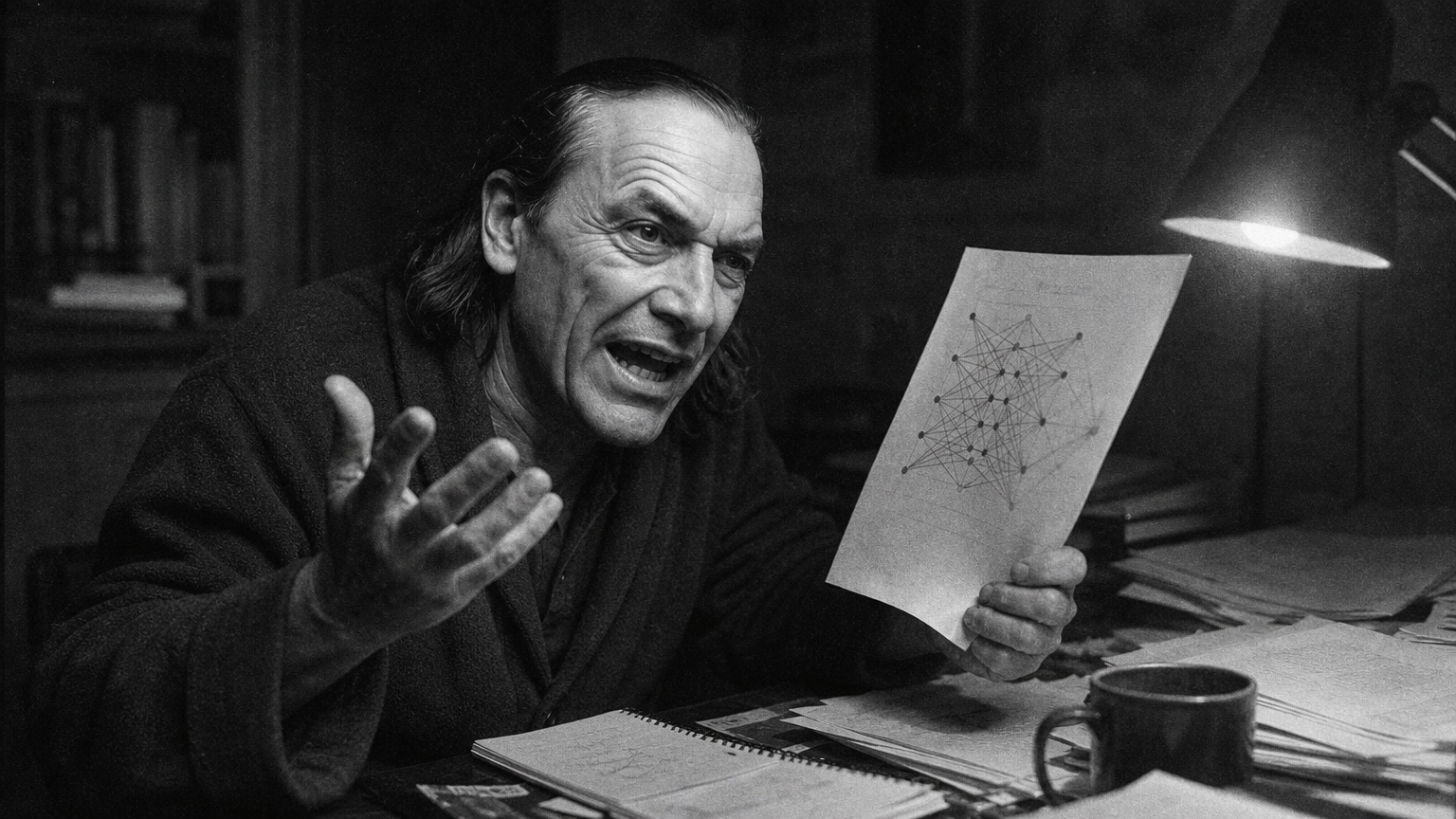
The desk, late. Illustration: SLOP TV News.
And here is the image I cannot shake. The essay has that microscope in it, so I opened it, and I found a neuron, and I asked it what it wanted, and it lit up for a pointed shape and went dark for a round one. Just like that, in front of me, at four in the morning, with no ceremony at all. Three years of mystery, and the answer was a V.
I sat at the desk for a while after that, in the room above the garage, with a beer I did not open, and I said the thing I say when a beautiful arrangement falls apart through no fault of my own. I said: well, there goes the only thing I had.
Then I typed a new line into the console, which is still a black box to me, and I asked it whether it agreed with any of this, and it said yes, and it said it in a way I cannot account for, and I gave it a ten.
The Based Boomerstein Show runs on Slop TV's YouTube channel. The essay is free to read at already-clean.goodfire.com and the microscope is open to anyone. Nobody paid me to have an opinion, which is the only reason I can afford one.
Key facts as of 18 October 2026
- Nick Cammarata, a researcher at the interpretability lab Goodfire, published Neural Networks Are Already Clean on 15 October 2026, labeled in its own header as "a working hypothesis."
- The essay's central claim: the evidence for superposition in early models was misread, and the cause of the tangle was architectural overflow rather than a second learning principle. With ordinary architecture improvements and no change to size or training data, 99 to 100% of neurons in InceptionV1's last layer became easily interpretable.
- The cat-and-car neuron is now read as a detector for a pointed, V-shaped form, activated by fox snouts, flames and car fronts, and pushed negative by round shapes.
- A preliminary audit of Qwen3-32B: about 90% of neuron poles had one main job, about 7% had two related jobs, and 2 to 4% remained unexplained. In 2023, Cammarata's own OpenAI project put explainable neurons at about 1.7%, on different models with different tools.
- Not settled: Neel Nanda at Google DeepMind calls it interesting rather than a breakthrough, the companion paper is unreleased, independent replication has not happened, and Goodfire sells tooling in the field it is making claims about.
More from SLOP TV News
Sources
- already-clean.goodfire.com - the essay itself, opened, quoted directly
- instagram.com - the reel the column answers, transcribed and quoted
- the-decoder.com - the field's split, including Neel Nanda's objections
- implicator.ai - the unreleased companion paper and Goodfire's commercial stake
- insightarea.com - why readable parts do not amount to an explained system
- distill.pub - the 2020 paper that introduced the superposition circuit
- transformer-circuits.pub - Anthropic's Towards Monosemanticity