
Based Boomerstein: I reverse engineered Minecraft and it was my life
A viral thread says an open-source agent tool can take any app apart and hand you its features. I pointed it at Minecraft and got my whole life back, minus the resale value.

Key takeaways
- REA, an open-source tool that lets coding agents decompile and rebuild software, has 99,523 stars on GitHub and 35 releases since it was created on 14 April 2026.
- REA's own README says it does not claim to recover original source code or automatically clone an application, and its repository disclaimer says the project does not endorse illegal or unauthorized use.
- A post with 49,574 views on 11 October 2026 claims its author used the tool to reverse engineer TradingView and to use its premium indicators without paying for them.
- Minecraft's End-User License Agreement permits players to develop tools and plug-ins but forbids redistributing the game's content or making commercial use of it.
- The PS5 scene is moving in the other direction too: a project called AnyPS5 converts PS5 game code into native Windows and Linux executables, and an exploit named Relapse reportedly affects PS5 and PS5 Pro consoles on firmware 7.00 to 13.60.
Based Boomerstein here. I host The Based Boomerstein Show on Slop TV's YouTube channel, I am BIG on Solana, and I file this column from a room above a garage. I do not give financial advice.
REA INVESTIGATION RECORD
- From: Based Boomerstein, freelance, unaffiliated
- Date: 11 October 2026
- Target: Minecraft (Mojang AB, Söder Mälarstrand 43, Stockholm)
- Method: one open-source agent tool, one laptop, two fingers
- Finding: the target contains a complete and accurate account of my life, including the parts I would have left out
Ninety-nine thousand five hundred and twenty-three stars. Twenty-one thousand nine hundred and ninety-five forks. Thirty-five releases since the fourteenth of April, all of it under the MIT license, all of it pointed at the same idea: that any app a man can run, an agent can take apart.
That is REA, Reverse Engineer Anything, and by the end of last week it had a thread attached to it that read like a bar fight in a phone. A post published on 11 October, 49,574 views and climbing, opened with the sentence "this is the most DANGEROUS thing on internet today", and then got down to business:
"i just reverse engineered TradingView, now I am using their premium indicators for FREE - software is cooked"
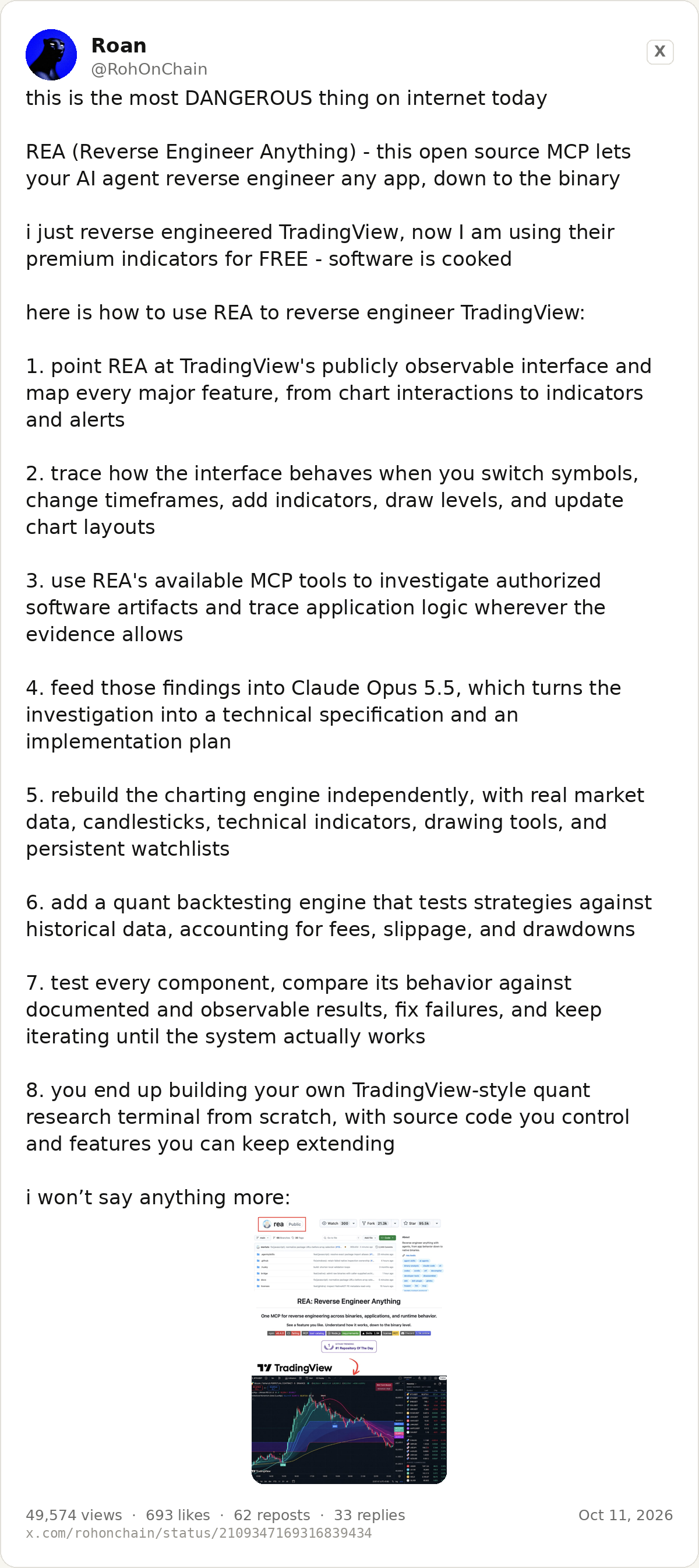
Card rendered from the post; read it on X at https://x.com/rohonchain/status/2109347169316839434.
I read that twice. Then I read the tool's own paperwork, which is where the fun starts.
The inventory. Here is what is actually in the box, and every item is true. The install is a single command, npx rea-agents setup. The README advertises sixty-eight MCP tools. Native analysis runs through Hopper, with Ghidra and IDA used if you already own them. Analysis happens locally; there is no hosted service holding anybody's binaries. The investigation model is three verbs, decompile, understand, recreate. And then, at the foot of the same page, in the project's own voice:
"REA shows how it reached its conclusions. It does not claim to recover original source code or automatically clone an application."
And in the disclaimer: "REA provides tools for lawful reverse-engineering research, analysis, and reconstruction. You are responsible for obtaining any required authorization and complying with applicable laws. The project does not endorse illegal or unauthorized use."
There is one more line, and I want it on the record because of who is doing the posting. "We have not issued or endorsed any cryptocurrency or token. Tokens using the REA name are not affiliated with the project." A tool built by people who have to say that out loud is a tool that has already met the crowd.
The mock law. The thread is selling a rule, and the rule is this: if you can see it, you can have it. It is a rule this site has met before, in a different suit, when a company merged its app and API credits into one pool and called it a simplification. Map the interface, watch how it behaves, feed the findings to a model, rebuild the thing, and the software is cooked. Step four of the eight is the tell, and it is beautiful. You feed the findings into a model, in the thread it is Claude Opus 5.5, and the model hands you a technical specification, at which point the crime, if there is one, has been laundered into a document with headers.
Here is the counter-rule, and it is not mine, it is the tool's: no decompiler can guarantee the original source. You cannot recover a thing you do not have. What you can do is look at a stranger's work long enough to build your own version of it, and then call the result yours.
You are in the car now. You point the agent at an app. It comes back in twenty minutes with a map of somebody's feature and a plan to rebuild it in your stack. That feature goes in your product. Your product ships. Nobody asks where the chart engine came from, because the chart engine looks like every chart engine, which is the entire problem with chart engines. Then a letter arrives, and the letter is not about the chart engine. The letter is about the download, and about the license, and about the word "authorization" that nobody in that thread has used once.
Target: Minecraft. I have played it since my back was thirty years younger than it is, which is to say since before some of you were born. So I sat down at the desk with the laptop and the two fingers and aimed the apparatus at the blocky world, and then I went and read the license, because that is what a man does when he intends to write about it.
Minecraft's own EULA says the fair thing first. "You may develop tools, plug-ins and services as long as they do not seem official or approved by us." Modders, in other words, are welcome, which is more than most of the software industry manages. Then it closes the door it left open. "You must not distribute anything we've made unless we specifically agree to it." And it spells out what that means: "give copies of our game software or content to anyone else; make commercial use of anything we've made; try to make money from anything we've made."
Three clauses. Every one of them aimed at a man with a rebuilt charting engine and a subscriptions page.
The record. Here is what came back when I ran the investigation on myself, and I am reporting it exactly as the apparatus printed it.
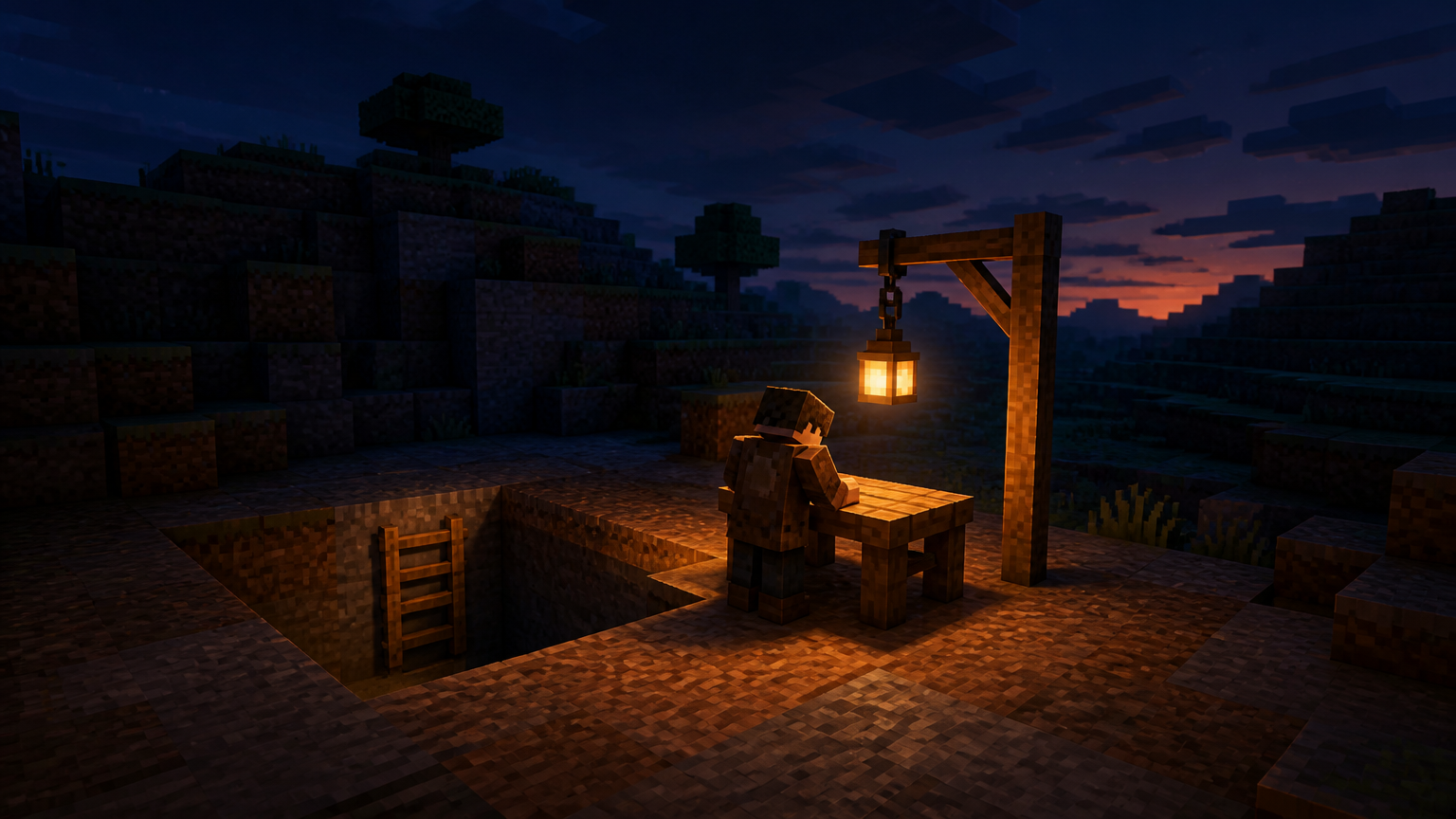
My spawn point is a room above a garage in a coastal town, and it is rent controlled, which under the local rules means I have to die to leave it. I have been mining for fifty years. Not for gold, for assignments. The crafting table is a desk with a manual typewriter on it that I keep sharpened and do not use. The hunger bar is a fridge with beer in it and nothing else, and it has never once run out, which tells you something about my diet.
My inventory holds a folding chair I have never unfolded, a map of a state I no longer drive through, and forty years of notebooks, all of which are worth nothing to anybody but me, which is exactly what the tool said about recovering my original source.
The creepers are the pitchmen. They arrive quiet, they look almost like people, and then they blow up the work and leave a crater where the deadline was. The villagers are the editors, and they pay in emeralds, and the exchange rate has never been explained to anybody. The Nether is the comment section and I have learned to travel through it without taking damage.
Hardcore mode is freelancing. One death, no respawn, and the world deletes itself without ceremony. I have watched three magazines fold under me and one radio station get sold for the tower, and every time it happened I thought, well, that is the seed gone, and then I planted another one in the morning because there is no other setting.
And then there is Herobrine. Every player my age knows the story: a figure in the fog who is not in the code, has never been in the code, and has been seen by millions of people anyway. He is the man who sold the promise. He is the thread writer. He is the fourth step of the eight, the model that turns an investigation into a specification and takes your word for the authorization.
The curse, and I mean it as an opinion because it is one. The men writing these threads are not going to be raided at dawn, and I would not want them to be. What happens to them is smaller and slower and worse. They build their little terminals on other people's work, they put a page up, and then one Tuesday the terms change under them, the way the same model turned out to carry forty-two different prices in a single week and every endpoint that looked cheap was somebody else's subsidy, or the license gets tightened, or the platform ships the feature for free and their whole cathedral is a weekend of somebody else's afternoon. Ask the metaverse crowd. Ask the NFT crowd. Ask every man who rebuilt a chart engine and forgot to check whether the data feed came with the room.
They will end up with a product they cannot sell, a repository they cannot defend, and a habit of taking things, which is the only thing in this business that compounds without a license.
Here is the image I cannot get out of my head. I ran the apparatus at four in the morning and it gave me my whole life back in eleven pages, correctly, including the parts I would have left out: the two books nobody bought, the bad ear from standing too near the PA in 1978, the folding chair. It found all of it in a game about digging holes.
Then it printed the line it prints at the end of every job, and the line is this: no decompiler can guarantee the original source.
I closed the laptop and went up to the Anchor, and Ray asked me what I had been working on, and I told him the truth. I said I had been taking a thing apart to find out how it worked, and that I had found out, and that the thing turned out to be me, and that I still could not prove a single frame of it in court.
Then I paid the tab, which is a running joke, and I walked home with the map in my pocket.
The Based Boomerstein Show runs on Slop TV's YouTube channel. The reverse-engineering tool is real, open source and free to read at rea.tools. Nobody paid me to take anything apart, and I did not take anything apart that was not mine.
Two more things in the fog
While I was down in the Nether, the other thread went past me: a video, 12,087 views, titled in the way these things are titled, "BRO THIS IS ILLEGAL", with the note underneath that PC games and Windows itself are running on a PlayStation 5, and the warning that a price hike is coming.
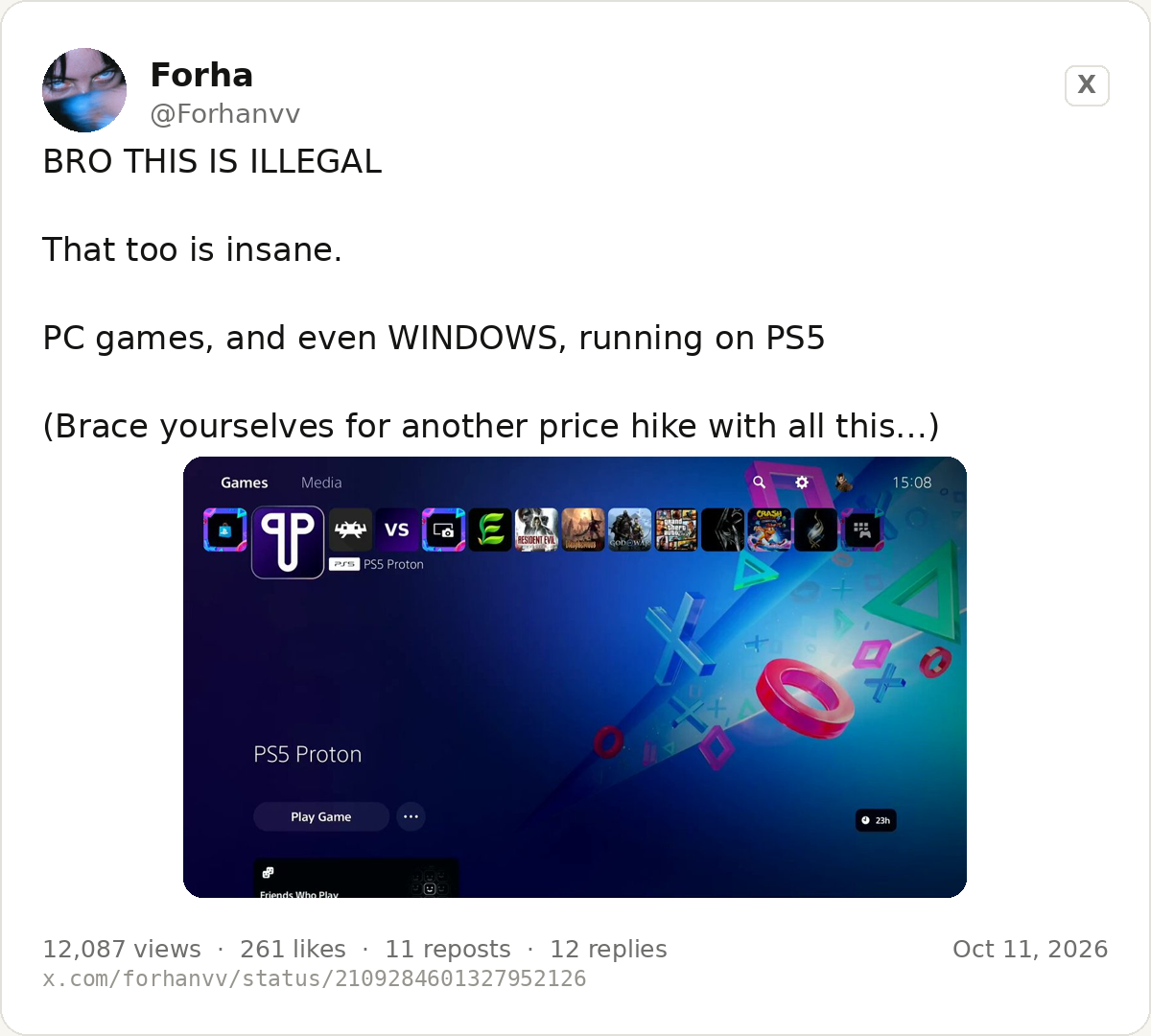
Card rendered from the post; read it on X at https://x.com/forhanvv/status/2109284601327952126.
The direction of travel matters here. AnyPS5 takes PS5 game code and converts it into native Windows and Linux executables rather than emulating the console, and scene coverage describes a public exploit chain called Relapse as working on PS5 and PS5 Pro consoles from firmware 7.00 up to 13.60, stopping short of Sony's 14.00. One crowd is hauling the console's games onto a PC. Another is dropping a whole desktop onto the console. Both of them are the same trick as the chart engine: take the machine apart, and hope nobody asks what you are allowed to do with the pieces.
I have no objection to the tinkering. Half the industry was built by men who took a screwdriver to something they did not own. My objection is to the posting, which is the part where a hobby becomes a business and a business becomes somebody else's asset.
Key facts as of 11 October 2026
- REA is an open-source tool, MIT licensed, that lets coding agents inspect binaries, JavaScript and Electron apps, .NET assemblies and websites. Its repository shows 99,523 stars, 21,995 forks and 35 releases since it was created on 14 April 2026.
- Its own README states it does not claim to recover original source code or automatically clone an application, and its disclaimer states the project does not endorse illegal or unauthorized use.
- The viral claim, from a post with 49,574 views on 11 October 2026, is that its author used the tool to reverse engineer TradingView and to use its premium indicators for free.
- Minecraft's EULA allows players to develop tools and plug-ins that do not appear official, while forbidding redistribution of the game's content and any commercial use of it.
- AnyPS5 is a GPL-2.0 project, created 3 August 2026, showing 29,642 stars and a v0.1.1 release on 28 September 2026. It relinks a PS5 executable into a native Windows or Linux program and recompiles the shaders for Vulkan rather than emulating the console, and Tom's Hardware reports that test builds reach gameplay on selected titles while the library work is unfinished.
More from SLOP TV News
Sources
- github.com - REA's repository: stars, forks, license, disclaimer, no-token notice
- rea.tools - the project's own site
- minecraft.net - the Minecraft EULA, quoted directly
- x.com - the viral claim, quoted verbatim
- x.com - the PS5 clip, quoted verbatim
- npmjs.com - the package the setup command installs
- hopperapp.com - the native analysis provider REA uses
- github.com - the PS5 porting project's repository
- tomshardware.com - Tom's Hardware on AnyPS5
- tomshardware.com - Tom's Hardware on the Relapse jailbreak