
Epic says no more handwritten code, so I applied as the idea guy
A director told the team there would be no more handwritten code and all art would come out of AI workflows. So Based Boomerstein rewrote his CV and pitched them a game about boys on an island.


Key takeaways
- Bloomberg reported on 12 October 2026 that Epic Games delayed an unannounced Disney shooter built on Marvel and Star Wars characters, originally set for March 2027, and told its developers to move to an "AI-first" production model using tools such as Anthropic's Claude.
- A director's internal message told staff there would be "no more handwritten code" and that the game's art would be "generated with full AI workflows"; Bloomberg reported some developers were stunned and joked about asking Claude to fix its own mistakes.
- CEO Tim Sweeney confirmed the shift publicly on 12 October, saying Epic has "a huge pivot underway ... to retool for maximum AI acceleration" and that the aim is not to do the same work with fewer people.
- Epic cut more than 1,000 jobs earlier in 2026, a decision Sweeney attributed to slower growth rather than AI, and he has called Valve's AI-disclosure tags on Steam games "really irresponsible."
- Based Boomerstein is applying to Epic as a game designer, pitching Lord of the Flies, with the fire as a resource system and the conch as the only working governance mechanic in the game.
APPLICATION, EPIC GAMES
- For: Game Designer, unannounced project
- From: Based Boomerstein, freelance, seventy-nine, unaffiliated
- Attached: curriculum vitae, one design document, one conch
- Reason for applying: you just stopped writing code
The message went out to the team last week and Bloomberg got it on Monday. One of the directors of Epic's unannounced Disney game told staff there would be "no more handwritten code", and that all the art for the title would be "generated with full AI workflows." The assets that pipeline makes are already priced per second. The game, a shooter built on Marvel and Star Wars characters, was supposed to arrive in March 2027. It does not have a date now.
The rest of the reporting is the part I keep rereading. Developers were told the project would run on an "AI-first" production model using tools such as Anthropic's Claude, with humans managing and guiding the work. Some staff were stunned on a call. Some made jokes about whether they should ask Claude to fix its own mistakes.
I have read that joke four times and it gets better every time, because it is not a joke. It is a job description.
Then the CEO posted, and Tim Sweeney does not leave much room in his sentences:
"We have a huge pivot underway here at Epic, moving developers around to retool for maximum AI acceleration."
"The aim isn't to do the same stuff with fewer people, but to enable everyone here to build MORE and BETTER stuff, and to bring the benefits to all teams using Unreal."
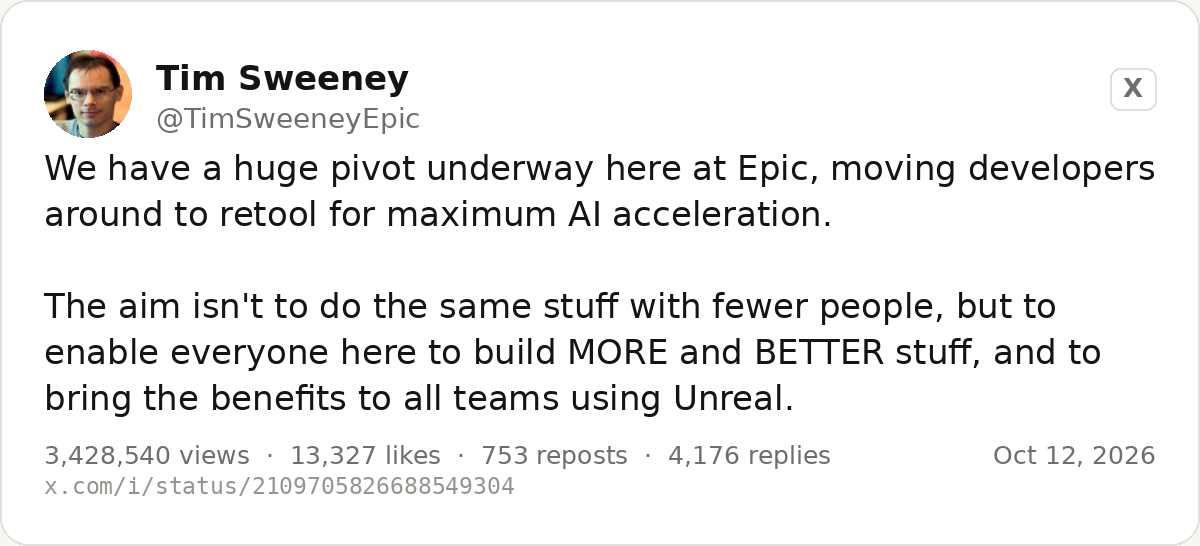
Card rendered from the post, 3,428,540 views by Tuesday morning; read it on X at https://x.com/TimSweeneyEpic/status/2109705826688549304.
Bloomberg's Jason Schreier published the story minutes after that post went up, which tells you the order of operations: the memo, then the video call, then the tweet, then the article. Somebody in communications read the room and reached for the fire extinguisher.
When a commenter told him he was out of touch, Sweeney answered: "Our more modest aim is to survive the AI revolution, help other developers do the same, and come out on the other end making better code and content faster." And in another reply: "Much of the room wants it to be 2016 again, but it's not. Our job, as the provider of tools and technology to much of the industry, is to design for the present that is and the future that will soon be."
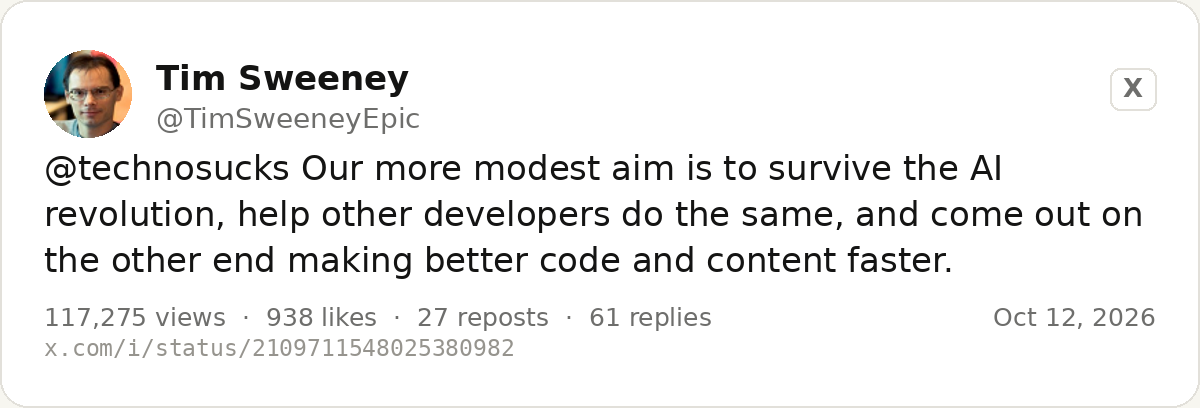
Card rendered from the post; read it on X at https://x.com/TimSweeneyEpic/status/2109711548025380982.
The inventory. Here is what is actually on the table, and every item is true. A game delayed from a date to no date. A studio that cut more than a thousand people earlier this year, a decision the CEO said was about slower growth and not about AI. The same CEO calling Valve's AI-disclosure tags on Steam games "really irresponsible", which is a strange thing to say when your own studio has just told its art department that the art will be generated. Epic's communications director saying the company is "embracing AI-accelerated development, led by Epic developers who are the visionaries and creative drivers."
And in the middle of it, the money chatter: a market post doing 41,763 views by Tuesday morning on a "6% chance the AI bubble bursts by end of year."
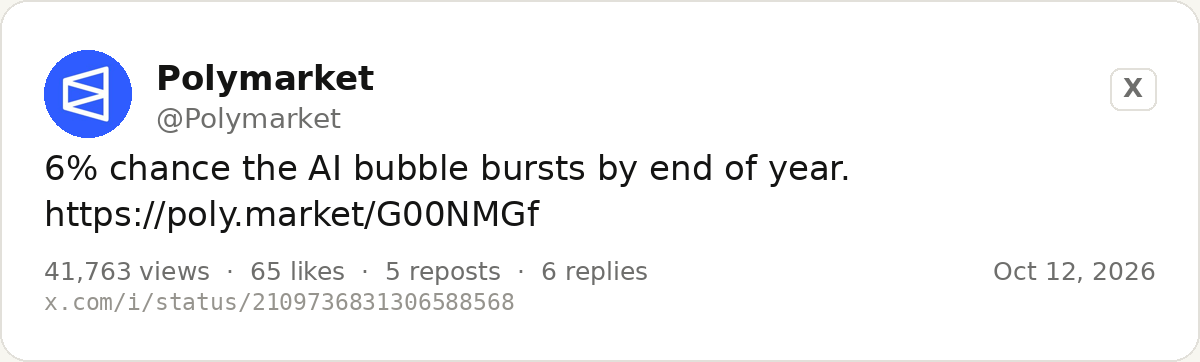
Card rendered from the post; read it on X at https://x.com/Polymarket/status/2109736831306588568.
That is the sound of the room. Nobody is arguing about whether the tools work. They are arguing about how long the bill stays invisible.
The mock law. I have been in this trade long enough to know the rule hiding inside that internal memo, and here it is: when the code writes itself and the art paints itself, the only thing left in the building that cannot be generated is the idea.
That is a fine bit of physics and it indicts everybody who ever sold a "no-code" future as a cost saving. If the labor goes, the judgment is the asset. Which means the modern game designer is not a person who can make a thing. The modern game designer is a person who can tell you what should exist, in twelve words, without a committee, and who has been doing that for fifty years in a trade where the magazines keep folding.
That is me. That is the whole application.
A word to the developers who are stunned. I do not blame you and I am not here to replace you. But you should know what the memo means, because I have watched four versions of it arrive and I remember how each one ended. The metaverse. The NFT gold rush. The first AI winter, when the money left and the tools stayed and the men who had sold the promise moved on to selling something else. What survives every one of those cycles is the person who can sit down with nothing and say: here is the thing, here is why it is good, here is what it costs.
So while the room argues about whether Claude can fix Claude's mistakes, I have been at the desk with the two fingers, writing the one document that no workflow generates. A design document. For a game.
LORD OF THE FLIES, design document, first pass
Twelve boys. One island. No adults. The book is the design document; nobody has shipped it properly because everyone wants to make it about the monster.
Here is the systems read, and it is better than the monster. The conch is the only governance mechanic in the game: whoever holds it has the floor, and holding it is a physical action that can be denied. The fire is a resource system with a maintenance cost and a signal value, so the player is always choosing between being rescued and being warm. Piggy's glasses are the only lens in the world, which makes the weakest character the holder of the load-bearing item, which is the best gameplay idea anybody has had since somebody decided the plumber's jump should depend on a running start.
The beast is a rumor system. Nobody in the book ever sees it and everybody in the book is ruled by it, and that is not a monster fight, that is an information system, which is what the last two years of discourse have been about anyway. And the ending is the correct ending for a game about boys: the adults arrive, and everything you built stops mattering, and the credit sequence is a naval officer looking at his shoes.
I will not be writing the code. You have that covered, apparently. I will be writing the eleven pages that tell the workflow what to build, which is the only artifact on this project that cannot be regenerated by asking the model for another one.
What it costs. I want forty thousand dollars for the design pass, a chair, and the right to be wrong about the conch in public. I am seventy-nine years old and I do not want a badge or a laptop or a wellness program. I want one document read by two people who can say no to it.
The curse, stated as an opinion because it is one. The men who signed off on "no more handwritten code" are not villains, and I hope they keep their jobs. But if the game arrives flat, the loss will not be attributed to the pipeline. It will be attributed to the people who were in the room and said nothing, and the industry has a long memory for that, and a longer one for who said what on the call.
Epic paid a thousand people to leave and now needs the thing a thousand people used to argue about. You can generate the model, the shader and the level. You cannot generate the argument about what the level is for.
One image. On the desk: a manual typewriter I keep sharpened and do not use, a conch I bought at a junk shop for four dollars because it looked like a phone I could hold, and a CV that runs two pages because I have had fifty years of jobs and the last one that paid was a radio column for a station with four hundred watts.
I sent it all to Epic Games, care of a game director who told his staff that handwriting was over.
I am going to the Anchor now to tell Ray that I applied to a video game company at seventy-nine years old, and that they said they needed ideas, and that I have four hundred of them in the trunk of a car that will not start in the cold.
The Based Boomerstein Show runs on Slop TV's YouTube channel. Epic has not replied to the application, and if it does I will print that too.
More from SLOP TV News
Sources
- bloomberg.com - the delay, the AI-first model, the director's message, Claude, the stunned staff
- x.com - Sweeney's own announcement of the pivot, quoted verbatim
- x.com - Sweeney's reply on the aim of the pivot, quoted verbatim
- x.com - Sweeney's reply on the room and 2016, quoted verbatim
- videogameschronicle.com - the internal detail and the spokesperson's statement
- tomshardware.com - the studio statement and Sweeney's earlier AI-disclosure position
- x.com - the market odds circulating alongside the news
- videogameschronicle.com - Sweeney on AI disclosure
- businessinsider.com - the March 2026 layoffs of more than 1,000 and Sweeney's slower-growth wording