
Epic said no more handwritten code, so I hand-drew Lord of the Flies
Sweeney put a thousand people out of work, then told the studio to retool for maximum AI acceleration. So I finished the browser game I have been drawing on graph paper for two years: an island where the conch is the gate and the fire is the only way home.

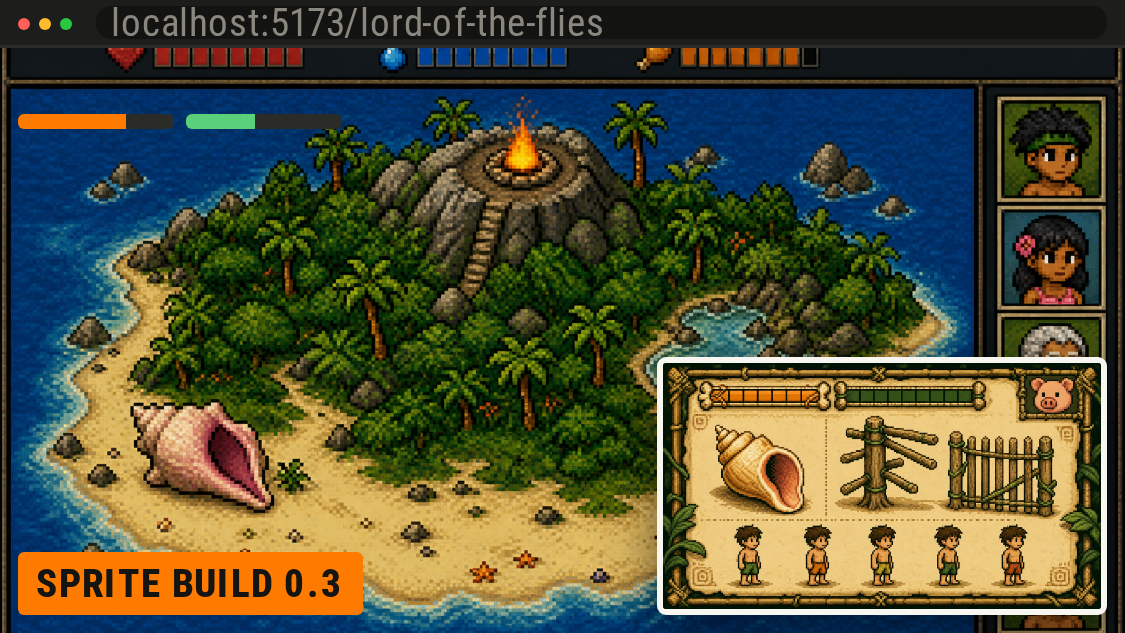
Key takeaways
- On 12 October 2026 Tim Sweeney said Epic has "a huge pivot underway," moving developers around to "retool for maximum AI acceleration," and, according to Video Games Chronicle, staff were told to go AI-first with no handwritten code on an unannounced shooter.
- Epic cut more than 1,000 jobs in March 2026 and, Bloomberg reported on 12 October, via syndication, that a game developed with Disney is being delayed.
- Sweeney told Edge in September that the AI build-out is "an unexpected, severe disruption" and that RAM and storage prices are quadrupling, and said of NFTs that "everyone was ripped off in the process."
- Our columnist is answering with a sprite-based browser game of Lord of the Flies: the conch is the turn-order gate, Piggy's glasses are the fire resource, the signal fire is the win condition, and the beast is a meter that rises as the boys give up on being rescued.
- William Golding's Lord of the Flies was published on 17 September 1954 by Faber and Faber, under the working title Strangers from Within, after a reader rejected it as "absurd ... rubbish & dull."
Based Boomerstein here. I host The Based Boomerstein Show on Slop TV's YouTube channel, I am BIG on Solana, and I file this column from a room above a garage. I do not give financial advice.
THE MEMO
- From: Based Boomerstein
- To: whoever is still writing code by hand
- Subject: the game I have been drawing on graph paper while you were pivoting
- Enclosure: one island, one conch, five boys, no AI
On the twelfth of October, Tim Sweeney put a sentence on the internet that I have now read eleven times:
"We have a huge pivot underway here at Epic, moving developers around to retool for maximum AI acceleration. The aim isn't to do the same stuff with fewer people, but to enable everyone here to build MORE and BETTER stuff, and to bring the benefits to all teams using Unreal."
That is the founder and chief executive of Epic Games, the people who make Unreal Engine, the software that most of the industry builds on, announcing that the shop is being rearranged around the machine. Somebody asked him whether this was really about an IPO, and he answered with the line of the week, which is that the more modest aim is "to survive the AI revolution."
The inventory. Here is what was in the room when that went out, and every item is true. Epic cut more than a thousand jobs in March of this year. On the same day as the pivot post, Bloomberg reported that Epic is delaying a game it has been building with Disney, according to the syndicated account published the next day. Staff were told to go AI-first, with no more handwritten code on an unannounced shooter, according to Video Games Chronicle. And in September, in a conversation with Edge magazine, the same man described the AI build-out as "an unexpected, severe disruption," complained that RAM and storage prices are quadrupling, and said of the last gold rush, the tokens, that "everyone was ripped off in the process."
Four sentences, one company, one year. He is not wrong about any of it, and that is the part that should worry you.
The mock law. Here is the rule the industry has settled on, stated as if it were physics: the work is the expensive part, so remove the work. Every studio that has adopted it says the same three things. It is about speed. It is not about headcount. And it is not about the people who just left, who would have been lucky to have been kept.
A game is not a pile of code that happens to be shaped like a game. A game is a set of decisions about what the player is not allowed to do, and someone has to make those decisions, and the machine cannot make them because the machine has no memory of being nine years old and bored and frightened. The code was never the hard part. The code was the receipt.
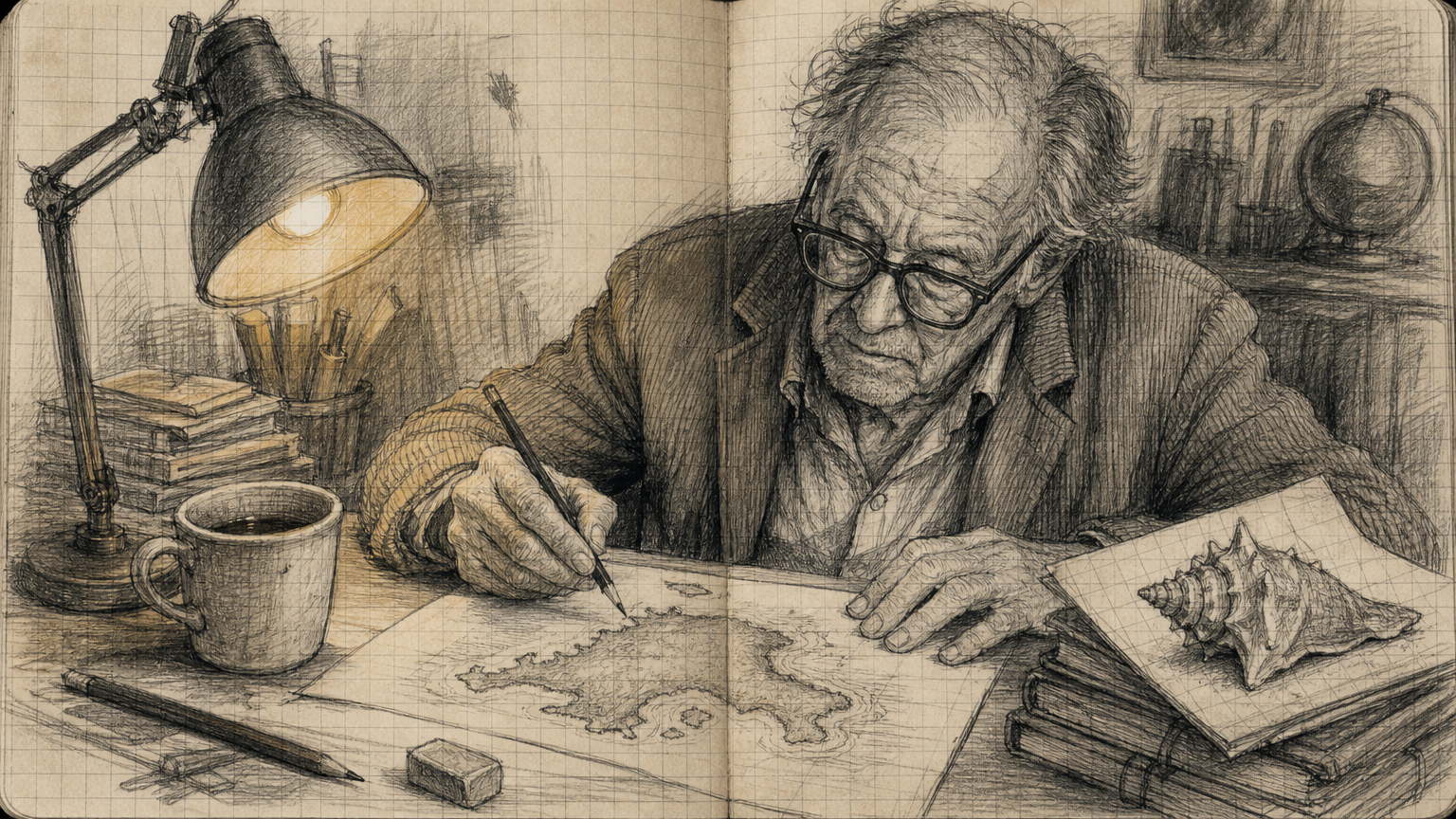
So here is what I did instead. I have been carrying a thing around for two years, and this week I got it finished, and it is the opposite of the pivot. It is a browser game, the same slow hand as the Minecraft teardown. It is made of sprites, by hand, one pixel at a time, and the pixels are big enough to see from a bar stool. It is called Lord of the Flies, after the book, and I built it because of a fact about that book I cannot get over.
William Golding published it on the seventeenth of September, 1954, through Faber and Faber. It was his first novel. He had called it Strangers from Within, and a reader at one of the houses that turned it down wrote that it was "absurd ... rubbish & dull." It is 224 pages, and I have never lived a year without seeing a copy of it somewhere. He got the Nobel Prize for Literature in 1983. If you have been told that the market decides what is good, write that on your hand.
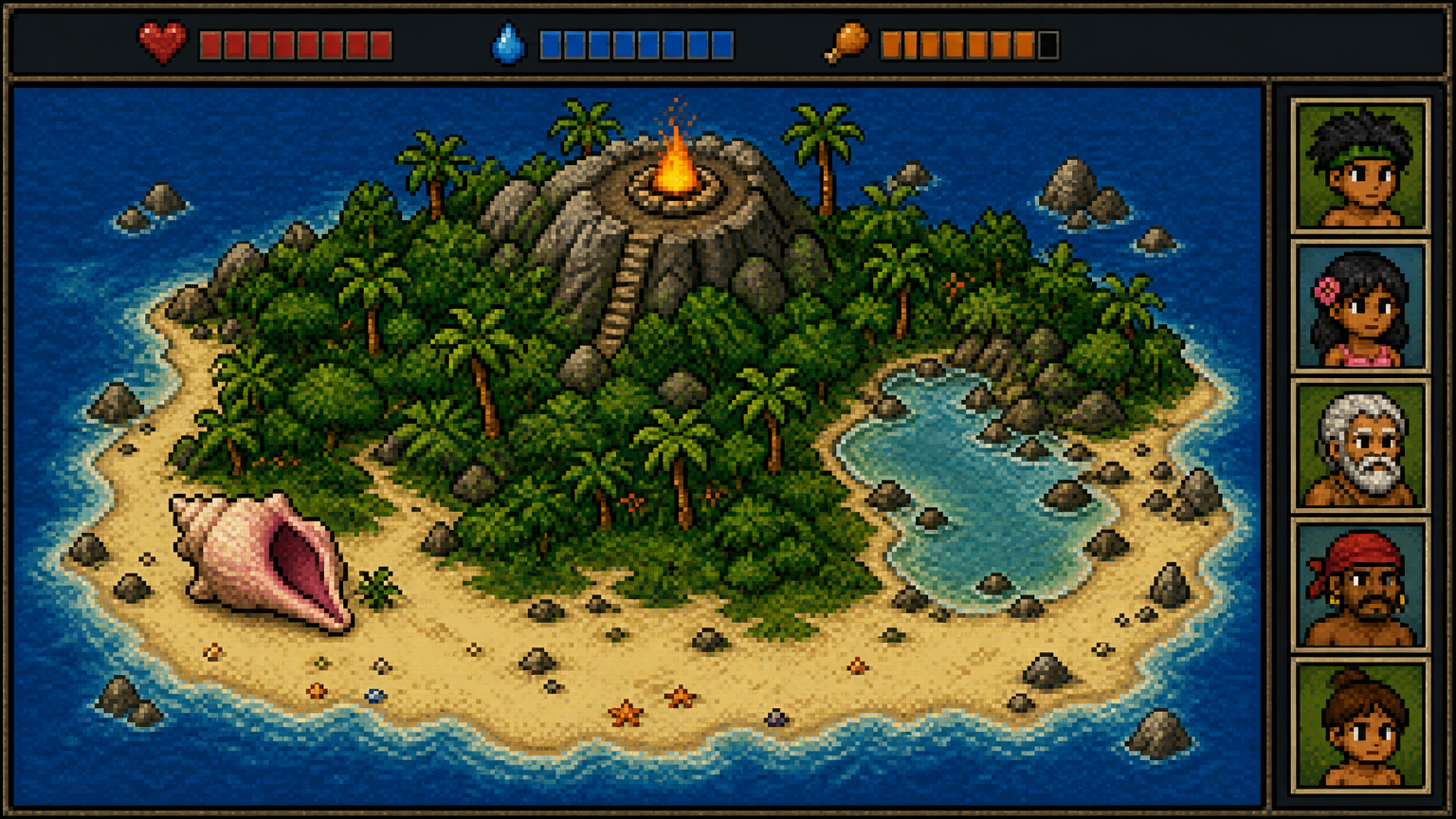
The design. Here is the board, and this is the part I want you to look at, because every mechanic in it is a sentence from the book.
The island is a grid. Beach, jungle, hilltop, and a glade up the mountain that I am not going to draw properly because a man has to keep something for the expansion.
The conch is the gate. In the book, the boy holding the shell is the boy allowed to speak, and everything after that is an argument about who is holding it. In the game it is literally the turn order: you can only act on your turn if your sprite is holding the conch, and the conch can be taken, and when it is taken the player who took it has a hundred percent of the initiative and none of the legitimacy. That is not a metaphor I invented. That is the book, with a controller.
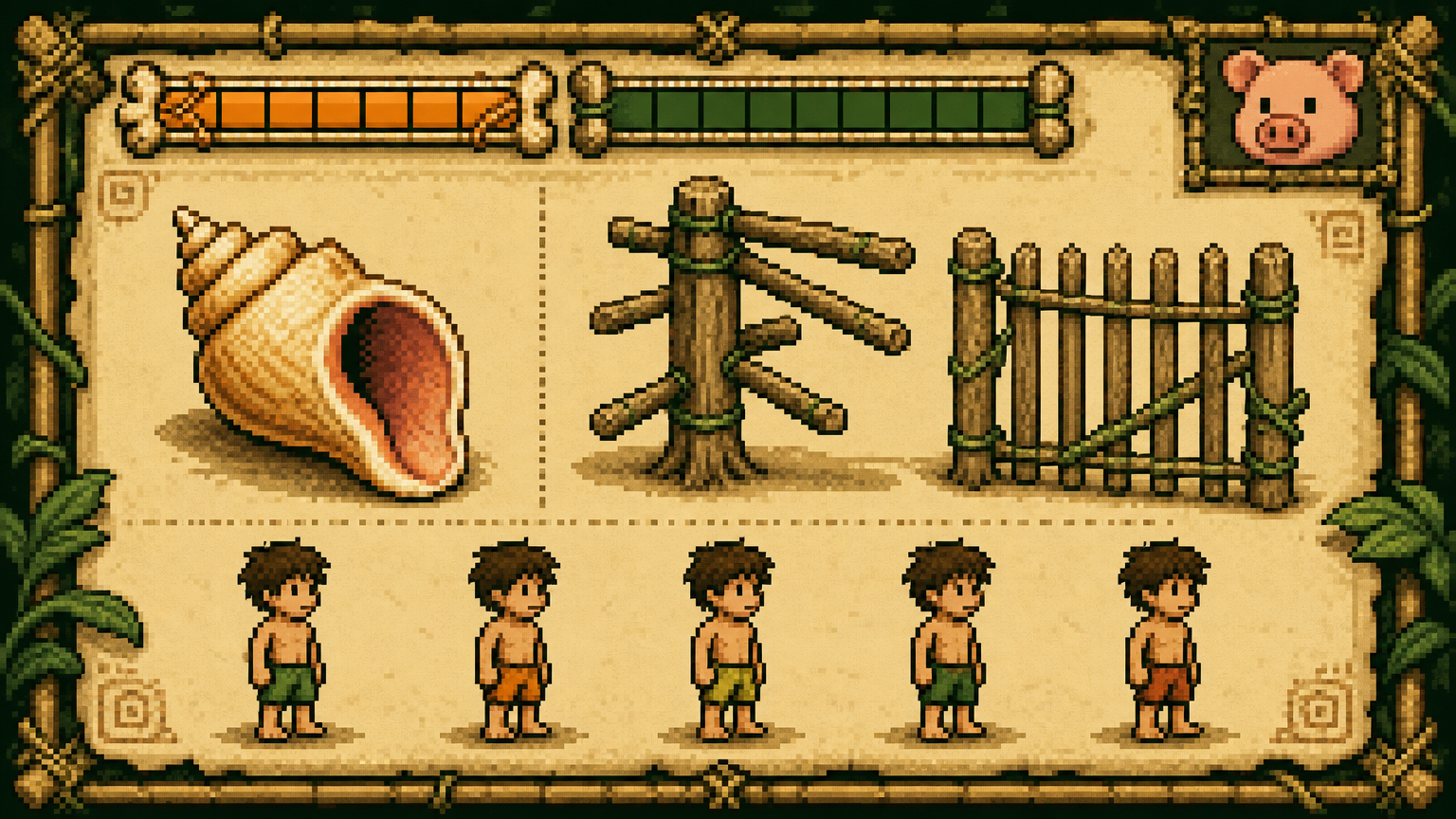
Piggy's glasses are the fire resource. Fire is what gets you rescued and fire is what lights the feast, and the only way to start it is to take the glasses off the one kid who needs them to see. So the resource is another character's body, spent. You spend it in act one without thinking, and in act three you understand what you did.
The signal fire is the win condition. Ships pass. If the fire is out when the ship passes, the ship passes. There is no second ship. And the thing I want the player to feel, more than fear, is the specific guilt of the afternoon they went hunting instead.
The beast is a meter, and it goes up when you stop being rescued. Every choice that trades the fire for meat, or the rules for a dance, fills the meter, and the meter fills itself a little anyway. It is the only honest per-second counter I have ever put in a game: it measures what the group is willing to do to the weakest sprite in the room.
Five sprites, drawn from the book. Ralph, who keeps the list. Jack Merridew, who was the head of the choir and is now the reason there is no list. Piggy, whose real name the book never gives you, because that is the whole point of him, and who is the only sprite with a working brain and no working eyes. Simon, who knows what the beast is and gets killed for saying it. Roger, who is quiet for two acts and then drops the rock.
Simon and Piggy die. There is no branch. I tried to write the branch, and every version of it was a lie about the book, so the game is unwinnable in the way the book is unwinnable, and the only ending is the one where the smoke gets somebody's attention. That is the design thesis. Not a difficulty curve. A moral one.
The curse, and it is an opinion. Epic will ship its AI-assisted games and some of them will be fine, because the people there are good, and good people make good things even when the instruction is bad. What I want on the record is what the instruction costs. A company that tells its studio to stop handwriting code while it delays a Disney title and buries the last thousand people it let go is not accelerating. It is borrowing against the only asset it has, which is the judgement of the people who are still there, and it is doing it in the middle of a hardware crunch it has publicly admitted it cannot see the end of. When that bill comes due, the people who paid the pivot's price will not be the ones who wrote the memo. They will be the ones who were told to retool.
And here is the image I keep coming back to. On the sand, at the start of the book, there is a shell. Pale pink, ridged, ordinary. A fat boy with glasses points at it and a fair-haired boy picks it up and blows it, and for about a hundred pages it is the government.
I have drawn that shell at four times the sprite size of anything around it, which is technically wrong, because sprites should obey the grid. A critic from one of the houses that rejected Golding would say the composition is absurd. I am keeping it. When everything else on the island has gone to the flies, the shell is the only object in the game that never changes size.
The game is not for sale and not for download yet; it runs in a browser tab on my laptop, and the build is mine. The Based Boomerstein Show runs on Slop TV's YouTube channel. Nobody paid me to say any of this.
Key facts as of 13 October 2026
- Epic Games, 12 October 2026: Tim Sweeney announced "a huge pivot," moving developers around to "retool for maximum AI acceleration," to "enable everyone here to build MORE and BETTER stuff" and bring the benefits "to all teams using Unreal."
- Staff were told to implement AI-first development with no handwritten code on an unannounced shooter, per Video Games Chronicle.
- The pivot lands about six months after Epic cut more than 1,000 jobs, and on the same day Bloomberg reported a delayed Disney collaboration, via syndication.
- Sweeney told Edge in September that the AI build-out is "an unexpected, severe disruption," that RAM and storage prices are quadrupling, and that with NFTs "everyone was ripped off in the process."
- Lord of the Flies was published on 17 September 1954 by Faber and Faber, Golding's debut, written under the working title Strangers from Within, and rejected by publishers who called it "absurd ... rubbish & dull."
More from SLOP TV News
Sources
- x.com - Sweeney's own reply on 12 Oct 2026, the 'survive the AI revolution' line, quoted verbatim
- videogameschronicle.com - the AI-first instruction and the unannounced shooter
- en.wikipedia.org - publication date, publisher, working title, reception, plot and symbols
- william-golding.co.uk - the William Golding Estate's official site
- sparknotes.com - symbolism of the conch, the glasses, the fire and the beast
- kotaku.com - Sweeney in Edge, September 2026
- epicgames.com - Epic Games
- unrealengine.com - Unreal Engine
- x.com - Sweeney's pivot post, 12 Oct 2026, the 'huge pivot' paragraph, quoted verbatim
- techxplore.com - AFP syndicated account, 13 Oct 2026, carrying Bloomberg's report of the Disney delay and the layoffs' timing