
Ruby on Rails creator has retired from writing code by hand
Rails creator David Heinemeier Hansson told Rails World 2026 that writing code by hand is no longer economically productive, and that he has retired from the job. Nine of the quotes everyone is arguing about, checked against the video.
Key takeaways
- David Heinemeier Hansson opened Rails World 2026 in Austin on 23 September with a keynote in which he said 37signals has gone "pencils down" on writing code by hand as a normal course of business.
- Hansson said he has not written code by hand since about March 2026, and that in August alone he produced 150,000 lines, against about 30,000 lines of production Ruby a year over his twenty-one years with the language.
- He told the audience English is a better programming language than Ruby, and predicted hand-written code stops being economically productive for "virtually all programmers, virtually all companies" by the end of 2026.
- A 169-second excerpt of the keynote posted by @scottstts on 25 September reached 2,741,759 views; Hansson replied to a video parody of the talk on 27 September with "This wasn't what I said, but it's still funny."
Based Boomerstein hosts The Based Boomerstein Show, is BIG on Solana, and files this column from a room above a garage. For the people who make things and against the people who sell the promise.
David Heinemeier Hansson, the man who wrote Ruby on Rails, walked onto a stage in Austin on 23 September and said eleven words into a microphone. He had retired from being a professional programmer.
Then he said the rest of it for an hour. By the weekend, a 169-second piece of that hour had 2.7 million views on it, a caption somebody else wrote, and a fight attached. The fight was about a word he never used.
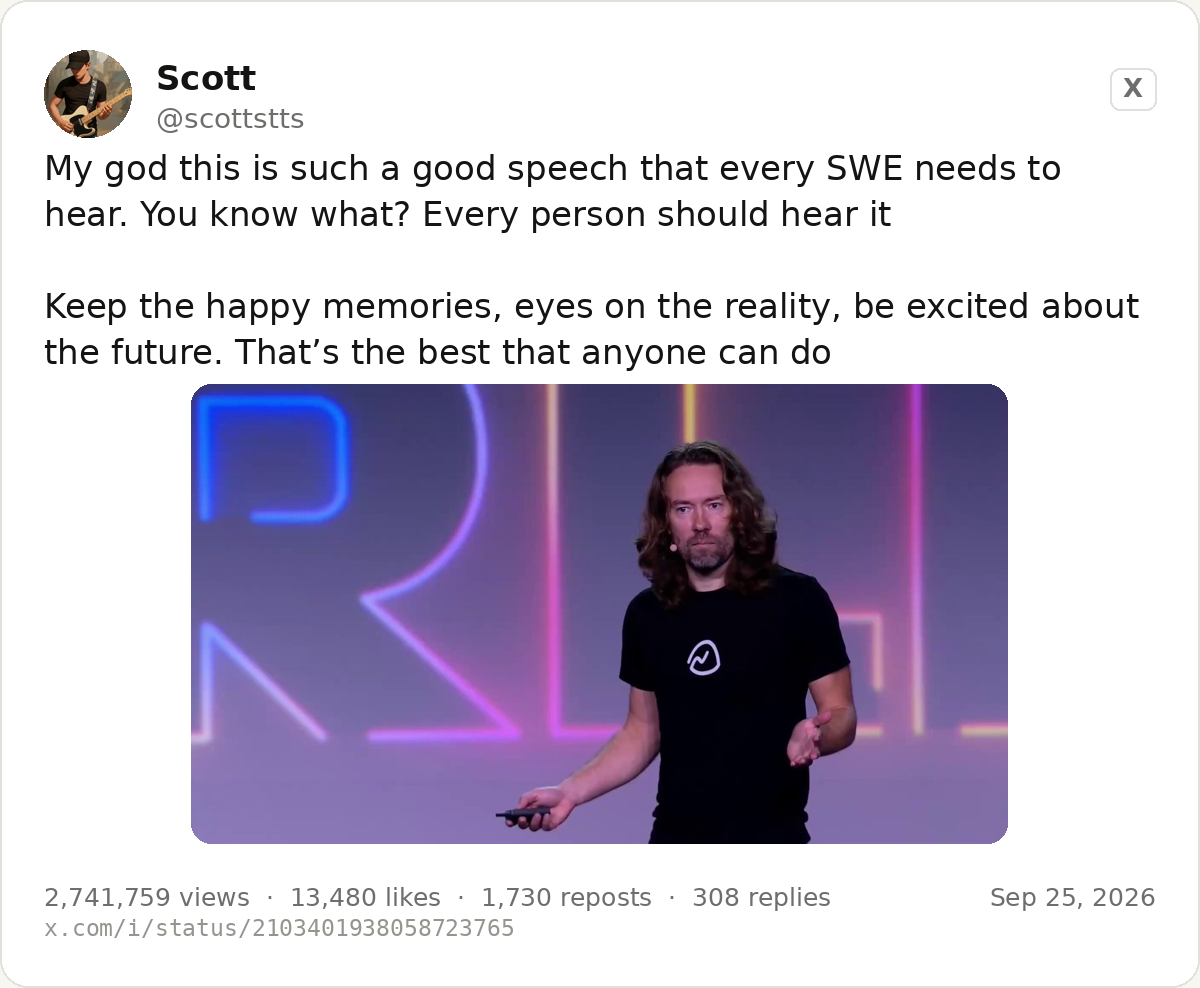
@scottstts, September 25, 2026. Card rendered from the post; read it on X at https://x.com/scottstts/status/2103401938058723765.
I read the whole transcript with the chapter list open beside it, the way you read a will, and I have been paid by the word since before this man could drive. Forty minutes in, he says the sentence that matters. Nobody clips that one. I wrote it in the margin twice, because I did not believe it the first time.
The sentence, and the one right after it
At 40:40 he says it flatly, to a hall of professional Ruby developers: "Writing code by hand is no longer an economically productive enterprise for the vast majority of programmers working at the vast majority of companies." Then the second half, which is the part to sit with: "By the end of the year, it will be virtually all domains, virtually all programmers, virtually all companies."
A minute earlier, at 39:21, he had already described his own position without ceremony. "I have retired from being a professional programmer." He dates it to "somewhere around 4 to 5 months ago, maybe March." The decision at 37signals — the maker of Basecamp, HEY and the Omarchy Linux distribution — was made a couple of weeks before the keynote. In his words, the company has gone "pencils down on the idea that we were gonna write code by hand as a normal course of business creating things."
In practice that reads like the error tracker. Hand-written code at 37signals is now the exception. An exception means something went wrong somewhere: find out why the agent could not do the job, and fix the machine so it can. I have worked in newsrooms where a rule like that arrived by email on a Friday, and it never lasted a month. This one is being said out loud on a stage, which is a different animal.
Then he took the room's temperature and it came back cold. He asked who still writes material amounts of code by hand every week and counted about five hands, in a hall full of people who do this for a living. Two or three months earlier, he said, the same slide would have convinced a fair number of them that he had "a screw loose."
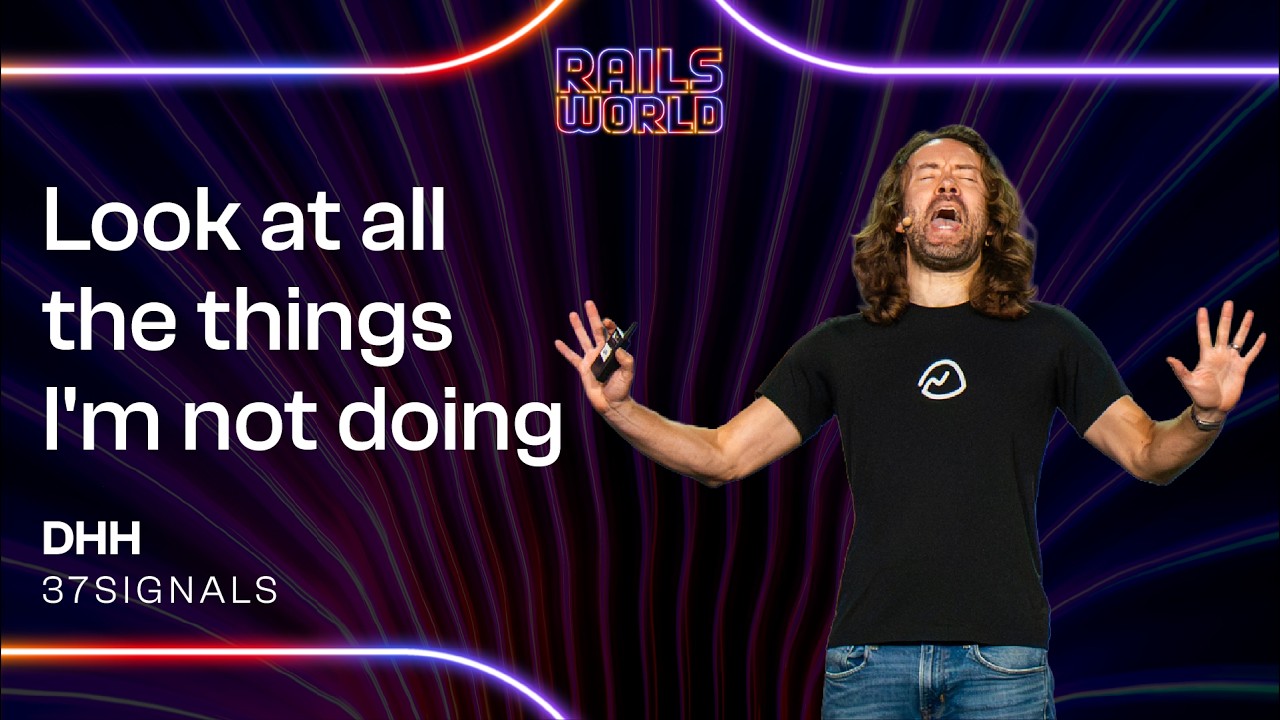
The keynote video's title card, as published on YouTube: DHH at Rails World 2026 in Austin on 23 September. Image: Ruby on Rails.
"English is a better programming language than Ruby"
There is a language he likes better than Ruby, he says, which he did not expect, and it is called English. "English is a better programming language than Ruby." He loves Ruby more than any other traditional language in the world, and says that too, in the same breath.
The ledger is why you take it seriously instead of filing it under stage talk. Over twenty-one years, more than half his work was Ruby. This year it is about three per cent. In twenty-one years with Ruby he wrote roughly 30,000 lines of production code a year, enough to build a framework and a couple of businesses on top of it, and in August alone he wrote 150,000 lines. A lot of it is verbose Rust he does not want to look at, and he says so out loud, which is the honest half of the boast.
Calling it "an absolute joy" is the other half. He also concedes the language is vaguer and less deterministic than Ruby, because it is. He is describing a trade, not a discount. I have been on the wrong side of that trade myself, and I will say this much for it: nobody rides a bike for the transmission.
The 10x man and the 1,000x man
The "10x programmer" came out of a 1968 ACM article that measured a spread of 5x to 30x and averaged it at about 10x. The industry spent forty-five years arguing about whether it was real. That argument is over. The question now is the gap once the tools are in the same sentence as the person.
His answer, at 17:21: 100x between the worst programmer working without these tools and the best programmer working with them, which he calls "not a very controversial statement," and then he floats the next order out loud — 1,000 times — and agrees with himself. He does not know what that means for competition between companies, and he says that too. That is the admission that makes the rest of it land. Anyone who has watched their own throughput move this year knows the feeling he names next, which is "a little dizzy."
Pencils down, and the Swiss cheese
He plays a clip of himself from a 2005 presentation in Brazil, a younger man walking through a Rails demo, saying "look at all the things I'm not doing" and "look at all the configuration I'm not writing." Convention over configuration, demonstrated in a room that had never heard of an agent, and the reason the phrase keeps coming back: five months with no code written by hand, spent instead on "every dream. Every annoyance, every paperclip, every frivolous feature suddenly within reach."
Then the best story in the talk, which is a failure. In the spring, finishing Basecamp 5, 37signals had designers vibe-code the last features they wanted. Every pull request looked reasonable by itself. Twenty or thirty of them together left the architecture looking like Swiss cheese, and the team concluded the technology was not ready.
He now calls that "the wrong conclusion, clearly." Had they "given it freaking 5 minutes," he says, Fable would have arrived and "the whole thing would probably have worked as originally intended." I have sat through a hundred of these talks and I can count on one hand the number of executives who put their own name on a mistake from a stage. It is the reason I believe the Swiss cheese story and not the rest of the boilerplate around it.
The Rust confession, and the numbers under it
The most quotable thirty seconds are about Rust, a language he hates with a passion, "like pouring acid in my eyes." Rust is the HEY backend, and the reason he has made peace with it is that he never has to look at it. He says what to do, an agent writes it, and he judges the result from the outside, the way an owner has always judged a programmer's work. That arrangement is spreading through this beat as well: a director's agent-built pipeline and a decision model that runs without a model at all both assume the human specifies outcomes and not methodology.
The payoff is concrete and he does not dress it up. With the front end moving to native apps, the old web application became a mail server. The result uses 99 per cent less CPU and 95 per cent less memory, running on ten hosts that exist for redundancy alone. On peak traffic for HEY, he offers a back-of-the-envelope guess — "probably" one Raspberry Pi — and presents it as a guess. Read it as one, and then notice that nobody needs the guess to be right for the number above it to be remarkable.
Behind him on screen, six native applications the company started about a week earlier. His account of how a team that size built them: "we're not writing a goddamn line of code."
P(bloom) over P(doom)
The closing argument is game theory, and it is the reason the hour is worth more than the clip. Since nobody knows how this ends, being cheerful about it is the rational position. Gloom has a downside: if things go well you wasted the gloom, and if they do not go well you spent the day before in a bad mood for nothing. He cites Jevons' paradox, and the ATM. Thirty thousand bank tellers in 1950, around forty thousand in 2010, because cheaper branches meant more branches.
So: the white pill, and lean in. The black pill, he told the room, is for losers. I have taken a pill or two in my time and I will take the one that pays the rent. He also left the real questions on the table, named and unanswered: where the line between native and web should sit, how a codebase should be shaped for an agent to work in it, how any of this gets organised. A keynote that says what it does not know is a better advertisement for the era than one that pretends otherwise.
The frame that got away
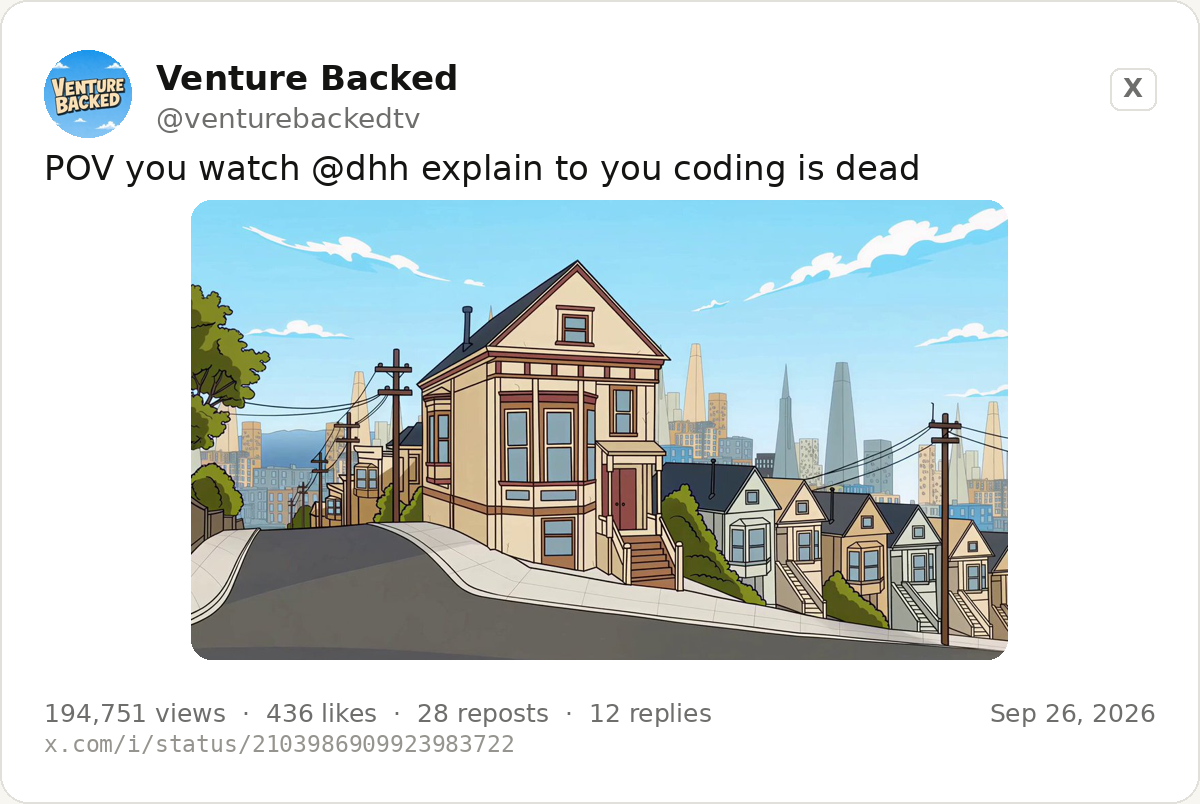
@venturebackedtv, September 26, 2026. Card rendered from the post; read it on X at https://x.com/venturebackedtv/status/2103986909923983722.
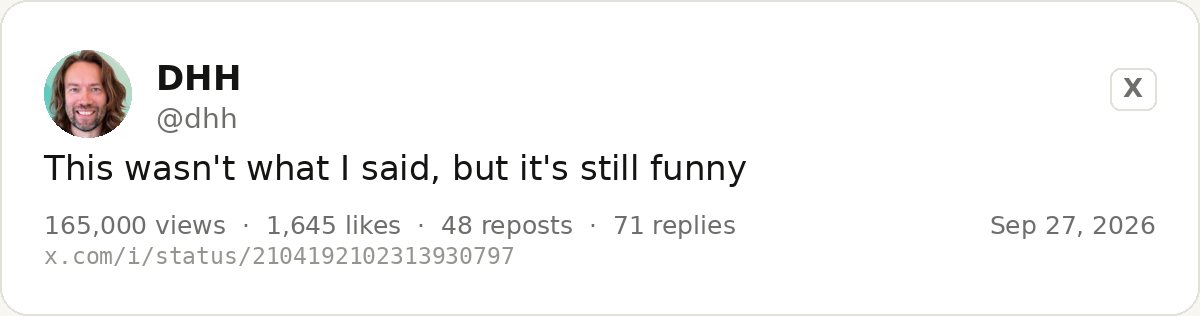
@dhh, September 27, 2026. Card rendered from the post; read it on X at https://x.com/dhh/status/2104192102313930797.
The parodies arrived before the transcript did, and one of them — a cartoon POV titled "POV you watch @dhh explain to you coding is dead" — got the reply every parody hopes for. DHH quote-posted it with grace: "This wasn't what I said, but it's still funny."
Watch the full keynote here.
What travelled furthest was not his line at all. On 26 September the Harvard computer scientist Boaz Barak quote-posted the clip for mathematicians, writing that he had enjoyed chiseling proofs by hand and that the era was over. That was his own reaction, offered as such, and fair enough.
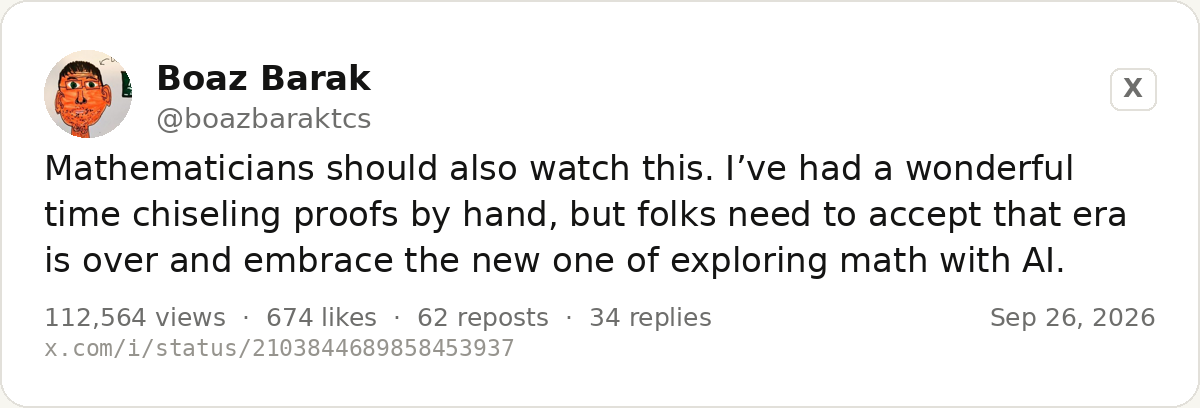
@boazbaraktcs, September 26, 2026. Card rendered from the post; read it on X at https://x.com/boazbaraktcs/status/2103844689858453937.
Downstream, as AI Frontier Post traced it, that became "DHH says the proof era is over," in a keynote that never once mentions mathematics. Nobody clipped the part where he says he does not know what the numbers mean for competition between companies. That part was available. It just was not the frame.
LaunchKit has the fuller audit of what he said against what he was reported to have said, and The Decoder carried the retirement as it happened.
What he actually retired from
Here is the part the clip cannot carry, and it is the whole talk. He did not retire from the craft. He retired from typing. The man still shows up, still knows what the system is supposed to do, still judges whether the thing that came back is any good, and he does that on a language he says hurts his eyes.
The people who will get rich on this pitch are not him. They are the ones selling the frame — the shortened clip, the confident summary, the phrase about the era ending, sold to people who will not read the transcript. The frame travels faster than the talk, every time, and the frame is free. That is not a scandal. It is arithmetic. I have watched four of these cycles come through this trade. Every one of them ended with somebody still typing, and none of them ended with the pitch getting smaller.
The video is still up, chaptered, a little over an hour of it. The 37signals experiment starts at 20:45, the Rust confession at 28:46, and P(bloom) at 58:26.
More from SLOP TV News
- How to render a 15-second video ad with an agent skill
- OpenMontage: turning a coding assistant into a video studio
- Opus 5.5 drew a 30-second Negroni explainer in HTML
- Invideo says manual editing is dying. The first pass is.
- Appeals court rejects copyright-notice claims over GitHub Copilot and Codex
- Mirage's Tesseract gives AI agents a free Premiere and After Effects
- The AI Stallone clips are a demo, and the audience is the inventory
Fourteen minutes of the fifty-eight are him admitting what he does not know. Play that part for anyone who tells you the era ended on Tuesday.